Written by S Shaji
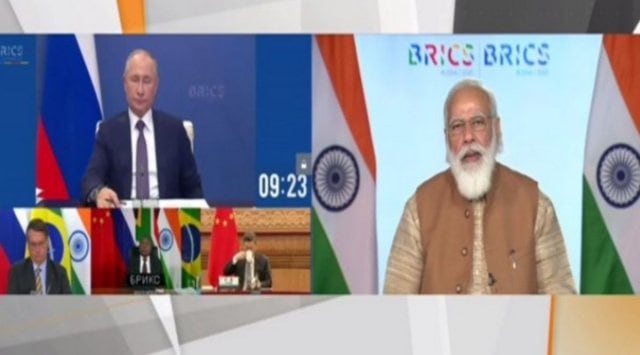
Though the US presidential elections dominated the debates in international relations in November, three other events invited attention. These pertained to multilateral economic groupings. The first was the virtual summit meeting of Shanghai Cooperation Organisation (SCO) on November 10, which India attended. Second, the Brazil–Russia-India-China-South Africa (BRICS) summit meeting (November 17) chaired by Russia and, the third, the signing of Regional Comprehensive Economic Partnership (RCEP) on November 15. India attended the BRICS summit while skipping RCEP. These events came into sharp focus primarily due to Indian and Chinese involvement (or non-involvement) in the backdrop of the stand-off involving the two countries in the Himalayas.


SCO, founded in 2001, is a Eurasian body comprising eight member states including India and Pakistan. India’s interest in the organisation lies in its need to access Central Asian states, which have large energy resources. Over a period, a few benefits have been materialised for India though its true potential is far from realised. One must bear in mind that India has been a late entrant to the group in which China and Russia have a pre-eminent position. The recent meeting in November discussed concerns such as terrorism, fight against the pandemic and vaccine development.
BRICS, a 2009 trans-continental grouping, encompasses 41 per cent of the world’s population, around one-fourth of the world economy and 70 per cent of total land. It is a formidable economic collation of five “emerging economies” signalling the rise of a new regionalism (a theme-based regional grouping which ignores geographic contiguity) that presents an alternative platform for non-OECD states. An idea of common financial structure such as BRICS Bank is attractive to states like India. Though it is yet to spread its operational space into BRICS countries, its potential can’t be dismissed. In addition, BRICS assumes paramount significance for India as the formal share of the participant countries in India’s imports is around 34 per cent. Similarly, BRICS is also significant in terms of addressing non-traditional threats such as pandemics, terrorism and climate change as evident from deliberations in the recently held summit.
Unlike the recent developments pertaining to the above-mentioned blocs, RCEP projects a different picture. RCEP represents 15 powerful economies, both developed and developing from Asia-Oceania regions (China, Japan, Australia, New Zealand, Philippines, Vietnam and Singapore among them). The organisation is touted as the largest such group in the world, representing two billion people and constituting one of the vibrant trading blocs in the world. India was originally expected to participate (India opted out of negotiations of joining the organisation in November 2019) in the RCEP summit. RCEP constitutes around 30 per cent of the global economy with an economic size worth $26.5 trillion. When the deal was finalised on November 17, the general opinion in India was that (a) joining the bloc would mean opening up its agriculture and service sector with negative consequences; and (b) terms regarding tariff issues, Most Favoured Nations (MFN) status and concerns about dumping etc. are unfavourable to India. India’s current position is that it can strengthen bilateral economic trade with these countries to offset some of the negative impacts emanating out of the decision not to join the bloc.
A few inferences can be drawn out of these developments. One, India has to engage with regional groupings in stronger ways though China has a pre-eminent position in the architecture of these organisations. Interdependence in the economy cannot be overlooked, especially for an emerging state like India, even when there is a tendency to switch over to protectionism in the pandemic phase. In other words, India must continue to pursue institutionalisation of multilateral frameworks irrespective of regional conflicts. On such occasions, one has to look at the possibility of strengthening neighbourhood multilateral frameworks (such as SARRC, where India is at the centre or finding a feasible framework through sub-regionalism; for instance, Bangladesh-Bhutan-India-Nepal Initiative). Further, domestic public opinion against a particular state should not slow down the multilateral trajectory that India has undertaken in the post-1990s.
In general, India needs to build multilateral trade blocs/economic groupings involving its South Asian neighbours along with Indian Ocean neighbours, while rejuvenating organisations such as BIMSTEC and IOR-ARC. Besides economic goals, such alliances can also broadly address non-traditional security threats. In short, India should not allow a “recession for multilateralism” in its diplomatic vision.
(The writer is Assistant Professor, Department of Political Science, University of Hyderabad)


