
Opinion A new shine to old ties
C. Raja Mohan writes: India and UK have faced legacy issues, fundamental paradoxes. Now, amid a changing strategic scenario, Boris Johnson’s visit is well timed to move the relationship forward
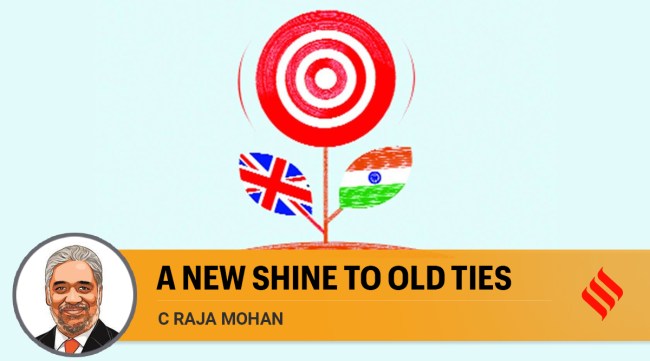 India’s post-colonial engagement with Britain has been riddled with multiple paradoxes (Illustration: C R Sasikumar)

The current upbeat mood on India’s relations with Britain stands in contrast to the entrenched pessimism in Delhi and London about their prospects. Although many contentious issues remain, including the visible differences over Ukraine, the outlook for bilateral ties has never looked as good as it is today. The bitter legacies of colonialism had made it impossible for the two sides to pursue a sensible relationship in the past. But over the last couple of years, Delhi and London have begun a promising and pragmatic engagement devoid of sentiment and resentment.
As Prime Minister Narendra Modi hosts British premier Boris Johnson this week in India, the moment is ripe to turn the expansive new possibilities — in trade, investment, high technology, defence, and regional cooperation— into concrete outcomes. The two bureaucracies have been working on a roadmap to transform bilateral relations by 2030 under the supervision of External Affairs Minister Subrahmanyam Jaishankar and British Foreign Secretary Liz Truss. Modi and Johnson can give it a decisive political push.

India’s post-colonial engagement with Britain has been riddled with multiple paradoxes. One is the deeply intimate relationship between the two elites that sat uncomfortably with a rough-edged political relationship between the two governments. Delhi’s lingering post-colonial resentments and London’s unacceptable claim for a special role in the Subcontinent generated unending friction.
The consequences of Partition and the Cold War made it harder for Delhi and London to construct a sustainable partnership. As the two sides make a determined effort to transcend the paradoxes, the regional and international circumstances provide a new basis for mutually beneficial engagement.
Central to this is the under-appreciated role of the US in transforming the bilateral ties between Delhi and London. It was the US that first recognised India’s rapidly-growing relative weight in the international system. At the turn of the millennium, Washington unveiled a policy of assisting India’s rise. This was based on a bipartisan American consensus that a stronger India will serve US interests in Asia and the world. Over the last two decades, it has led to a quick transformation of US relations with India.
That brings us to the second paradox. At the dawn of Independence, India saw London as the natural interlocutor with an unfamiliar Washington. Britain saw itself as a guide to the US in navigating the intricacies of the post-Partition Subcontinent. That, of course, did not do much good for Britain or the US in India.

Today it is Washington that is setting the pace for Delhi’s relationship with London. Britain was much slower in appreciating India’s new geopolitical salience. It is now playing catch up. That India’s relations with two key countries of the Anglosphere — the US and Australia — could be better than those with Britain is something that would have been unimaginable in the 1950s. Even more improbable was the proposition that Delhi could build these relations with Washington and Canberra without any reference to London.
That brings us to the third paradox on China’s role in shaping India’s relations with the West. For Washington, the strategic commitment to assist India’s rise was rooted in the recognition of the dangers of a China-dominated Asia. London in the last two decades was moving in the other direction — a full embrace of Beijing. Former British PM David Cameron and the treasury secretary, David Osborne, had declared a “golden decade” in relations with China in 2015. The City of London was ready to merge itself with Asia’s rising financial centre — Shanghai. Things were on course until the US pulled the plug on Britain’s China romance. Once the American deep state decided to confront Chinese power in the late 2010s, London had to extricate itself from the Chinese Communist Party’s powerful spell.
As the US unveiled a new Asian strategy, Britain followed with its own “Indo-Pacific tilt” that helped secure the region against China’s muscular policies. This provides a very different regional context for the elevation and consolidation of India’s strategic partnership with Britain.
Sceptics will say the regional dynamic is not all favourable to India and the UK, and point to Pakistan— which has long stuck in the throat of India’s relations with Britain. Unlike the US and France, which are committed to an “India first” strategy in South Asia, Britain remains torn between its new enthusiasm for India and the inertia of its historic tilt towards Pakistan. Delhi is acutely conscious that London’s affection for Pakistan will persist as a complication. But India is confident that Pakistan’s relative decline in the region is bound to make it a less weighty factor in India’s bilateral relations with Britain. Optimists might even imagine Delhi persuading London to nudge Pakistan towards political moderation and regional reconciliation.
The question of Pakistan brings us to the fourth paradox—the domestic dynamics of Britain that have tended to sour ties with India. For long, the reigning assumption in Delhi was that the Labour Party was empathetic to India while the Tories were not. That ceased to be true quite some time back, as the Labour Party’s vote bank politics at home began to target India and its position on Kashmir. Under Jeremy Corbyn, Labour took it to an extreme. The Tory leadership has rejected this approach and helped build a measure of political confidence with India.
The complications generated by Britain’s internal politics are not limited to Pakistan and Kashmir. The bad news is that most of India’s internal issues get politicised in Britain. The good news is that Delhi is learning to engage with British domestic politics. Delhi has figured out that the interconnected politics of India and Britain — shaped by the large South Asian diaspora of nearly four million — can be cut both ways.
Although the Tories have drawn close to India since Johnson took charge, the relationship between the Conservatives and the BJP leads us to the fifth paradox. If the Tories are romantic about the Raj, nationalists in India bristle at the British imperial connection. Yet, together they are constructing a new relationship between India and Britain.
For post-Brexit Britain, the romance with the past has an urgent realist basis — making the best of its historic ties. Having walked out of Europe, Britain needs all the partners it can find and a rising India is naturally among the top political and economic priorities. Delhi meanwhile has become supremely self-assured in dealing with London. With the Indian economy set to become larger than Britain’s in the next couple of years, Delhi is no longer defensive about engaging Britain.
Even more important, Delhi recognises the value of a deep strategic partnership with London. It may be recalled that former prime minister Inder Kumar Gujral had famously dismissed Britain as a “third rate power” 25 years ago. That statement was as untrue then as it is today.
Britain remains the fifth-largest economy, a permanent member of the Security Council, a global financial hub, a centre of technological innovation, and a leading cyber power. It has a significant international military presence and wide-ranging political influence. Realists in Delhi are trying to leverage these British strengths for India’s strategic benefit.
This column first appeared in the print edition on April 19, 2022 under the title ‘A new shine to old ties’. The writer is a senior fellow with the Asia Society Policy Institute, Delhi and a contributing editor on international affairs for The Indian Express

 Share
Share


