3 min read
© The Indian Express Pvt Ltd



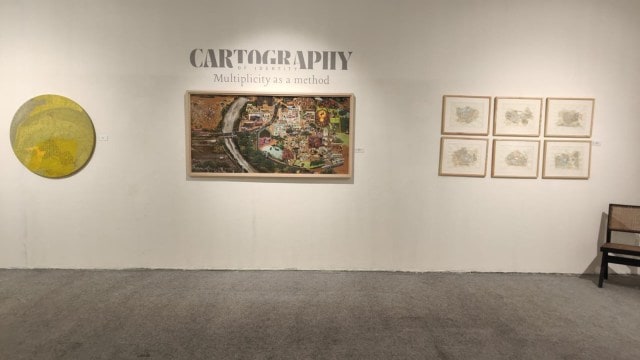 At the exhibition Cartography of Identity the maps are not just a blueprint to geographical structure, they are windows into one’s identity
At Apparao Galleries’ ongoing exhibition Cartography of Identity at Bikaner House, the maps are not just a blueprint to a geographical structure, they are windows into one’s identity – who and what they are and their stories. Curated by Sharan Apparao, the show brings together works from artists who reinterpret mapping beyond the scales and look at personal histories, human experience and cosmic balance.
The exhibition, which is on till November 17, was nearly nine months in the making. It reflects Sharan’s ongoing interest in the intersection of science, mathematics and art. “The grid, the map, the plan — they all come from a relationship between man, cosmos and aesthetics. Even the plan of a temple is based on planetary distances and the golden ratio. I wanted to see how artists interpret these connections in their own visual language,” says Sharan.
It features both familiar and new collaborators – RM Palaniappan, Satyendra Kumar, Orijit Sen, S Sujil and Smriti Dixit among them.
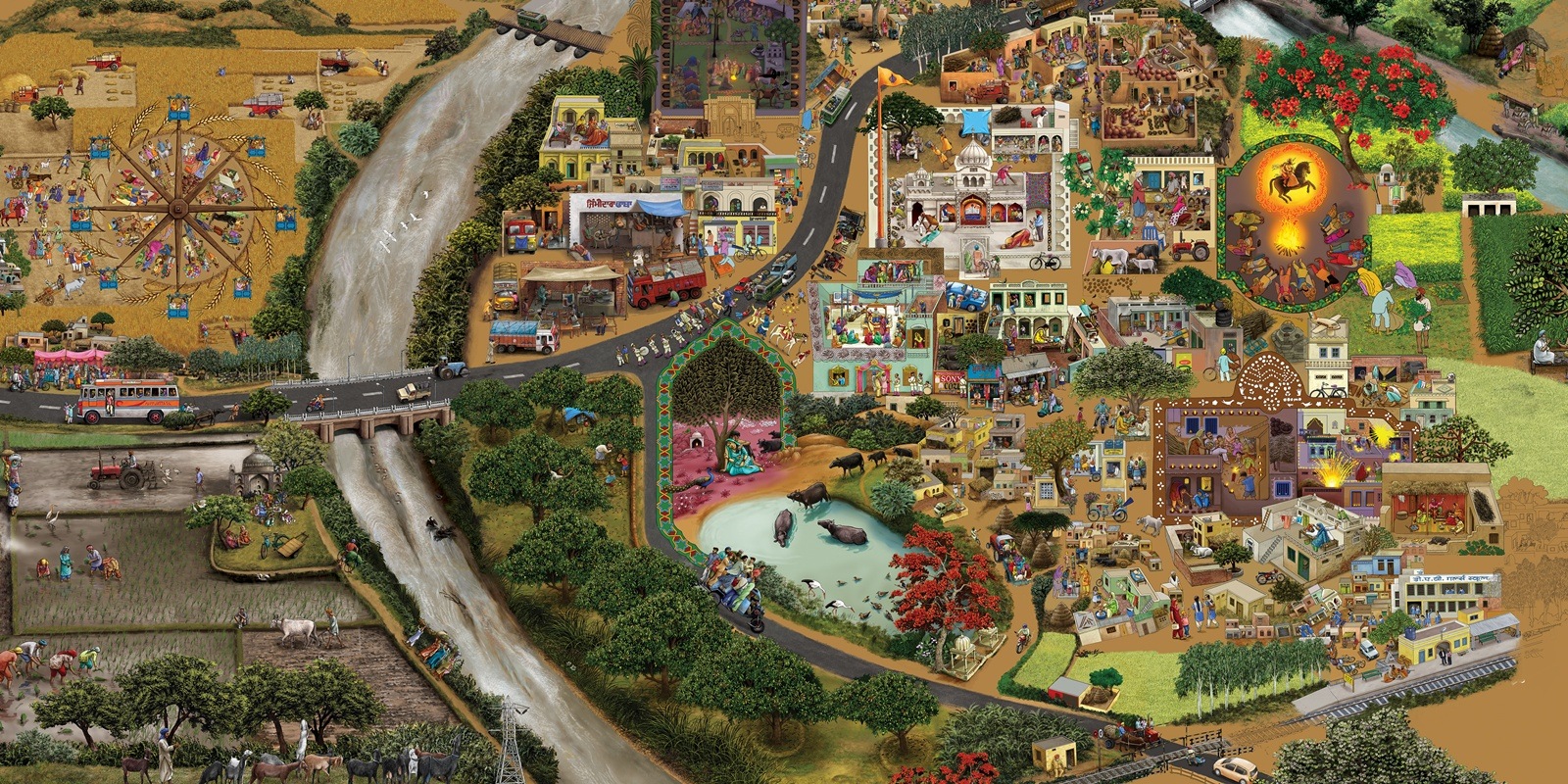
Each artist, in turn, redefines what a map can mean. In the piece The Place Remembers its People, Sen’s sprawling depiction of a Punjab town stands out for its dense narrative, every inch alive with detail. It reminds one of the multiplicity and the layers of a small town life. How people, very different from each other co-exist in a space, and yet thrive. “That city and that grid explode into something else. It personifies how identity unfolds within space,” says Sharan.
Smriti Dixit’s work uses old maps of places and found objects to create collages layered with memory. In one of her pieces titled Andaman Islands she keeps a small box full of found objects – like stones, small skeleton, shells on the map of the place.
Chantel Jhumel’s work titled Pinprick Tamil Geometry reimagines the traditional art of kolam making.
 In his work titled Looking Through The Map, Shijo Jacob translates coordinates and data into visual form
Some works approach mapping through abstraction. Shijo Jacob translates coordinates and data into visual form. “He said, when you read a document, it only tells you degrees and location. But when you try to see that space, visually it becomes something entirely different,” says Sharan.
RM Palaniappan’s work titled Berlin/e Effect / Chapter II (2000), a digitally reworked print drawn from his earlier sketches and drawings, inspired by his 1999 visit to Germany, reflects on the aftermath of war and the shifting contours of human experience.
His fascination with mathematics, astronomy and philosophy informs much of his art, where metaphysics and geometry intertwine.
The show’s rhythm feels effortless but Sharan admits that curating such multiplicity takes precision. “The challenge is to make the works speak to each other. It’s like constructing a landscape. You have to make sure one form flows into the next,” she says.
The exhibition suggests that identity, like a map, is never fixed — it shifts with perspective and time. The lines and grids that once marked territories now trace emotion and memory. In these works, mapping becomes less about direction and more about reflection — a way of finding one’s own coordinates in an ever-changing universe.