


Tags:


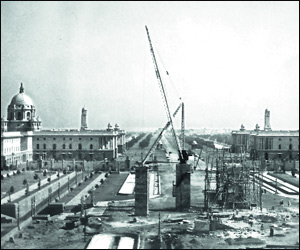
New DelhiMaking of a Capital is a broad canvas,consisting of pictures,drawings,press clippings,correspondence between those involved in the making of the imperial capital,and two excellent essays by Malvika Singh and Rudrangshu Mukherjee.
Mukherjee looks at the shift of the capital from Calcutta to Delhi,the reasons and the logic of the move. Malvikas much longer piece essays the actual building of the capital,the tussle between those conceptualising the symbol of permanence and order,the giving of the contract to Edward Lutyens,his sharing it with Herbert Baker,and Lutyens own evolution as he struggled with his own ideas on how to cast the Empires ideas in stone,slowly absorbing elements from Indiasmall symbols so that it may be slightly reflecting its context,but not at anytime be able to escape or grow larger than the larger imperial design.


The proposition was to plant a capital here,but not the capital that had dangerous associations or which could stir memories of the Empire gone by. It was to be a brand new Delhi,which could represent,architecturally,what the British Empire signifiedmost importantly,in an environment of increasingly restless Indians,a firm symbol,in stone,of the fact that they had come to stay.
There is an excellent section on how the decision had to be made between architect Henry Lanchester and Edwin Lutyens getting the contract to design Delhi,and how Lutyens,with his excellent connections incidentally,he was also married to former viceroy Lord Lyttons daughter,Emily scored over Lanchester. With that,Lanchesters big idea on what Delhi was to be like he had submitted five designs of his ideas also lost out. Lanchesters idea was to connect the new capital with parts of the old and make it more fluid and interesting as ..a link with Shahjehanabad that would ensure an integration of the new political and administrative city with inhabitants of Dilli,imperative for infusing a vibrancy and vitality into the stand-alone stone edifices that were being planted..he believed in urban improvement not new development devoid of intrinsic character and soul of the city..
Lanchester also wanted the Yamuna to be connected to the new city via a ceremonial avenue,but with Lutyens getting the contract,this was not to be. There are interesting sections in the book though about how Lanchester continued to influence and interfere in Lutyens plans through his friendship with Lord Hardinge,the Viceroyespecially in tempering some of Lutyens sense of very wide avenues which,on Lanchesters advice,ended up being less predictable,more full of curves,foliage,and wind-breakers to beat the tyranny of the hot summer winds,Loo.
Lutyens friend and associate Herbert Baker,who shared the commission with him,also was to be later engaged in a bitter duel,what Baker himself terms the controversy,about what was to be the more imposing of the structures as you came up from the All-India War memorial India Gate down Kingsway now Rajpaththe seats of the bureaucrats,North and South Block,are much more imposing,because of the gradient,and the dome of the Government House now Rashtrapati Bhavan comes into view only later. This,to Lutyens,was anathema,and the exchange of angry letters is discussed at some length in the book. However,as the author puts it,this did serve democratic India well,as she chose to house the titular head in the Government House,and the elected representative along with his/her bureaucrats chose to sit in the North and South Blocks.
Amongst the many wonderful pictures in the book,one of the most evocative ones is at the end,eight grabs from a short film of August 15,1947,as swathes of Indians can be seen milling inside the Parliament complexIndias first PM,and citizens on cycles,watching in amazement and curiosity,as imposing iron gates were thrown open to all. Of course,a few decades later,as the caption records,the iron gates would close again on the general public and the area would be declared a high-security VIP zone.


