4 min read

Journalism of Courage



It is difficult to historically analyse the recent past,far more to fictionalise it,because of the paucity of perspective. But in sympathy with Aristotles preference for the poetic art to the historical,literatures efforts to attain a higher,transcendental truth universalises it beyond the constraints of time and space. Aleksandar Hemons unnamed narrator in his fourth book,Love and Obstacles,looks back on his juvenile literary attempts thus: I never really understood what I wrote. I didnt know what my poems were about,but I believed in them I felt they attained a realm of human innocence and experience that was unknowable,even by me.
Literary treatments of the Yugoslav civil war are still nascent. But they are our truest witnesses and interpreters of the bloody Balkanisation,refracting it through the individuals consciousness. And like the Bosnian-American Hemon,or the Croatian-American Josip Novakovich,formerly Yugoslav writers are often hyphenated,residents or citizens of the US,writing in English for sometime now. Hemon,as his narrators usually do,was visiting the US in 1992 when the war began. He couldnt return,presumably watched the destruction of his beloved Sarajevo on TV,as does this narrator. Already a published writer back home,Hemon learnt English as an adult and soon evolved his own literary idiom. Yes,his narratives frequently allude to Conrad; and he is compared to both Conrad and Nabokov,perhaps rather hurriedly.
Hemon arrived on the Anglophone literary horizon with a short story in 1995,and published his first book,The Question of Bruno in 2000,followed by Nowhere Man 2002 and a novel,The Lazarus Project 2008,which was a finalist for the National Book Award. Love and Obstacles returns him to the short story his instinctive form. Linked by the narrator,these stories enable us to read the book as a compartmentalised,picaresque Künstlerroman,beginning with the narrators adolescence and early adulthood in cosmopolitan Sarajevo,his drunken memories,sexual misadventures and artistic aspirations. The opening story,Stairway to Heaven,is about a teenage summer in Africa and aborted arrival at adulthood; Everything is the 17-year-olds train ride across Yugoslavia to purchase a freezer chest his fathers effort to wean him away from his books and groom him into bourgeois responsibility; but the boy is desperate to lose his virginity and ends up with a beating from a hotel receptionist.
As in the pivotal story The Conductor which plays the narrator off against Dedo,his old friend and the biggest Bosnian poet alive,who lived through the siege of Sarajevo and ultimately moved to America a shrunken,near-defeated man to die Hemon doesnt deal with the Balkan war directly. Thats the tragic backdrop to his black comedy of the immigrant experience,the duality of love and hatred received and given,American ignorance and immigrant exasperation,American kindness and immigrant gratitude.
Sympathetic to post-modern self-reflexivity,Hemon nevertheless steers clear of the temptation to succumb to such identity games,using his bathos as a trademark tool of exploring a tangible reality. Life comes like the Balkan war: We knew but we didnt want to know what was going to happen,the sky descending upon our heads like the shadow of a falling piano in a cartoon. As we step over the corpses,its important to know We are never as beautiful as now.

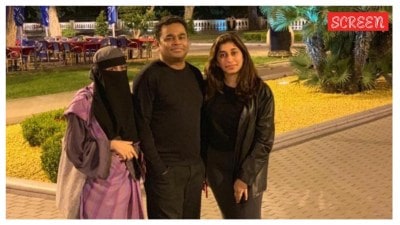
AR Rahman has been under fire after his interview last week, during which he noted how less work has been coming to him due to a power shift within the Hindi film industry in recent years and said it could also be due to the “communal thing”. Now, Rahman’s daughters Khatija and Raheema have come out in their father’s support.