


Tags:


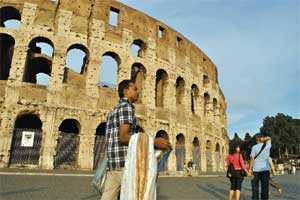
Step out from Romes metro station at the Colosseum and you find the world eclipsed by the ancient arena with its jagged mouth open to the skies,as it has been for nearly two thousand years.
Step out from Romes metro station at the Colosseum and you find the world eclipsed by the ancient arena with its jagged mouth open to the skies,as it has been for nearly two thousand years. You will even find Roman centurions in complete regalia who can join your picture for an Euro. For the authentic look they tell you. You could be fooled into believing that everything remains the same here.


Walk for five minutes and you will reach the neighbourhood of Monti,where young Romans gather on the steps of the fountain in the main piazza,strumming their guitars and singing into empty beer bottles. Here we meet Moshraf,who prefers his daak-naam Raju and sells roses in the evening. He purchases flowers,20 for 10 Euros,from the Chinese traders,starts early in the evening,and typically stays out till dawn. Business only picks up after midnight when people are drunk enough to loosen their fists. At the end of the night,hes usually left with just 10 Euros.
But Raju has seen worse in his four years in Rome,six months of which he spent working for a shopkeeper,three hours a day,four times a week only to never get paid. But then,how does an illegal immigrant file a court case? He finally got his documents in order,just as the jobs began to run out. And so he waits outside drunken parties with wilting roses. That night though,Raju had more pressing worries. Kolkata Knight Riders will definitely win the IPL, he says,Shakib-al-Hasan! Number one all-rounder in the world!
Raju is part of a rapidly growing minority. According to the Italian National Institute of Statistics,there are currently about 4.5 million immigrants in Italy,rising from 1.5 million in 2003. Many immigrants use Italy as a conduit through which they can move on to wealthier European countries to the north,but some find ways to stay and survive. In the northern countryside,many Indians,mostly from rural Punjab,work in the vineyards and dairy farms,producing exquisite Italian wines and cheeses. In Rome at least,Bangladeshis are the most visible immigrant group. Most of them are single men who save money for concrete homes and English medium schooling for families back home. They rely on community connections to find flowers,trinkets,a place to sleep,and sometimes,a job.
Raju stays in Piazza Vittorio,a square surrounded by palazzi,buildings with giant porticoes,built in the 19th century. Now,Bengali and Chinese store signs have sprung up all over the neighbourhood. Raju shares a 50 square metre apartment with 15 other men. One spring afternoon,we meet Rajus neighbour,Shahin,also in his late twenties. Shahins arms are draped in looping necklaces. All stone,no plastic, he assures us,putting the flame of his lighter below the beads.
Shahin recounts his journey to Italy,seven years ago. The legitimate flight to Pakistan,then three months on the road,slipping from one shadow to the next. He was brought to Iran,and then Turkey. We were kept in dark rooms for days,not knowing where we were going. We were given one meal every three days,I think. Strangers,speaking in foreign tongues escorted them,through dirt roads on foot and at times in the boots of cars. From Turkey to Italy,he was brought in a container,where 20 of them kneeled unmoving inside cardboard packing for 48 hours. Finally,they were pulled out into the middle of a meadow. This is it,they were told: Europe. The name that had prompted Shahin to pay 7 lakhs to a dalal in Dhaka. The promise that dragged him into insurmountable debt,across borders and away from the familiar. Thousands make the illegal journey by donkey,as the South Asians call it: smuggled in boats or making death-defying climbs across the mountains of Russia and Ukraine.
For the first four years,Shahin was illegal,employed in factories that skirted inspections,working on large farms with other foreigners. He finally received his permit of stay three years ago. But theres been no job available since then. This is not a job, he spreads his bejewelled arms,no one wants to do this. Shahins eyes dart about while speaking. The Italians dont give us a moment of shanti, he says. In Rome,its common to see vendors bolting across the street. The police follow a few seconds later. We crouch behind a tourist-stall while we finish our coffees,which Shahin insists on paying for. Beneath us is a huge fenced pit with crumbled stone halls: the gladiator training area of ancient Rome,where foreign fighters sparred in preparation for an almost-certain death. And the illusion of glory.
In a university area beyond the city walls,we run into Iqbal. He prefers Italy,chased by cops and all,to his previous homes. The problem is, Iqbal says,our people are haraamis. When I was working in Dhaka and Delhi,every boss tried to s me over. But here,they expect work and pay me honest wages. We wonder if Raju would agree.
Many Bangladeshi immigrants have thrived in Rome and have graduated in the gradual-but-classic immigrant success story. Ali,who is in his fifties,owns his own flower shop and employs two young men at night. Most flower-shops are open all night in Rome,it is almost impossible to find a 24-hour pharmacy or department store,but emergencies of the heart are a different matter. Alis wife stays in Dhaka,in a four-storey mahal he has constructed. He wants to return as soon as he can,but the money keeps him here. Italy has been good to him but he doubts if he will fit in. The flowers here have no scent, he jokes,just like the women here have no virtue.
A mile away from Alis store,Masoom mans an all-night store selling fresh sliced fruit. Masooms luck in Italy was short-lived. He arrived on a work visa: 3000 Euros a month,with accommodation and benefits, he claims. But when the recession hit,he was among the first to lose his job. Italys not like the US,where Masooms brother makes at least 10,000 dollars a month from his shirt-pant business. Masoom has had no formal job in three years. We are hungry now. But in five years,the Italians will be hungry too, he warns.
Ali and Masoom may want to return,but many have stayed on. The waiter at a popular open-air terrace bar has been here since childhood. Dhaka is too crowded, he says in Bengali,but then slips into effortless Italian. He knows the rules. He works out at a local gym,three times a week,claiming that if you want to be Italian,you only need to look good.
After the IPL finals,we run into Raju again. Did you see Shakibs four? he asks us,KKR pulled it off. Amra jeetlam. KKR jeetlo. We couldnt dissect the match in detail; he hurries off to the nearest bar. If there were more Bangladesh fans in Rome,Raju would have sold his roses quicker. But then,if there were more Bangladesh fans,Raju probably wouldnt be selling roses.
Kaushik Barua and Cyriac George are based in Rome. Kaushik8217;s first novel Windhorse will soon be published. Cyriac blogs at http://mrcyriac.com/


