Journalism of Courage
 4 min read



Every day at the crack of dawn, Satpal and Sumaru go for an 8-km walk. This is no casual stroll. Armed with torchlights, gigantic spanners, pickaxes, crowbars, spades and a clawed instrument, the two men scour every inch an 8 km stretch of the railway tracks between Ambala and Chandigarh.
Satpal, a keyman, walks along the tracks to see if there is anything amiss8212;loose bolts, ungreased nuts or broken tracks. Sumaru, a gangman, helps Satpal remove any obstruction from the tracks. Together they are responsible for smoothening any bump, fixing any crack and clearing the tracks to ensure that your journey is not disrupted. Every station has a keyman and about 20 gangmen. They patrol round the clock in shifts.
Sometimes there is too little time. For such emergencies, Satpal and Sumaru also carry crackers that are used to warn oncoming trains. The crackers are placed about 900 metres to 1.8 km away from the point where the track is either damaged or there is to big an obstruction. When the crackers burst, the train driver is alerted to avert an accident. 8220;Last year, we spotted fire extinguishers on the tracks. There wasn8217;t enough time so we planted crackers and were able to alert the driver in time,8221; recalls Sumaru.
Such clockwork heroism is performed every day along the 84,260 km railway network across India, come rain or shine. Little wonder then that Union Railway Minister Lalu Prasad refers to the gangman as the hero of the Indian Railways. 8220;His is a 24-hour job. Every kilometre of rail track is inspected by him,8221; he says see interview.
If the keymen and gangmen are the f ootsoldiers of the railways, the stationmaster is the points man. He is responsible for every train that comes and leaves the station and is a key link between stations. At Dappar, stationmaster Hem Raj Meena is studying a complex map with illuminated lines. 8220;The red light on the line means it is occupied. We press these buttons to divert oncoming trains to free lines,8221; he explains.
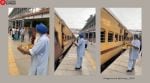
Exchange of information is crucial. A stationmaster has to be in constant touch with neighbouring stations and inform them about every train passing through. After a train has left a station, the next station on its journey is told of its arrival. The stationmaster moves out to show the green flag to the train if it has no stoppage. The work requires unwavering concentration. The slightest mistake can spell disaster. 8220;We check if the wheels are intact as the train passes. If we spot something wrong, we flag it down,8221; explains Meena.
For the train driver and his assistant in the engine, the work is no less tough. They have to be wide awake and on their feet8212;literally. 8220;The seats are used when the train halts,8221; says Deshraj, driver of the U2 passenger train.
Relaxing is not an option. 8220;We keep checking each other if either of us feels sleepy,8221; adds Subhash Chandra, the assistant driver. Every day before they begin work, the drivers are checked for alertness. If they look tired or there is a hint of a hangover, they are sent back home. Every two years, drivers also undergo eye tests, especially the Doppler test because at fast speeds, the eye cannot differentiate between colours. This can be disastrous if you are at the helm of 600 tonnes of metal at 120 kmph.
You rarely see gangmen, stationmasters or drivers when you are on a train. But they are the moving force behind your journey8212;the invisibles who put in long hours so that you don8217;t face even a moment8217;s discomfort on the train.