Journalism of Courage
 6 min read



Nowhere is this more apparent than when we raise our voices in protest. The quality of protests in our country, unlike the quality of mercy, is strained. An Amitabh Bachchan reciting a mantra with his shoes on in a movie is cause for greater concern among a segment of our society than, say, the injustices against women and children. It is somehow more important to threaten the life and limb of our greatest artist, M.F. Husain for some perceived insult to our culture it is his culture too, but nobody seems to notice that than it is to raise a voice against an illicit liquor baron whose concoctions have killed innocent people.
A killing in South Africa or a show of US indifference is enough to bring our brethren in Calcutta rushing out into the streets in protest 8212; but the same people seem so much more tolerant and accommodating towards their own municipalities and local authorities who switch on and off essentials like power and water almost at whim.
India8217;s 8220;protesting classes8221; are diminishing. This, in proportion to the rise in the so-called Middle Class, or the consumer class which quickly finds alternatives to public service. The Middle Class shares one abiding characteristic 8212; it is indifferent to what happens outside its ken. The recent postal strike was not the success it might have been even a decade or two back because the Middle Class has alternatives, and will use them. Courier services registered a killing, and those who only communicate through e-mails anyway hardly noticed anything amiss.
The protesting classes are increasingly losing power, money, and a support base. They are losing sight of their cause, more often than not, and that is a deadly mix. If you carry that argument to its extreme, it is possible to imagine protests as a form of gaining attention being ultimately ineffective. Indifference will kill them. On the other hand, lack of awareness leads to a reduction in the spirit that makes for protests. The so-called 8220;Me8221; generation has been replaced by the 8220;What8217;s-in-it-for-Me8221; generation, and if there isn8217;t anything in it for this lot, then nothing affects them 8212; not postal strikes, not droughts in Orissa, not match fixing, nothing.
There is no gainsaying the fact that protest is the birthright of the citizen in a democracy. It was the most powerful weapon of the nationalists when the British were in power. The Salt March is seven decades old, yet it is spoken of with reverence even today. There was a simplicity to its execution, a rightness about its cause, a dramatic nature to its implementation that caught the imagination. The satyagraha as a form of protest has not been bettered anywhere in the world. In fact, in many places it is used even if those indulging in it have no clear idea of its history or background. Strikes, hartals and bandhs, the illegitimate offspring of the pristine idea of the satyagraha, continue to dog our working days. These may be outlawed, as in Kerala, but they are perpetrated under other names and in other forms. Sack an employee caught cheating, and you have a strike on your hands. Sack a minister or ignore one, and you have a bandh. Buses are burnt, shops are stoned, often statues are defaced. This is noprotest, this is letting off of steam, and it is counter-productive.
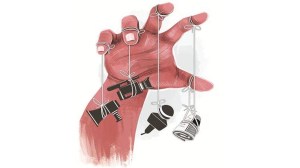
Increasingly too, the protest is becoming an urban phenomenon. There is a good reason for this. The cities have the newspapers, the cities have the television cameras. Action in the cities and towns means that the media have their dose of protests served to them on a plate. And if the protest comes with a personality attached to it, so much the better. A Medha Patkar is identified with the Narmada Bachao Andolan. An Arundhati Roy is even more welcome 8212; she is a rebel with many causes, and is equally quotable in all of them.
The urban, English newspaper-reading public, the aspiring as well as the established Middle Class, has little time for too many heroes. Environment is sexy, and they will keep track so long as the frontmen or women of the movement remain interesting. But for all they know, the real battle might be taking place elsewhere. The media are happy with one or two names, and so are the public. We know so little of our real heroes.
The protesting classes are thus up against a range of forces: The indifferent Middle Class, the uncaring media, the convenient heroes of the protests, the slots into which everybody so conveniently fall.
There is too the lack of a national leader to whom the aggrieved can take their problems. The BJP leaders8217; support base is suspect, and they will not do anything to rock the boat; the opposition is too inward-looking; the regional leaders are toying with their version of modernism, and struggling with the computers that seem to be its symbols; the Laloo Prasad Yadavs have to deal with the charges against them first. A leader who is not moored to politics but welfare, who is aware of at least the problems if not the solutions, is hard to come by. The last serious protest in India was against the implementation of the Mandal Commission report. Self-immolation as a public statement asks for no reply, the protestor cannot know whether his protest has succeeded or not. It is a form of Benthamism, the greatest good for the greatest number, even if it involves the elimination of some of that number. It may be argued that the murder of the Staines was a form of protest too, but it was a cowardly act, and a protest,by definition, must be an act of heroism.
The problem of protests therefore, was set out by Yeats all those years ago. Those with the best weapons, the best causes lack all conviction, cocooned in everydayness. The worst have the intensity 8212; of the futile, badly-directed kind.
There is the lack of a national leader to whom the aggrieved can take their problems. A leader who is aware of at least the problems if not the solutions