Journalism of Courage
 5 min read



The turn of events in Uttar Pradesh, bomb blasts in Mumbai, Archaeological Survey of India8217;s findings on Ayodhya, prime minister in Srinagar 8212; more than one political process is in operation. The preoccupation in New Delhi is with the drama in UP. In Mumbai, the focus is still on the blasts, which local authorities have been informing journalists, off the record, are Gujarat related. But both, New Delhi and Bombay, have one common element in their focus: How are all the various state-level happenings likely to impact on the ultimate Kurukshetra, the 2004 Lok Sabha elections.
In a sense, the federal, parliamentary political processes and the 8216;8216;presidential8217;8217; electoral game plans are proceeding almost along parallel tracks. While L.K. Advani is keeping a steady gaze on Bombay one day, Lucknow the other, the prime minister, a little aloof, on a pedestal, is holding onto the broader theme he enunciated in Srinagar on April 18: Peace and harmony on the sub continent.
On another day, elements entrenched in the Indian establishment would have strained to break loose from the restrictions of moderation rigorously imposed by the prime minister. There have been so many provocations: A brigadier killed and a general injured when terrorists broke into an army camp in Akhnoor; a superintendent of police shot in Rajauri; pilgrims killed on the way to Vaishno Devi; terror in Mumbai and Srinagar.
It would be churlish not to concede the point that all these provocations have not invited a communal backlash. There has been a cleansing of the air. Considering that this has happened in the year since Gujarat, someone must be given credit for this restraint. Would it be wrong to place most of it at Vajpayee8217;s door?
This restraint is not a function of some sad delusion that cross border terrorism has stopped. In his meeting with Indian parliamentarians in Islamabad earlier this month General Musharraf offered, as part of a quid pro quo, to appeal to the militants in Kashmir to lay down their arms. General Musharraf may argue that he has not been given what he requires from New Delhi, namely a suspension of army action against militants, a scaling down of the military presence in the Valley, for him to issue an appeal to such militants as would listen to him.
The Indian response has been calibrated. The tendency to bunch all terrorism as 8216;8216;Mian Musharraf8217;s8217;8217; handiwork has been resisted. It is recognised that the success of Indian operations at places like Hill Kaka may have caused the trapped militants to scatter to other parts of J038;K. There is also a cool effort to analyse Bombay blasts in a different light. The PM is not relaxing his grip on the theme of internal and external harmony, on being in a problem solving mode. Statesmanship, he seems to suggest, will also be good electoral politics in 2004.
After the dust has settled on the elections in Madhya Pradesh, Rajasthan, Delhi, Chhattisgarh, the battlelines will be drawn for the 8216;8216;presidential8217;8217; contest: Vajpayee vs Sonia whose political education will have been put to test for the first time in the rough and tumble of UP.
I am not suggesting that we are not in for exciting times upto end November when new governments are expected in four states. But some in the BJP are beginning to contemplate the state elections as a win-win affair.
The logic is somewhat self serving. Since all the four states have Congress chief ministers, increase in BJP vote share, number of seats, victory in one, two or three states will be cited as huge gains. Unless there is a rout, there will be enough in the results to cite as gains. Vajpayee has been against mixing up state elections with the national ones. In 1998, Congress won MP, Rajasthan and Delhi. But in the 1999 Lok Sabha elections Sonia led the party to its lowest ever tally of 114 seats.
The BJP leadership cannot be unaware that Vijay Kumar Malhotra, Sushma Swaraj and Sahib Singh Verma are not likely to bust their guts to crown Madan Lal Khurana, just as Khushabhao Thakre, Kailash Joshi, Sunderlal Patwa are not going to break their backs for Uma Bharti who may be credited for having regained the loyalty of her brother and Yashodhara Raje. Heaven knows how Mayawati8217;s influence on the Dalits in the northern states is going to play against the backdrop of an altered UP.
Rajputs belonging to the BJP and the Congress have been holding joint rallies in Rajasthan. Even leaders like Naval Kishore Sharma have been seen on these novel, cross-party, caste platforms. Bhairon Singh Shekhawat cannot be faulted if the vice president8217;s house is lined with panchayat leaders looking for guidance. He is a political animal first, vice president later.
In all, an exciting time ahead. But it will all pale when the ASI findings in Ayodhya are played up by Vinay Katiyar against 8216;8216;Mullah8217;8217; Mulayam. The gossip circuit is talking of a deal between the BJP and Mulayam which may even cover the issue of the Ayodhya case against BJP leaders blocked so far because a fresh notification has not been issued. It is in UP where the prime minister8217;s agenda of internal and external harmony 8212; 8216;problem-solving8217; 8212; will be most tested.

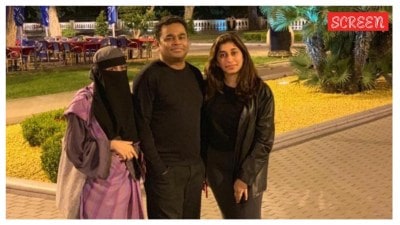
AR Rahman has been under fire after his interview last week, during which he noted how less work has been coming to him due to a power shift within the Hindi film industry in recent years and said it could also be due to the “communal thing”. Now, Rahman’s daughters Khatija and Raheema have come out in their father’s support.