Journalism of Courage
 3 min read


Five years ago,the math just wasnt working for the Kedari and Thorat families in Karkudi village in Ambegaon taluka of Pune district. They couldnt afford the Rs 30 a day that farm labourers asked for and they needed at least two such labourers everyday for six months. A difficult situation,they thought. But when the elders of both families got together to discuss the problem,they came up with a solution: they decided they would work on each others fields.
So Jayashree Lahu Kedari and her husband Lahu Nyandeo Kedari joined the Thorat family in cultivating their land. In return,Manjula and Ashok Thorat began working on the Kedaris farm. The idea caught on. What began as an understanding between two families five years ago has today graduated into a full-fledged method of group farming for the 53 families of Karkudi. It has not only solved the problem of finding farm labourers,but has also helped these families cement relationships over the years.
Five years ago,the rate per labourer was Rs 30 a day. The money was too steep for us to pay. Today,the rate is Rs 50, says Lahu Kedari. The villagers say they no longer have to deal with farm labourers who work only for five hours a day and demand more money.
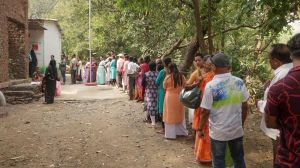
Located about 10 km from the pilgrim town of Bhimashankar,Karkudi is one of the many tribal villages in Ambegaon taluka. Most of the villages have half-to-one acre farms in which they cultivate paddy,the Indrayani variety of rice. We grow only enough to feed our families for the entire year. Since we face water scarcity in summer and winter,we cannot grow any other crop, says Kedari.
The villagers have organised themselves into about 60 groupseach with about nine to 10 peoplewho work in each others farms.
The work begins in May when the land is prepared for sowing, says Anjanabai Bhojane. After the arrival of the monsoons,we bring our bullocks to plough the fields. We sow paddy together and later come together for harvesting around October.
The villagers have decided that only the young and middle-aged would work in the fields. The children are sent to the gram panchayat school,while the elderly stay back at home, says Ulhas Kedari,another farmer.
The group farming practice has also ensured that that there are fewer disputes in the village. They also learned to trust each other. So much that no farmer has systems to monitor people working on his farm.
After the harvest,we ensure that the produce is handed over to the rightful owner. Usually it is between eight and ten bags of rice, says another farmer Arati Kedari.