3 min read

Journalism of Courage




PUNE, June 4: Senior professor at the Tata Institute of Fundamental Research TIFR Narendra Karmarkar today said it was not enough for the country to merely supply the labour component in the rapidly moving IT industry.
8220;It was necessary to engage in high end computing to reach higher levels and increase investment in basic research. Moving a step forward in this direction the TIFR is now setting up a new laboratory for computational mathematics,8221; he said.
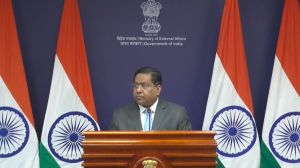
Karmarkar was delivering the key-note address on the topic 8220;IT revolution and the role of mathematical programming,8221; at the two day seminar 8211; 8220;Update 998221; organised by the Software Technology Parks of India STPI to mark the ninth Foundation Day.
He said the IT revolution in India has been marked by distinct phases. The first phase beginning from the year 1965 to 1985 involved replacing humans with computational procedures while the second phase made it possible for small businesses to computerise their operations leading to improved business productivity.
The third phase not only involved achieving higher levels of connectivity in internet but also providing easy and timely access to internet leading to electronic commerce, he said, explaining that main objective here was to make PCs universally available. More than 800,00 PCs were sold last year alone thus setting the stage for the revolution to come, he pointed out.
The concept of mathematical programming, according to Karmarkar, originated during the Second World War. It has applications in a number of areas including the oil industry, airlines, telecommunications, financial industry, manufacturing and distribution. The new emerging applications in these areas are chiefly in new algorithms enhancing the ability to solve complex problems and new architecture.
He felt that the new business paradigm should concentrate on selling solutions rather than software. Referring to the emerging areas of data mining, Karmarkar said that this would allow corporations to improve their marketing and customer support operations through better understanding of its customers. Billions of dollars are expected storing and distributing current technologies for storing road advances in data gathering, storing and distribution, he said, adding that new technologies outpaced the existing ones in converting the raw data into actionable information.
Earlier, Dr Arun Nigavekar, Vice-Chancellor, University of Pune introduced Karmarkar. N Chandrasekaran, director, C-DAC, Bangalore spoke on 8220;Digital libraries8221; and S D Pradhan, CEO, Tata Technologies Ltd, Pune delivered a talk on 8220;Emerging Directions in IT for Manufacturing Industries8221;.
Top