6 min read

Journalism of Courage




The silly millennial season is upon us. As time present merges with time past in this cusp between two millennia, names fly about through cyber space as the whole world is enjoined to name the men and women who have inspired them and come to represent the spirit of the age. What follows is a fame game where anything goes, a giant democracy wall up for cyber scribbles. Here an Indira Gandhi can quite easily get transmogrified into the greatest woman of the millennium. An Amitabh Bachchan can have his name up there among the greats of all time. A Mahatma Gandhi can rub shoulders with a Nathuram Godse. There are no rules in this ceremony of cyber consecration. All that matters is that there are a sufficient number of nerds out there, in Boston or Birmingham or Bangalore, with some keenness and a keyboard.
But somewhere in that jumble heap of associations and images, something is lost. Memory plays tricks, perspective passes into thin air. It is far easier to remember an effulgent personality of the immediatepresent rather than one who had, just a decade earlier, wrought a similar magic. Pop stars, for instance, have always resided uneasily on the quicksands of time.
Superstars, even great performers of the stage and screen, sportspersons and makers of wealth, painters and inventors they may inhabit a moment, never an eternity.
The people who have survived the ages, the true heroes of humanity, do more than inspire instant recall. It is then perhaps useful to ask oneself who a hero is the term, it must be clarified, is used here in a strictly gender neutral manner. What do we look for in people who, through their thoughts and actions, are believed to embody heroism?
At the outset one needs to make an important distinction between the hero and the leader. Leadership, as a social phenomenon, has exercised the minds of many philosophers over the years. German sociologist Max Weber, for example, talks of three ideal kinds of authority: the traditional, the legal and the charismatic. In the traditional, theways of the past and the authority of the elders hold sway. Legal authority, in contrast, is exercised through norms and laws. Therefore individuals who hold authority in the legal sense of the term, do so through the power vested in them by law.
But what constitutes the third category 8211; charismatic authority 8212; as Weber understood it? He defines charisma as a 8220;certain quality of an individual personality by virtue of which he is considered extraordinary and treated as endowed with supernatural, superhuman or at least specifically exceptional powers or qualities8221;.
As British sociologist, Anthony Giddens, in his exposition of Weber in Capitalism and Modern Social Theory explains, the point at issue here is not whether the man really does have any or all the characteristics attributed to him by his followers, what matters is that extraordinary qualities should be attributed to him by others. Giddens also reminds us that 8220;charismatic domination can arise in the most varied social and historical contextsand consequently charismatic figures ranged from political leaders and religious prophets whose actions have influenced the course of development of whole civilisations, through to many sorts of petty demagogues in all walks of life who have secured for themselves a temporary following.8221;
The fact is that while the twentieth century8217;s greatest demagogue, Adolf Hitler, may have had tremendous charisma, he was no hero 8212; indeed he was the very opposite. It follows then that while heroes invariably have charisma, not all charismatic personalities are heroes.
Which brings us back to the basic question. Who is a hero? According to the Chambers Twentieth Century Dictionary, the word 8220;hero8221; originally signified a person of superhuman powers, a demigod. Today, it has come to mean a person of distinguished bravery; an illustrious person; or a person reverenced and idealised. In other words, there are three broad aspects of such an ideal. The first is courage in the face of change and adversity.
The second isthe ability to rise above personal circumstance and inspire people beyond one8217;s immediate circle. There could be many people endowed with heroic characteristics who are destined to waste their fragrance in the desert air and are thus not heroes in the truest sense of the term. The third aspect is perhaps the most important heroes are people who by their thoughts and deeds express the universal ideals of human society and are therefore reverenced by the people of their time and, often, by people of all time.
Mathew Arnold, the eminent literary critic of Victorian England, came up with an interesting device with which to measure great literature. He called them touchstones. By this he meant small pieces of writing, short passages, even a single line from the all-time greats 8212; from Dante, Chaucer, Shakespeare, Milton 8212; which are unmistakable examples of great literary work. Literary critics, according to Arnold, must necessarily carry such lines with them always and apply them as norms in estimating thevalue of poetry and, by implication, any literary work that comes their way.
Perhaps we could borrow from Arnold8217;s method and evolve touchstones with which to measure those whom we deem as the real heroes of our time. Mahatma Gandhi8217;s definition of what makes a man truly great could serve as just such a touchstone. According to Gandhi, 8220;man becomes great exactly in the degree in which he works for the welfare of his fellow men8221;.
Others like Karl Marx would argue that only those who transform society would qualify for the honour of being termed great. 8220;The philosophers,8221; Marx once observed, 8220;have only interpreted the world in various ways, the point however is to change it8221;.
The truly great also have the gift of self-correction, of being able to alter their perceptions when faced with the truth. Albert Einstein exhibited this quality in large measure. When asked about his role in making the atom bomb possible, he is believed to have exclaimed: 8220;If only I had known. I should have become awatchmaker.8221;
Choosing a hero for our times is a lot more difficult than punching a name on a keyboard, it would seem. As for the rest, it is what T.S. Eliot once highlighted at the end of his A Choice of Kipling8217;s Verse: 8220;And for the little, little span/ The dead are borne in mind/ Seek not to question other than/ The books I leave behind.8221;

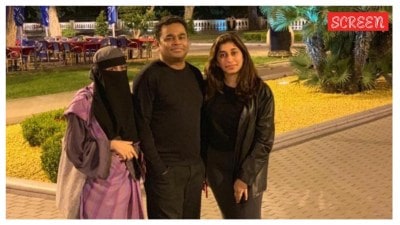
AR Rahman has been under fire after his interview last week, during which he noted how less work has been coming to him due to a power shift within the Hindi film industry in recent years and said it could also be due to the “communal thing”. Now, Rahman’s daughters Khatija and Raheema have come out in their father’s support.