4 min read

Journalism of Courage




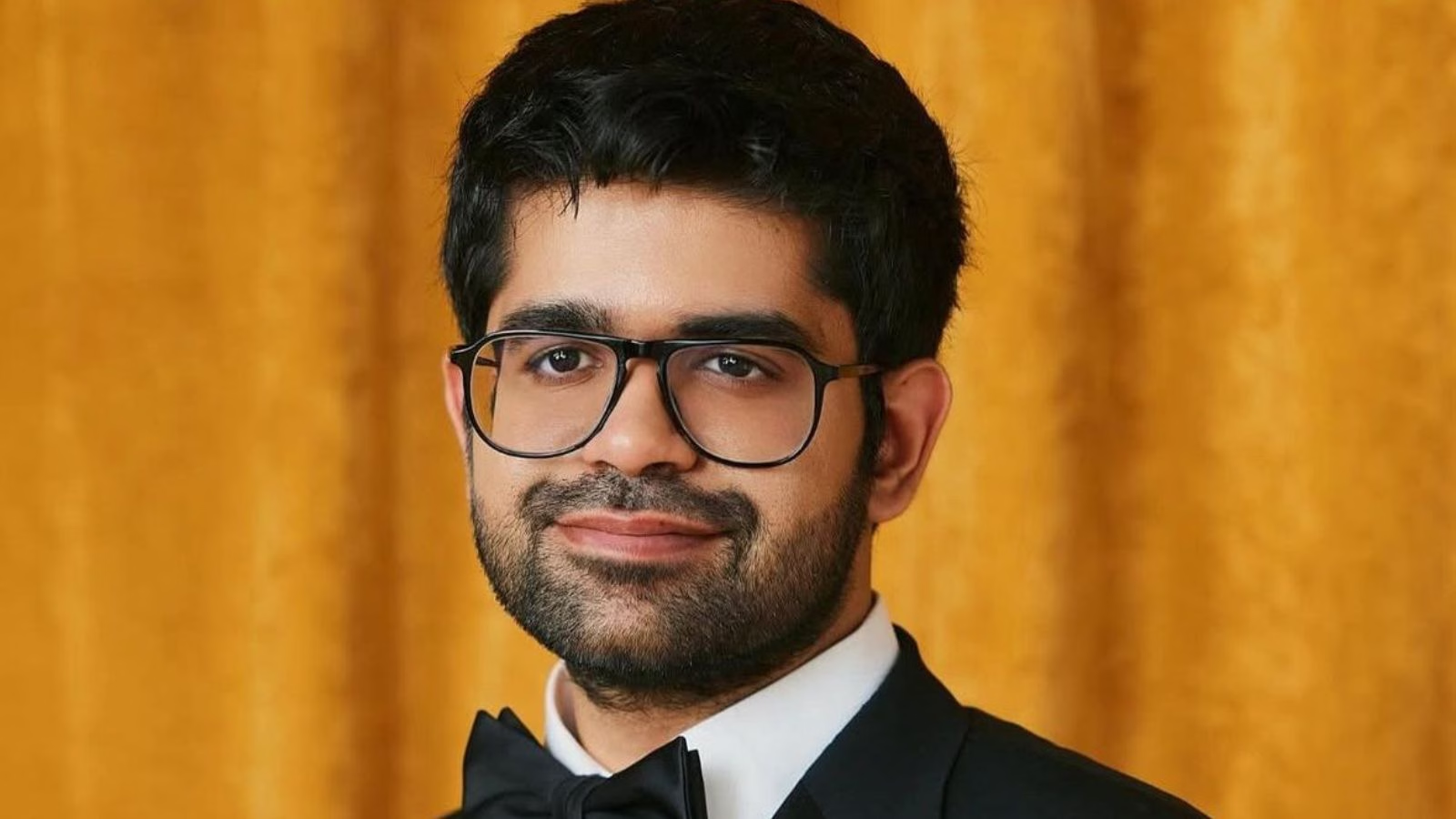
Stuck in a traffic jam in his bulletproof BMW, the richest man in Turkey wears a satisfied grin. Since 2000, Husnu M. Ozyegin has spent more than 50 million of his money, building 36 primary schools and girls8217; dormitories in the poorest parts of Turkey. Next to the Turkish government, Ozyegin is the biggest individual supporter of schools in the country. 8220;If I can have an impact on one million Turkish people in the next 10 years, I will be happy,8221; he says in his gruff, cigarette-scarred voice.
The global wealth boom has created a new breed of billionaire in once-poor countries like Turkey, India, Mexico and Russia. Propelled by their rising economies, robust currencies and competitive companies, they have ridden a surge in local stock markets that have reached previously untouchable heights in a five-year timeframe. Now, a number of them are using their wealth to bolster their standing and push for social changes.
For these emerging economies, where loose regulation, opaque privatization processes and monopolistic business practices abound, this extraordinary and uneven creation of wealth rivals in many ways the great American fortunes made at the turn of the 20th century.
While such countries have long been accustomed to vast disparities between a tiny class of the wealthy elite and the impoverished masses, the new elite shares some characteristics with counterparts in the United States. And just as Rockefellers, Carnegies and Morgans once used philanthropy to smooth the rough edges of their cutthroat business reputations, local billionaires in emerging markets are trying to do the same.
Carlos Slim Heluacute;, the telecommunications entrepreneur in Mexico who is worth more than 50 billion, has pledged billions of dollars to his two foundations that will aid health and education. Roman Abramovich, Russia8217;s richest man, who has a net worth of 18 billion, has channeled more than 1 billion into the impoverished Arctic area of Chukotka, building schools and hospitals. In India, Azim Premji, the chairman of the software company Wipro who is worth 17 billion, has established his own foundation that supports elementary education. But as these fortunes are still being made, the sums donated are relatively small in light of the pressing social needs of these countries.
A Nontraditional Climb
Here in Turkey, Ozyegin, who is 62 and has a net worth of 3.5 billion, did not secure his wealth by buying government assets on the cheap or by belonging to a rich family that controls a monopoly. The founder of a mid-tier corporate bank called Finansbank, he cashed in on a rush of interest by foreign financial institutions in Turkish banks last year and sold a controlling stake in his bank to the National Bank of Greece, receiving 2.7 billion in cash. Flush with money and ambition, he is doing all that he can to lift Turkish educational standards at the primary and university level.
Ozyegin8217;s grandparents came to the southern Turkish city of Izmir from the Greek island of Crete in the late 19th century, during the dying days of the Ottoman Empire. The son of a doctor, he attended Robert College, an elite academy in Istanbul, before setting off to Oregon State University in 1963 with 1,000 in his pocket. After a successful banking career, he founded Finansbank in 1987, selling his two homes and borrowing 3 million to get the deal done.
As a businessman, his frequent interaction with Southeast Asia, China and Russia has impressed upon him the need for Turks to become more competitive. 8220;The most important problem that Turkey has is education,8221; he said. He cites the rapid increase of applications to Harvard Business School from Chinese and Indian students. Turkey sends only four to eight students a year, said Ozyegin, who meets with the students when he visits. 8220;I want to do something on a major scale,8221; he said. 8220;My vision is that we can train and export people like India does.8221;
Ozyegin hopes that focusing on education as an economic development tool will help transcend the current bitter disputes over religious practice, including whether the increase in the number of women wearing head scarves signifies the emergence of a more Islamic, less secular Turkey.
8220;I want Turkey to have the same education levels as Europe 25 years from now,8221; he said. 8220;Whether you wear a scarf should not matter.8221;