Journalism of Courage
 6 min read



Intellectually, wrote Nirad C. Chaudhuri in the mid-60s, the European mindwas outraged by the Hindus precisely in those three principles which werefundamental to its approach to life, and which it has been applying withever greater strictness since the Renaissance: that of reason, that oforder, and that of measure. In discussing E.M. Forster8217;s A Passage to India,his main criticism was that the major Indian character, Aziz, and most ofthe supporting Indians were Muslims. Nirad Babu believed that Forster didthis because he shared the liking the British in India had for the Muslims,and the corresponding dislike for the Hindus. So that Dr. Godbole, the chiefHindu character in the novel, was not an exponent of Hinduism but a clown.
Doubtless, this criticism was unjustified. But the noteworthy point is thatNirad Chaudhuri did not comment on why, with some notable exceptions, theMuslim characters did not figure creatively in Bengali literary writingsoutside the circle of Muslim writers for well over a century. Equally, itis not clear why he, the self-styled defender of Victorian rather thanIndian values, was flustered by the presence of an Aziz in A Passage toIndia. One will have to turn to his other writings to explain his ownantipathy towards Islam and the Muslims.
Yet another writer of Indian origin has chosen to fulminate against Islamand the Indian Muslims. He is no other than Sir Vidiadhar Naipaul, whoseancestors left India in the early-1880s, as indentured labourers for thesugar estates of Guyana and Trinidad. Having explored an area of darknessand chronicled the histories of a wounded civilisation and a million littlemutinies in India, he decided to fire his shots at the world of Islam. Thiswas the beginning of a long-term laboured project. Long before SamuelHuntington earned his reputation for expounding the clash of civilisationstheory, the Trinidad-born writer alerted his Western readers to the growingIslamic menace. Among the Believers, his Islamic journey to Iran, Pakistan,Malaysia and Indonesia, led him to represent Islam as a hostile andaggressive force, and caricature Muslim societies as rigid, authoritarianand uncreative. 8220;Is-lam sanctified rage, rage about the faith, politicalrage: one could be like the other. And more than once on this journey I hadmet sensitive men who were ready to contemplate greater convulsions.8221;
India: A Million Mutinies, published in 1990, conjured up the same images,though he was much more restrained in his overall reflections on the countryas a whole. He referred to the 1857 revolt as the last flare-up of Muslimenergy in India until the agitation, 80 years or so later, for a separateMuslim homeland. He found bazaars in Lucknow expressing the faith of thebook and the mosque. Everything in the bazaar, he felt, served the faithFor all these years, I have searched in vain for such a bazaar in a citythat I know better than Naipaul. Two years after this book was published,he came out in virtual defence of the demolition of the Babri Masjid.
Naipaul would have also derived satisfaction from the fact that, for once,he and his compatriot in Oxford, Nirad Chaudhuri, was on the same wavelength.Today, Naipaul8217;s worldview remains unchanged. Hindu militancy, he says in arecent interview to the Outlook magazine, is a necessary corrective to thepast, a creative force. To say that India has a secular character, he adds,is being historically unsound. This makes Naipaul a worthy chairman for thecommittee that is being readied for a major political rehearsal 8212; thereview of the Indian Constitution. He rejects the possibility of Islamworking out reconciliation with other religions on the subcontinent. Islamis a religion of fixed laws. This, he points out, goes contrary toeverything in modern India. This is, in just a few crispy sentences, theclash of civilisations theory applicable to the subcontinent.
There is a great deal of talk nowadays of re-writing our history. Naipaulhas quite a few brilliant ideas for the newly appointed chairman of theIndian Council of Historical Research. One of them is to give voice to thedefeated people.8217; Mind you, not the poor or the downtrodden but the Hindusliving in Hindu India.8217; To add poignancy to our historical narratives,Naipaul suggests that we concentrate on a more tragic and more illuminatingtheme. That theme is the grinding down of Hindu India.8217; So, revive memoriesof temples being destroyed, Hindus being forcibly converted to Islam, andSikh gurus being mercilessly executed by the Mughal emperors.
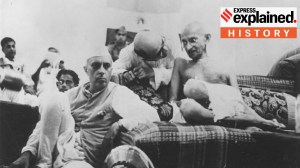
If one has to build a modern India by invoking the brutal past, theprescription is to rubbish the forces of assimilation and integration inIndian society. Finally, if the ICHR chairperson pays heed to Naipaul8217;sadvice, he would drop Gandhi from the history syllabus. That is becauseNaipaul regards the Mahatma as uneducated, and not a thinker. He has nomessage today, even though Indians have used the very idea of Gandhi to turndirt and backwardness into much-loved deities. The Hind Swaraj is sononsensical that it would curl the hair of even the most devoted admirer.
Mercifully, Jawaharlal Nehru is spared for being a democrat and a humaneperson who did not abuse his power.
Naipaul8217;s exposition is clumsy, naive and gibberish. He is as muchill-informed about India as Samuel Huntington is about the world outside theWestern hemisphere. He talks of India8217;s fractured past solely in terms ofthe Muslim invasions and the grinding down of the Hindu-Buddhist culture ofthe past. He mu-st know that celebrating the coming of the Turks or thevandalism of the Islamic zealots is nobody8217;s favourite pastime. Thehistorian8217;s job is to come to terms with Turkish, Afghan and Mughal rule,study their polities objectively, and examine the consequences of theirpolicies dispassionately. Fuming and fretting, which is what Naipaul does inthis interview, takes you nowhere. Anger, remorse and bitterness are not asubstitute for serious study and analysis.
We have both inherited and self-created problems and difficulties. But wemust have time and our own spaces to sort them out. Most of us wouldtherefore prefer not to be told, by people living in Mayfair Gardens orManhattan, how to move into the next millennium with our heads held high.Believe me, some friends living overseas can be our worst enemies.