In November 2001, in Thunderbolt, Georgia, a woman walked in on a burglar inside her house. The burglar sexually assaulted her at knifepoint and fled with her belongings in a stolen car.
The car belonged to Gujarati-American Sandeep ‘Sonny’ Bharadia, who had earlier reported his vehicle missing. The day of the crime, Bharadia was in Lithonia, a Georgian city at least 400 km away from Thunderbolt. Yet, a bizarre twist of fate and circumstances led to Bharadia being convicted of burglary and sexual assault in 2003. After two decades in prison, on May 16, at a hearing that lasted less than a minute in the Chatham County Superior Court in Georgia, Bharadia was finally exonerated of all charges.

“This should not happen to anyone,” Bharadia said as Senior Judge James F Bass read out the order clearing him.
“Okay,” replied the judge.
Two decades ago, it was the same court led by Bass that had convicted Bharadia.
(From left) Georgia Innocence Project (GIP) senior attorney Christina Cribbs, former GIP staff attorney and co-counsel Olivia Vigiletti, Sandeep ‘Sonny’ Bharadia and co-counsel Noah Pines of Ross & Pines.
On a videoconferencing call from the US, Bharadia talks to The Indian Express about his 22-year-long fight for justice. “It is surreal. You wait for something for so long and believe it will happen, but circumstances are so overwhelming that you fight against hope,” he says.
A nightmare begins
In the early 2000s, Bharadia, whose family has roots in Padana village of Gujarat’s Kutch district, worked as a sheet metal worker at air-conditioning job sites in Atlanta, Georgia.
Days before the incident that would upend his life, Bharadia was a happy man. He had just turned 27, had a girlfriend, earned a decent wage and spent his spare time in the gym.
Story continues below this ad
He had, however, called the police to report that his “acquaintance” Sterling Flint had “disappeared” with his car.
His stolen car and the assault-cum-robbery led the police to Flint, from whom they recovered the stolen goods. The victim too identified Flint as her attacker from a photo line-up. Bharadia’s attorney said Flint had used his vehicle to commit two burglaries and was also involved in a high-speed chase with the police in the same vehicle before crashing it.
Denying all accusations in the Thunderbolt case, Flint claimed Bharadia had given him the stolen goods for safe keeping. So the police organised a second photo line-up — Bharadia’s legal team says that this time, they only put his photo and not Flint’s. The victim identified Bharadia as her attacker, says his attorney.
According to the Georgia Innocence Project (GIP), which helped overturn Bharadia’s conviction, Flint pleaded guilty to burglary in exchange for immunity from the “aggravated sodomy and sexual battery” charge and a statement against Bharadia.
Story continues below this ad
There was still no physical evidence against Bharadia, says GIP Senior Attorney Christina Cribbs, who, along with a pro bono counsel, filed an amended habeas corpus petition (used in cases of illegal detention) in December 2022.
She adds that Flint and his girlfriend’s “incentivised” testimony, the “unreliable” second photo line-up and a pair of blue batting gloves worn by the attacker — the only item the victim recalled in her police statement — led to Bharadia’s conviction on charges of burglary, aggravated sodomy, aggravated sexual battery and theft by receiving on June 27, 2003.
Bharadia says: “I had given the investigators proof of my innocence: the calls I had made (that day), and my stops at Wendy’s (a fast-food restaurant) and a gas station (around 11.45 am). I was on (CCTV) cameras at these locations, but… the court relied on this guy (Flint’s) girlfriend (whose testimony said Bharadia had brought the goods stolen from the victim’s house to hers).”
A cutting-edge DNA test
Since the Georgia Bureau of Investigation required bodily fluids to conduct DNA tests and none was present, the gloves — that would eventually lead to Bharadia’s exoneration — were not tested at the time of his trial. When his attorney reached out to the GIP, they suggested the “touch” DNA test, then a cutting-edge procedure that tested for DNA from skin cells left on surfaces.
Story continues below this ad
Bharadia says, “My attorney asked if I was sure because the results could be the final nail in my coffin. ‘I am innocent,’ I wrote back in big letters on a sheet of paper.”
The attorney sent the glove to a laboratory in California, almost 4,000 km away, to obtain a DNA profile and compare it with a sample from Bharadia. The two DNA samples were not a match. In 2004, the attorney moved a plea seeking a sample from Flint, but his plea was denied.
The development left Bharadia “crushed”. He says, “In TV shows, when a DNA test comes back negative, the person is set free. For me, there was hurdle after hurdle after hurdle. I was even denied a new trial.”
The first breakthrough came eight years later, in 2012, when the DNA profile matched with someone else after it was run through CODIS (the national DNA database): Flint.
Story continues below this ad
Bharadia’s case then went all the way to the Georgia Supreme Court, which ultimately decided against him, partially on the grounds that his counsel had not insisted on a DNA test for the gloves during the 2003 trial, although “touch” DNA testing was not routinely performed by the Georgia Bureau of Investigation until 2015, over a decade after Bharadia’s trial.
The GIP and a pro bono counsel filed an amended habeas corpus plea in December 2022. An evidentiary hearing was held on June 20, 2023. On April 9, 2024, an order of Gwinnett County Judge Laura Tate overturned his conviction, stating that Bharadia’s “constitutional rights were violated”. Once again, his case was sent back to the Chatham County District Attorney’s Office to determine whether it wanted to prosecute Bharadia. As the state’s decision was awaited, he was released in November 2024. On May 16, 2025, the state dismissed all charges against him.
Attorney Cribbs says, “Although the court exonerated Bharadia in its final order, Flint was never arrested or held accountable for the crime despite the DNA evidence.”
She says a new legislation that came into effect in the US on July 1 will make Bharadia eligible to move an application for compensation from the state for unlawful incarceration, “but the process would be long”.
Story continues below this ad
‘Attacked in jail, family cut ties’
Stating that his initial years in jail were “full of turmoil”, Bharadia says he faced attacks by aggressive prison gangs, including getting stabbed in the ear. Having served his term in a “high-security prison”, he recalls, “My biggest fear was dying there. It was like trying to survive in a jungle. I was surrounded by hardened criminals. They had illegal arms, which they used to run gangs inside. I never met another Indian man in prison. I got stabbed in the ear once. They (the inmates) are aggressive. I stayed in touch with my family using the phones the other inmates had (smuggled in).”
His family drifted away.
“My sister, who stays in London, cut ties with me. The hardest was losing my father 10 years ago. My mother says she saw him cry only once in the 45 years they were married — when I was arrested. Though we made peace just before he passed away, I could not attend his funeral,” he says.
Despite his Indian roots, Bharadia has never visited India. “My family has not lived in Gujarat for generations now. Most of them are in London now. My father was born in Africa, my mother in Uganda. He moved to London in the early 1970s. They migrated to the US in 1984.”
Since his exoneration, Bharadia has been living with his mother, nearly 75. Stating that he still “hasn’t fully processed the ordeal I went through” he says, “She is glad to see me out of prison. I am not in touch with most of my family members now.”
Story continues below this ad
On his future plans, Bharadia says, “I saw my 20s, 30s and 40s go by in jail. I will be 51 soon. I grew up in a Gujarati-speaking household, but forgot the language in prison. Maybe I will pick up the language again.”


 8 min read




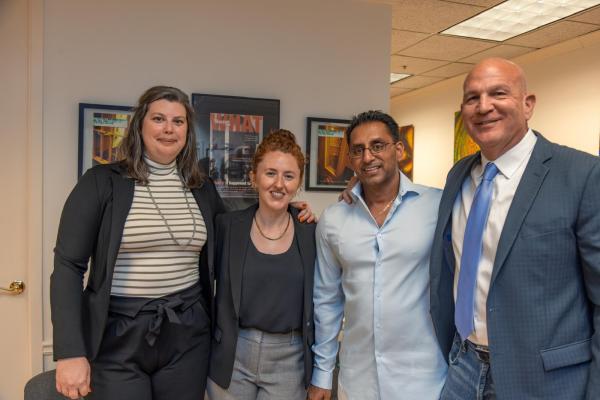 (From left) Georgia Innocence Project (GIP) senior attorney Christina Cribbs, former GIP staff attorney and co-counsel Olivia Vigiletti, Sandeep ‘Sonny’ Bharadia and co-counsel Noah Pines of Ross & Pines.