Journalism of Courage



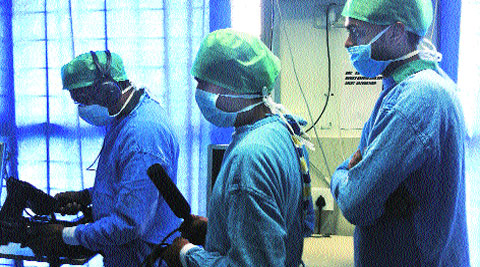
 A still from the film
Agitated by the monsoon, the waves crashed harder on the shore as Gopinathan decided his course of actions. Suicide, he thought, was the way out. The breathlessness he had felt while walking had been a subtle pointer in the direction that he needed a kidney transplant, and he couldn’t arrange one. Then stepped in his parish priest Father Davis Chiramel, offering Gopinathan his kidney. A tale of dejection followed by hope — that is the beginning of the film To Give or Not To Give (2014) by Delhi-based filmmakers S Kumar and Malgorzata Skiba.
Scheduled to be screened today at India International Centre (IIC), the documentary centres on organ donation. “In October 2012, we lost a dear friend when he didn’t find an organ donor. The same day I read about the entire village of Pootharakkal (in Kerala), whose people had volunteered to be organ donors. It made us want to highlight the issue,” says Skiba.
Made over one year, the 52-minute documentary was shot primarily in Kerala and Delhi. Interspersed are interviews with medical specialists, those on the waiting list for donations, donors and their families. “Initially, the film was meant to be 27 minutes, but the issue is so vast that we had to make it longer. It’s not just the social, medical or legal components, but its complexity that makes it so highly sensitive,” says Poland-born Skiba.
 S Kumar and Malgorzata Skiba
One of the many people substantiating Skiba’s point in the film is Dr Sanjay Kumar Agarwal, Professor and Head of Nephrology at All India Institute of Medical Sciences. “Across the world in big cities, 10 per cent of the adult population has some degree of chronic disease. At any point of time in India approximately 4.5 to 5 lakh of people require renal replacement therapy. Even with medical treatment, they can’t survive for more than three-four weeks without a donor,” says the doctor.
Among many projects, the filmmaker couple directed Chitraanjali (2012), a film about Polish artist Stefan Norblin, who fled to India after Hitler attacked Poland during WW II, and Autumn in the Himalayas (2008), which documented the struggles of elderly Buddhist nuns in Ladakh. A graduate of the Jagiellonian University of Krakow, Poland, Skiba, first came to India in 1995 to document the Kumbh Mela. That when she met her husband S Kumar, a graduate of the Film and TV Institute of Tamil Nadu. For their next documentary, the filmmakers plan to tell the tale of a Polish social worker who worked in India and Sri Lanka. To Give or Not To Give will also be screened on Doordarshan soon.
The film will be screened as part of PSBT’s Open Frame on Sunday at IIC, 4pm onwards. Contact 24619431

 3 min read