Journalism of Courage



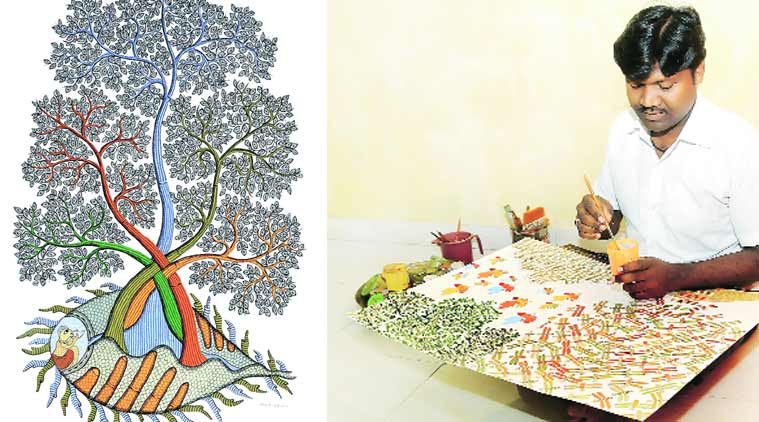 Sukhnandi Vyam Pardhan’s art stand out due to its use of less-common motifs and icons
Sukhnandi Vyam Pardhan was nine years old when he made sculptures on the walls of his home in Madhya Pradesh’s Dindori district. This marked his first brush with art. Born into the Pardhan community — which belongs to the Gond family, the largest tribal group in India — Vyam grew up in a place where painting is less of an individual discovery and more a shared tradition.
Inspired by the age-old myths, customs and songs that characterise the life and culture of the Gond people, painting emerged as an act of preserving and celebrating that heritage. For Vyam, whose first solo show in Mumbai, “Sacred Roots”, opens on August 11 at Artisans’, Kala Ghoda, painting also carries the hope of sharing his tribal art with a world larger than the one that gave form to it.
Acknowledged for his work with wooden sculptures, the Bhopal-based artist now focuses more on the medium of painting. The conceptual and narrative nature of his art, however, remains consistent in both. Of the 40 paintings that have been curated for the exhibition, many are interpretations of the same, larger mythology or ritual and yet each tells a story that is distinct from the other. “The tales, rituals and songs that my paintings are about all originate from my Pardhan Gond community, but I take only certain elements from the longer story and work with that. Even with that selected element, I do not represent it literally but with some imagination and interpretation of my own,” says the artist, who uses the combination of a pen and acrylics to create works that are vivid in detail and colour.
The nephew and student of the late Jangarh Singh Shyam, Vyam was introduced to the practice of tribal art by the very first Gond artist to have gained international recognition. “It is because of him that I learnt art, and I have come from painting the walls in my village to the forefront of sharing my work with art lovers across India,” says the 32-year-old artist, considered an emerging talent in indigenous art.
The strength of Vyam’s art is rooted in its hybrid thought process, where ancient oral histories meet with independent vision. Trees with feet of their own, leaves with embedded eyes, and raindrops rendered as fish form are a few of the images that depict Vyam’s personification and animism of nature through intricate patterns of lines and dots.
Each painting — with its representations of nature, deities, animals and seasons — is replete with context, raising the issue of its readability when left to the urban viewer alone. But the same issue — when addressed in the context of a gallery — captivates the attention of the audience, enforcing them to seek an understanding of the work, and ensuring that indigenous art is appreciated for reasons beyond the aesthetic. “When it’s found in craft bazaars, it loses its value and is treated as something that is simply pretty and handcrafted, whereas it goes much beyond that,” says Radhi Parekh, director of Artisans’, which promotes the less-exposed names in art, craft and design. Artisans’ will also host a lecture series by speakers from the Talking Myths Project, a group dedicated to documenting traditional tales from the Indian subcontinent.
Like most art where evocative imagery holds the power to transcend the stories they represent, Vyam’s paintings possess similar strength. What Parekh describes in his works as “the obvious reverence for the natural world, and the affinity and intimacy with it,” is a relationship that requires no context. Vyam’s ability to generate that experience speaks for the presence of the artist’s individual expression and voice within a tradition of art often deemed as lacking one.

 4 min read