4 min read
© IE Online Media Services Pvt Ltd



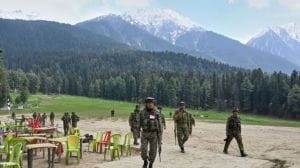
 Himachal Pradesh High Court order: The Himachal Pradesh High Court said that the assertion regarding alleged tantrik was not established. (Image generated using AI)
Himachal Pradesh High Court order: Observing that the “treatment from tantriks” could not be accepted as a valid ground to justify prolonged absence the, Himachal Pradesh High Court recently upheld dismissal of a woman trainee constable by the state government.
Referring to the documents placed on record, justice Ranjan Sharma said, “Records reveal that the petitioner had taken a stand that she remained under-treatment from tantriks cannot be accepted as a permissible ground, to obviate the petitioner charge of wilful absence.”
The court said that the conduct of the petitioner being “incorrigible” definitely pointed towards the “wilful absence” — an act “solely” attributable to her.
In 2010, one Sapna Devi was appointed as a constable in Bilaspur district following which, she had to undergo the training according to the rules.
She remained absent for 48 days — between February 19 and April 6, 2010 — from the training but submitted medical certificates only for 13 days and continued to be absent.
Devi was served notices with a direction to resume training on April 22, 2010 which she failed to comply with.
On May 28, 2010, she was suspended, a departmental inquiry was initiated under the Punjab Police Rules and two charges of wilful absence were framed- one for the period of February 20 to April 6, 2010 for 48 days and another from April 23 to May 31, 2010 for 39 days.
Devi was issued a show cause notice on August 6, 2010 and granted 15 days to respond but she did not file any reply and was discharged from service on August 25, 2010.
After four years, she filed an appeal to the director general of police on November 29, 2014 which was rejected on April 22, 2015.
Following this, Devi moved the high court seeking the quashing of her discharge order and the appellate order, on the ground that her absence was due to illness.
Plea that she remained under treatment of “tantriks” cannot be accepted as it is not permissible for seeking such treatment to validate absence, the court said.
Rejecting her arguments of being a “poor lady” and “at the verge of starvation”, the court said that sympathy cannot overturn legally valid action.
Saying that the assertion regarding alleged tantrik was not established, as neither such person was summoned nor examined, the court said nothing of this sort was led in evidence.
The court said that the record clearly revealed no admissible medical evidence.
The court observed that her conduct was borne out of her wilful absence and that there were no infirmities in her discharge orders as well as in the rejection of her appeal by the DGP.
The findings of the inquiry report were never challenged in the writ petition and she also failed to reply to the show cause notice issued after the inquiry report.
The petitioner failed to prove during departmental inquiry that the absence was not wilful but was for reasons beyond her control.
The only derivable conclusion is that the petitioner was incorrigible to be an efficient police officer, the court added.
Referring to the Punjab Police Rules, the order dated November 18, said, “A constable who is found unlikely to prove an efficient police officer may be discharged by the Superintendent at any time within three years of enrolment. There shall be no appeal against an order of discharge under this rule.”