


Stay updated with the latest - Click here to follow us on Instagram
Tags:


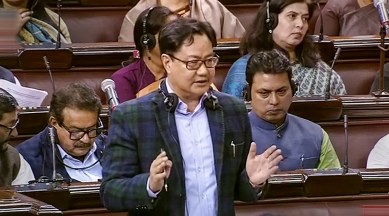
Union Law Minister Kiren Rijiju on Thursday told the Rajya Sabha that the issue of vacancies and appointments in the higher judiciary would continue to linger till the time a new system is created for the same.
Rijiju, while responding to queries in the Rajya Sabha during the ongoing Winter Session of the Parliament, said the Centre has limited power over the appointment of judges.


Answering supplementaries during the Question Hour, Rijiju further said that the total number of cases pending in various courts is about to touch five crore, a number whose impact on the public is obvious. He pointed out that the Centre has taken various measures to reduce the pendency of cases. “We are giving our full support to reduce pendency of cases. But questions will keep arising on vacancy of judges and appointments till we create a new system for appointments,” he added.
“Currently, the government has limited powers to fill the vacancies (in courts),” he said and added that the Centre cannot look for names other than those recommended by the collegium. Rijiju also told the House that requests, both verbally and in writing, have been made to the chief justices of the Supreme Court as well as high courts to send names at the earliest for filling up the vacancies of judges.
Asked if the government will revive the National Judicial Appointments Commission (NJAC) Act, Rijiju said several retired judges, prominent jurists, advocates, lawyers and leaders of political parties have opined that the striking down of the Act by a five-member Constitution bench of the Supreme Court was not correct.
In order to make the collegium system for appointment of judges to the Supreme Court and high courts more broad-based, transparent, accountable and for bringing objectivity in the system, the government enacted the Constitution (Ninety-Ninth Amendment) Act, 2014 and the National Judicial Appointments Commission Act, 2014 with effect from April 13, 2015.
However, the Acts were challenged in the apex court, which, through a judgment dated October 16, 2015, declared both Acts as unconstitutional and void.
Rijiju’s response in the Upper House came amidst a row between the judiciary and Centre over judicial appointments. The Supreme Court collegium on Tuesday recommended five names to the Union government for elevation as top court judges, an announcement that came amid the apex court criticising the Centre for not acting swiftly on the Collegium’s recommendations.
Meanwile, a Parliamentary panel earlier this week said it is “regrettable” that the judiciary and Centre are not adhering to the timeline for appointing judges to High Courts and the Supreme Court. The Centre, on the other hand told the Supreme Court that binding the President of India to a timeline in matters of judicial appointments is “not appropriate”. The Centre has also flagged concerns about appointing retired judges to tackle the massive pendency of cases across high courts.
With inputs from PTI


Stay updated with the latest - Click here to follow us on Instagram


