Journalism of Courage



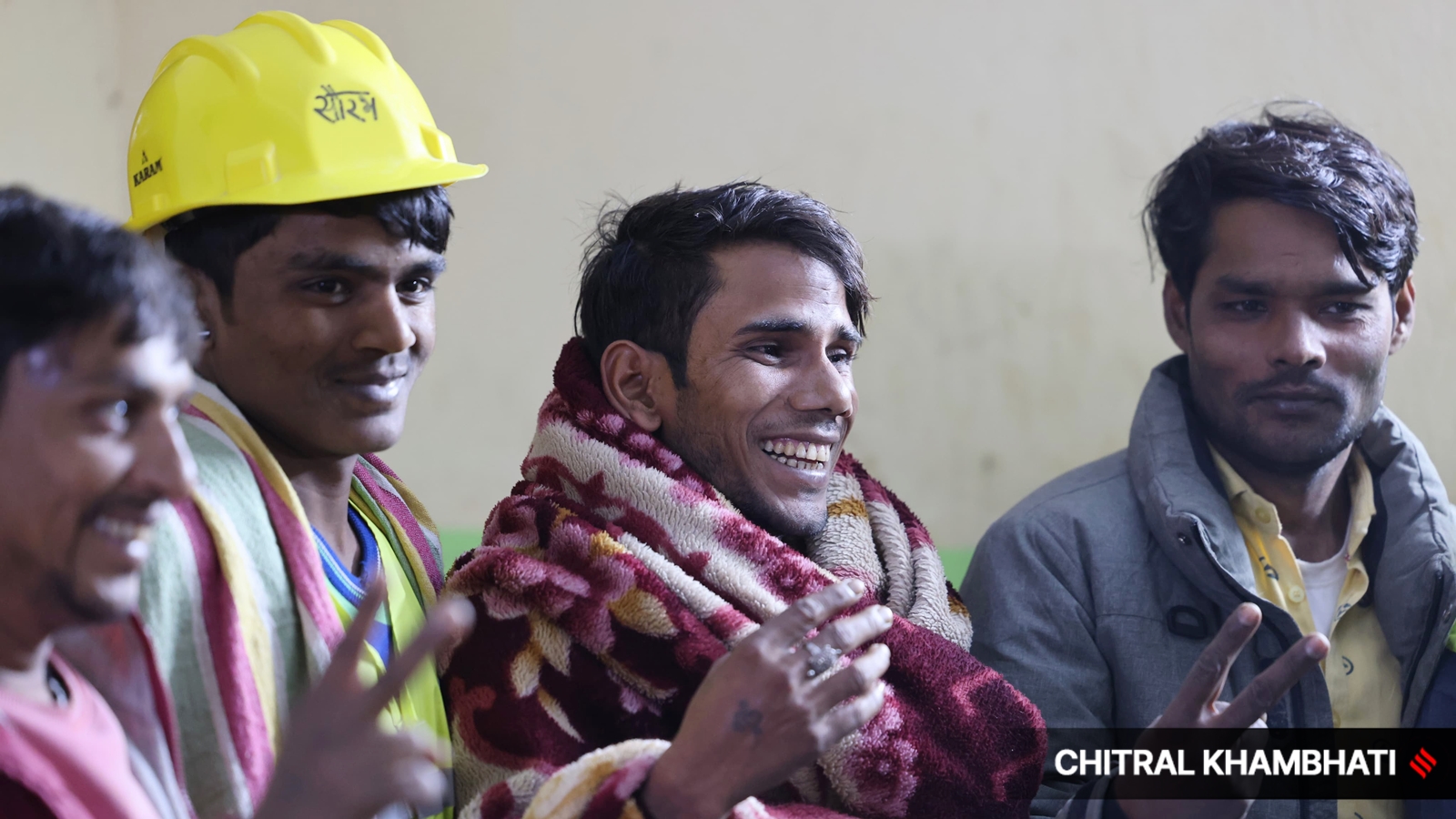 Rat-hole miners after the completion of the rescue operation of 41 trapped workers in the collapsed Silkyara-Barkot tunnel in Uttarakhand on November 28. (Express photo by Chitral Khambhati)
 The head of the company whose employees dug the last stretch of the Uttarakhand tunnel that led to the rescue of 41 trapped workers on Tuesday has underscored the diversity of faiths in his team, saying the job couldn’t have been done alone.
Speaking to The Indian Express, Vaqeel Hasan, who owns Delhi-based Rockwell Enterprises, said: “In our team, there are both Hindus and Muslims, and people from both religions worked hard to save these 41 lives. None of them could have done this alone, and this is the message I want to give to everyone… We should all live in harmony and not spread the poison of hate. We all want to give our 100 per cent for the country… Please convey my message to everyone.”
Twelve people from his company – six from Delhi and six from Uttar Pradesh’s Bulandshahr – were called into action when the drilling machine gave way. Between Monday and Tuesday, they dug roughly 12 metres in cramped pipes to reach the trapped men.
The rescuers – Hasan, Munna Qureshi, Naseem Malik, Monu Kumar, Saurabh, Jatin Kumar, Ankur, Nasir Khan, Devendra, Firoz Qureshi, Rashid Ansari and Irshad Ansari – are aged between 20 and 45.
These men are adept at maneuvering through narrow pipes and excavating soil – a skill integral to their work with the Delhi Jal Board. Typically, workers in this line of work are called “rat holeminers”.
On Wednesday evening, their bags were packed and they were ready to leave Silkyara. “We work for the Delhi Jal Board and our job is to enter pipes like mice and dig the soil. Two of the workers would go inside the pipe so that one could do the digging and the second could fill that in a bucket for the others to remove. Once some space is created, the pipe is pushed further,” Hasan said.
 View of the Silkyara-Barkot tunnel in Uttarakhand, after the completion of the rescue operation of 41 trapped workers, on November 29. (Express photo by Chitral Khambhati)
Talking about the difference in their job and the rescue operation, he said that inSilkyara, the pressure to save lives only motivated them further.
“Lives were at stake here. More than 140 crore people, along with the whole world, were counting on us. It created pressure, but it also gave us the motivation that we must do this and there is no scope for failure or getting lazy or tired… It took us around 26-27 hours to dig through around 12-15 metres. In normal circumstances, with the same kind of soil and work conditions, we would normally take 10-15 days. But here we were not just working, but saving lives,” he said.
The team was working in four shifts of six hours each to make sure work went on continuously.
“In our field, a small and lean body size and great stamina is a must. In this case, too, the pipes were just 800mm wide and the boys needed space to move their hands. They needed to use hand-held tools, remove the muck, fill them into buckets, and get them out of the pipes,” said Hasan.
He said they did not take any money or salary for the work. “We did not want any money in exchange for this work. This was not any other job for us but a mission to save 41 lives. The company that called us, however, provided the travel fare. We were approached by Navayuga through our senior, who said we are needed in Uttarkashi. We immediately agreed,” he said.

 4 min read