Journalism of Courage



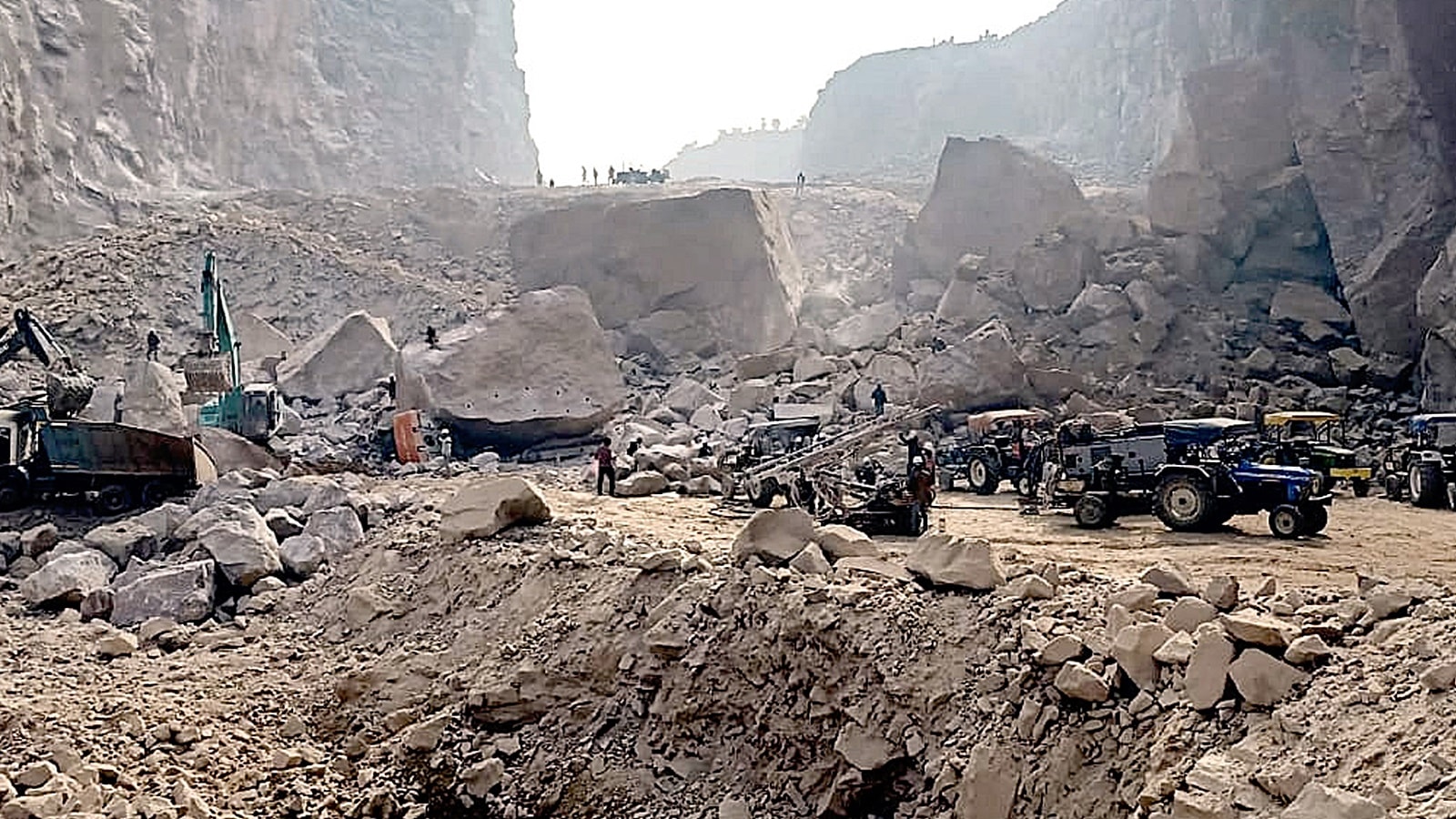 In 1989, the seven-judge Bench held that the primary authority over “regulation of mines and mineral development” lies with the Centre in accordance with laws enacted by Parliament, such as the MMDR Act, under Entry 54 of the Union List (List I). (Express Archives)
In an 8-1 majority ruling Thursday, a nine-judge Constitution Bench of the Supreme Court upheld the power of states to levy royalty on extraction of minerals from their land and said they can also tax the lands which comprise mines and quarries.
The majority verdict, delivered by Chief Justice of India D Y Chandrachud writing for himself and Justices Hrishikesh Roy, A S Oka, J B Pardiwala, Manoj Misra, Ujjal Bhuyan, Satish Chandra Sharma and Augustine George Masih, overruled the 1989 decision of a 7-judge Bench in India Cement Ltd vs State of Tamil Nadu which said royalty is tax and state legislatures lack competence to levy taxes on mineral rights because the subject matter is covered by the Minerals and Mines and Minerals (Development and Regulation) Act, 1957, enacted by Parliament in exercise of powers under Entry 54 of List I (Union List) of the Constitution.
The majority ruling said royalty, as envisaged under Section 9 of the 1957 Act, “is not in the nature of tax”.
It said Parliament can even prohibit states from taxing mineral rights by virtue of Entry 50 of List II (State List), but pointed out that “there is” however “no specific provision” in the 1957 Act that governs the field “which imposes limitations on the power of the states to tax mineral rights”. That being so, “the scheme of the MMDR Act cannot, by a process of stretched construction, be read to limit the taxing powers of the state under Entry 50 of List II,” it said.
Entry 50 of List II concerns “taxes on mineral rights subject to any limitations imposed by Parliament by law relating to mineral development”.
On tax on lands containing quarries or mines, the majority ruling said states can do so under Entry 49 of List II which concerns “taxes on lands and buildings”.
Disagreeing with the majority ruling, Justice B V Nagarathna, in her dissenting judgment, cautioned against the likely consequences of overruling the India Cement verdict including a “breakdown of the federal system” and “unhealthy competition” between states.
In the India Cement ruling of 1989, a 7-judge bench concluded that royalty was a tax. But in 2004, in the Kesoram Industries case, a 5-judge bench said royalty was not a tax. The matter was eventually sent to a 9-judge bench.
CJI Chandrachud, writing the majority ruling, said, “Indian federalism is defined as asymmetric because it tilts towards the Centre, producing a strong Central Government. Yet, it has not necessarily resulted in weak State governments. The Indian States are sovereigns within the legislative competence assigned to them. In a federal form of government, each federal unit should be able to perform its core constitutional functions with a certain degree of independence. The Constitution has to be interpreted in a manner which does not dilute the federal character of our constitutional scheme. The effort of the constitutional court should be to ensure that State legislatures are not subordinated to the Union in the areas exclusively reserved for them”.
The majority ruling said “the enumeration of taxes on mineral rights in List II is an entrustment to the states” and underlined that the court “is bound to abide by the constitutional distribution of legislative powers”.
Entry 50 in List II, the majority ruling said, “is subordinated only to the extent of any limitations that may be imposed by Parliament by law relating to mineral development,” and “unless Parliament imposes a limitation, the plenary powers of the state legislature to impose taxes on mineral rights is unaffected.”
“Since royalty payable under Section 9 (of MMDR Act) is not a tax on mineral rights, any limitation on the enhancement of the rates of the royalty is not the imposition of the tax under Entry 50 of List II,” it said.
Holding that Parliament has the power to even prohibit states from taxing mineral rights, it said Entry 50 of List II “specifically uses the phrase ‘any limitations’.” It said “the framers of the Constitution intended to empower Parliament to impose all and every possible limitation on the taxing power of the state in the interest of mineral development, which may include even a prohibition”.
Justice Nagarathna, on the other hand, upheld the 1989 India Cement ruling and said “viewed from the statutory framework of the MMDR Act, 1957 passed by the Parliament on the strength of Entry 54-List I of the Seventh Schedule of the Constitution of India and having regard to Section 2 of the said Act, royalty is in the nature of a ‘tax’ or an ‘exaction’.”
She said “Entry 49-List II is also not applicable to mineral bearing lands”.
Touching on the likely consequences of not holding royalty to be tax and allowing states to tax land on which there are mines etc, Justice Nagarathna said “this would result in mineral development in the country in an uneven and haphazard manner and increase competition between the states and engage them into what has been termed by Louise Tillin (professor at King’s India Institute) in a ‘race to the bottom’ in a nationally sensitive market.”
She said “there would be unhealthy competition between the states to derive additional revenue and consequently, the steep uncoordinated and uneven increase in cost of minerals” may even lead to “the national market being exploited for arbitrage”.
“The steep increase in prices of minerals would result in a hike in prices of all industrial and other products dependent on minerals as a raw material or for other infrastructural purposes. As a result, the overall economy of the country would be affected adversely which may result in certain entities or even non-extracting states resorting to importing minerals which would hamper foreign exchange reserves of the country. There would lead to a breakdown of the federal system envisaged under the Constitution in the context of mineral development and exercise of mineral rights. It could also lead to a slump in mining activity in states which have mineral deposits owing to huge levies that have to be met by holders of mining licences,” she said.
Justice Nagarathna said “overruling the judgment in India Cement would mean that all judgments which are akin to the ratio of India Cement, whether prior to or subsequent thereto, stand overruled irrespective of whether they are the judgments of the High Courts or this Court. Consequently, all states would once again start levying taxes on mineral rights under Entry 49-List II and thereby bypass Entry 50-List II so as to not be bound by any limitation that the Parliament had imposed by law on the power of the states to levy taxes on mineral rights.”
“The circle would come around when Parliament would have to again step in to bring about a uniformity in the prices of minerals and in the interest of mineral development so as to curb the states from imposing levies, taxes, etc. on mineral rights… There would then be legal uncertainty which would cause adverse economic consequences including on mineral development in India,” she said.

 7 min read