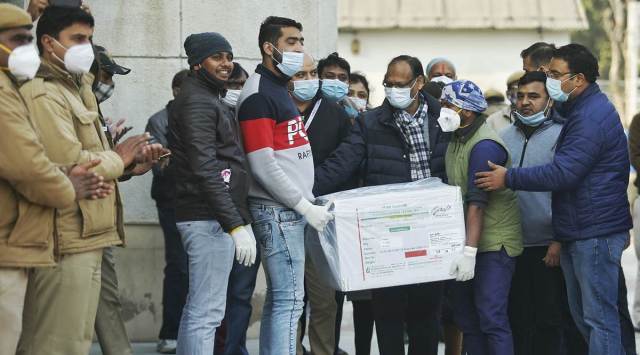
With limited doses of Covid-19 vaccines available initially, the Centre on Tuesday said states will not have the option to choose which vaccine to administer to its priority groups.
As of Tuesday, 54.72 lakh doses of the two vaccines cleared for use by the national regulator had reached vaccine stores across the country, the government said.

“As we speak 54.72 lakh doses have been received at the points; and 100 per cent doses, which is 1.1 crore from SII and 55 lakh from Bharat Biotech, will reach by January 14,” Union Health Secretary Rajesh Bhushan said.
Orders with the vaccine suppliers will be staggered, Bhushan said. “The manufacturers are aware of this,” he said.
Replying to a specific question on whether states or priority-group beneficiaries would have the option to choose between Covishield and Covaxin, the Health Secretary said, “Across the world, in many countries, multiple vaccine candidates are being administered. No such option is still available to the beneficiary (to choose a vaccine).”
As a special gesture, Bharat Biotech is offering 16.5 lakh doses to the central government for free. “In India, 110 lakh doses of Covishield vaccine are being procured from Serum Institute at the cost of Rs 200 per dose, and 55 lakh doses of Covaxin are being procured from Bharat Biotech,” Bhushan said.
“The cost of 38.5 lakh doses of Covaxin is Rs 295 per dose, and they are providing 16.5 lakh doses free of cost to the central government as a special gesture. Hence, the cost of Covaxin is Rs 206 per dose,” Bhushan said.
Story continues below this ad
A state-level regional vaccine store has been established in each state, where the doses are expected to reach at least two days before the rollout, Bhushan said. “However, a few bigger states and UTs have more than two regional stores – Uttar Pradesh has 9, Madhya Pradesh 4, Gujarat 4, Kerala 3, Karnataka 2, Rajasthan 2, and Jammu & Kashmir 2,” he said.
The price at which the government is procuring the vaccines is significantly lower than the current prices globally, Bhushan said.
“The price of a single dose of the Pfizer vaccine, which has got emergency use authorisation in many countries, is Rs 1,431; here were are not including the overhead cost and taxes as that information is not available in public domain. The cost of a single dose of Moderna’s vaccine is in the range of Rs 2,348 to 2,715; the Chinese vaccines developed by Sinopharm and Sinovac Biotech cost Rs 5,650 and Rs 1,027 per dose respectively. The per dose cost of Sputnik V and the vaccine developed by Johnson & Johnson is Rs 734.”
Dr Balram Bhargava, Director-General of the Indian Council of Medical Research (ICMR), said India will administer two doses, four weeks apart.
Story continues below this ad
“Currently, the recommendations are very clear that two doses will be given at day 0 and 28. There is some literature that you can give [the second dose] up to six weeks [after the first dose]. Some countries are discussing if it can be given at a bigger gap. But at the moment we would like to stick to 4 weeks,” Dr Bhargava said.
Bhushan emphasised that “due to limited availability of doses in the initial phase”, the “rollout will be sequential and will depend on the availability”.
Also, he said that states must be mindful of the fact that the effectiveness of the vaccine will be observed only after the second dose has been administered. “The most important thing is that there is a gap of 28 days between two doses, and it is only after 14 days after the second dose that effectiveness begins. Therefore, states must highlight this aspect and that Covid appropriate behaviour is a must,” Bhushan said.
“Our expectation from the state governments is that all logistics to be ready for Covid-19 vaccination rollout from January 16. We also expect that states, at the highest level, will exercise continuous oversight and personal involvement on the entire process of the rollout. We are country of more than 130 crore, and this rollout has to be monitored at every level,” he said.


 4 min read