





 Indian Prime Minister Narendra Modi addresses the 74th session of the United Nations General Assembly, Friday, Sept. 27, 2019, at the United Nations headquarters. (AP Photo)
PM Modi at UNGA 2019 highlights: A day after Imran Khan used the United Nations platform to criticise India and warned of a “bloodbath” in Kashmir, India Saturday shot back at the Pakistan Prime Minister and asked if his government will admit that it is the only one in the world that provides pension to global terrorists.
Exercising India’s right to reply to Khan’s address to the United Nations General Assembly, Vidisha Maitra, First Secretary MEA, said, “Will Pakistan acknowledge that it is the only government in the world that provides pension to an individual listed by the UN in the Al-Qaeda and Daesh sanctions list?”

While addressing the 74th session of the UNGA, Prime Minister Narendra Modi had described terrorism as one of the biggest challenges before humanity. “We believe this is one of the biggest challenges not for one single country but for the entire humanity. The lack of unanimity among us on the issue of terrorism dents those very principles that are the basis of the creation of the UN. That is why for the sake of humanity, I firmly believe that it is absolutely imperative that the world stands as one against terrorism,” PM Modi said.
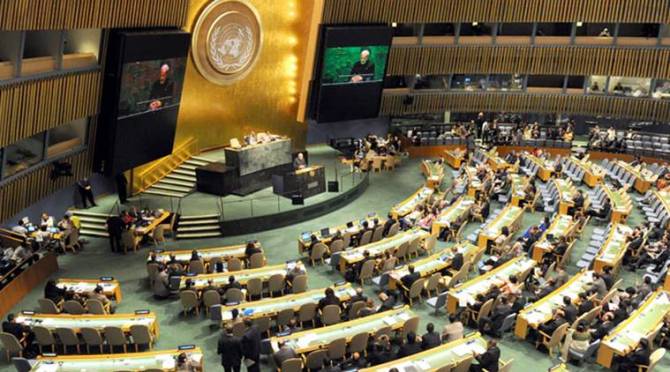 PM Modi addressing the 69th session of the United Nations General Assembly in 2014.

A day after Imran Khan used the United Nations platform to criticise India and warned of a “bloodbath” in Kashmir, India Saturday shot back at the Pakistan Prime Minister and asked if his government will admit that it is the only one in the world that provides pension to global terrorists. Exercising India’s right to reply to Khan’s address to the United Nations General Assembly, Vidisha Maitra, First Secretary MEA, said, “Will Pakistan acknowledge that it is the only government in the world that provides pension to an individual listed by the UN in the Al-Qaeda and Daesh sanctions list?”
Prime Minister Narendra Modi boards his flight to Delhi. His flight will take a technical halt in Frankfurt, Germany on its way to Delhi.
Prime Minister Narendra met Bangladesh PM Sheikh Hasina. The leaders reiterated their zero tolerance approach to terrorism & violent extremism, and agreed that a strong partnership in security had built trust and mutual confidence between the two countries. Hasina also extended an invitation to PM Modi to visit Bangladesh, and suggested that it could be undertaken also in connection with the birth centenary of Bangbandhu Sheikh Mujibur Rahman. The invitation was accepted by Prime Minister Modi.
After Pakistan Prime Minister Imran Khan criticised India's actions in Kashmir and presented its case about the entire escalation of hostility after the attack on CRPF convoy in Pulwama, India will use the right to reply in the United Nations General Assembly.
"Has PM Modi thought what would happen when the curfew in Kashmir is lifted? Do you think people in Kashmir would accept that you have withdrawn the special status? Thousands of children in Kashmir have been put under detention. They, too, will come out on the streets after the curfew in the state is lifted and the Army will shoot them," Pakistan Prime Minister Imran Khan said during his UNGA address. He also said that whatever happens in Kashmir after the curfew is lifted, there will be another terror attack like Pulwama and Pakistan will be blamed.
"India blamed us immediately after Pulwama attack. I requested the Indian government to present an iota of evidence about Pakistan's involvement, rather they sent jets and they bombed us. We retaliated, one of their pilots bailed out. We immediately returned the pilot because we want peace. Instead of taking it as a peace gesture, Mr Modi launched his entire campaign about saying that they have taught Pakistan a lesson," says Khan.
"We had joined the United State's war on terror and Pakistan went through its worst period in which 70,000 Pakistanis died and more than 150 billion was lost to our economy. I oppose the war because, in the 1980s, Pakistan had joined the Western countries in what was the freedom struggle in Afghanistan against the Soviets. And it was funded by the Western countries. These Mujahid groups which were trained in guerilla warfare by the Pakistani Army and funded by western countries were led by the US. The Soviets called them terrorists, we called them freedom fighters. In 1989, the Americans packed up their bags and left. After 9/11, we joined the war on terror, and we had to convince these Mujahids that this is not jihad anymore. Pakistan had to suffer a lot in the aftermath," says Khan.
"Islamophobia gained ground after 9/11. There's no such thing as radical Islam. If you analyse the history of suicide bombing, you'll notice that most of the suicide bombings were done by Tamil Tigers (LTTE) who are Hindus. Nobody questioned them by saying that these are radical Hindu terrorists. And rightly so. No religion teaches violence. Similar is the example of Japanese Kamikaze suicidal pilots. You should not marginalise Muslims because it is marginalisation that leads to radicalisation," says Imran Khan.
Unless rich countries build walls to prevent corrupt, economic elites from parking their ill-gotten wealth in tax havens, Pakistan will suffer. Why should tax havens be allowed at all? Sooner or later you're going to have a big crisis if the rich keeps getting richer and the poor get poorer, says Imran Khan.
"My optimism about climate change comes from the fact that Almighty has blessed us with great powers. We planted a billion trees in our country to make a change. But a single country can't achieve much alone. Richer countries must take the lead in combating the dangers of climate change," says Imran Khan.
"Honoured to represent my country on a forum where we come together to discuss problems. There are some very difficult problems that the world must confront. Climate change is one of the biggest problems today. Pakistan is one of the top ten countries that are most adversely affected by climate change," says Imran Khan.
Prime Minister Modi said the largest number of supreme sacrifices made by soldiers of any country for UN peacekeeping missions is from India. At least 160 Indian peacekeepers have been killed while serving with the United Nations Peacekeeping Missions.
"Terrorism poses serious challenges not merely for a single country but it is a threat that endangers the founding principles of the United Nations. In such a situation, a fragmented world is in the interest of no single country. Our voice against terrorism to alert the world about this evil rings with seriousness and outrage. We believe this is one of the biggest challenges not for one single country but for the entire humanity. The lack of unanimity among us on the issue of terrorism dents those very principles that are the basis of the creation of the UN. That is why for the sake of humanity, I firmly believe that it is absolutely imperative that the world stands as one against terrorism," says PM Modi.
"If you look at the per capita contribution to global warming, India's contribution is very less as compared to other countries," says Modi.
PM Modi talks about India's achievements in curbing open defecation and discouraging the use of single-use plastics. "In the next five years, we are going to build 1,25,000 kms of roads. India is a great culture that is thousands of years old. It has encompassed universal dreams, our culture focuses on seeing divinity in every being. As as a result, public welfare is embedded in our cultural values," says PM Modi.
"The largest democracy in the world elected me to serve for a second term with an even larger mandate," says PM Modi.
"If you want to go fast, go alone but if you want to go far, go together," says Indonesia Vice President.
"Many commitments in the UN Charter continue to be unfulfilled, even more so, infringed by powerful UN members. One of the most neglected commitments that continue to be the concept of sovereignty. Mutual respect between countries is essential for world peace," says Muhammad Jusuf Kalla.
Indonesia Vice President Muhammad Jusuf Kalla says that multilateralism is the most important founding value of the United Nations. "No country can solve global problems all by themselves. It is multilateralism that has prevented the outbreak of another World War," says Kalla.
Minutes before his address at the United Nations General Assembly, Prime Minister Narendra Modi tweeted about his upcoming speech.
The global security threats continue to grow. The situation is worst ever since the end of the Cold War. There are several economic tussles taking place between powerful countries, the arms race is also aggravated. This new normal in international relations is also concerning. It is important to underline that the Israel-Palestine peace process in alarmingly halted., says Mauritius President.
Acidification and pollution of our oceans are taking place at an alarming rate. Also, piracy, drugs trade, human trafficking continue to be concerned in our parts of the Indian Ocean. There are growing maritime threats in our region, says Mauritius President.
"Climate change continues to affect nations' economies. No country is immune to the disastrous effects of climate change. We need to renew and strengthen our commitments to limit global warming and need to double our use of renewable sources of energy," says Mauritius President Paramasivum Pillay Vyapoory.
Foreign Secretary Vijay Keshav Gokhale Thursday said Prime Minister Narendra Modi, who is leaving for the US Friday, will not discuss the issue of Article 370 at the United Nations and will focus on development and other issues when he addresses the United Nations General Assembly in New York on September 27 morning.Gokhale said Article 370 is an “internal issue”, and the Prime Minister will focus on issues related to development and India’s role in shaping the global agenda. “Terrorism is one of the issues, but will not be our focus,” he said. While Pakistan has been trying to internationalise the ending of J&K’s special status under Article 370, and plans to raise it at the UNGA, India has maintained that it is an “internal matter”. READ MORE
Pakistan Foreign Minister Shah Mahmood Qureshi did not attend the SAARC Foreign Ministers meeting in New York as long as External Affairs Minister S Jaishankar was present at the meeting Thursday. He came later, after Jaishankar left the meeting venue, and said, “Do you think I will sit down with the butcher of Kashmir?”. In a series of tweets on SAARC, Jaishankar said: “Ours is really not just a story of missed opportunities but also of deliberate obstacles. Terrorism is among them. In our view, elimination of terrorism in all its forms is a precondition not only for fruitful cooperation but also for the very survival of our region itself.” READ MORE