A DAY after it announced the suspension of flights from and to the United Kingdom until December 31, the Centre on Tuesday assured that there is no reason for panic, noting that the new strain of the novel coronavirus has not been seen in India.
The Union Ministry of Health and Family Welfare also released detailed standard operating procedures (SOPs) for states regarding travellers from the UK who arrived in India over the past month, which includes carrying out genome sequencing in case of positive samples.

“The Indian government is watching closely. We are fortunate that our country has robust laboratories. From the start of the pandemic itself, we are isolating the virus; we have systematically studied the genomic behaviour of more than 1,000 virus samples. We have closely examined the mutations. So far, we have not found any signal (of the presence of the UK variant),” said Dr V K Paul, Member, NITI Aayog.
“Also, until now, according to scientists, the most important thing is that despite this mutation, there is no negative impact on all the vaccines that are being developed in India,” he said.
Paul said “all the samples” collected “recently” in the laboratories that conduct genetic sequencing have been “prioritised” since Monday. “This is being done in a much more extensive manner and at a faster pace. CSIR, ICMR and DBT are working together,” he said.
He said that experts from India had a detailed conversation with their counterparts in the UK on Monday. “As of now, based on our discussions with scientists in the UK and deep understanding of the data available, there is no cause for concern or panic. Is it a cause for us to be more vigilant? Of course, yes… also with the new variant, there is no change in our treatment guidelines,” Paul said.
Union Health Secretary Rajesh Bhushan said the country’s premier labs would carry out the genome sequencing of the samples picked up from airports as well as Covid-positive patients with recent travel history to the UK.
Story continues below this ad
“We have been testing passengers originating from the UK. Thousands of genome sequencing during the pandemic have been established by laboratories of ICMR, CSIR and NCDC. And given this new challenge posed by the UK variant of the virus, these labs will be working with renewed vigour to establish genome sequencing of the samples which have been picked up from the airports as well the samples that will be picked up relating to passengers who have arrived in the country in the recent past,” he said.
Bhushan said the state-wise passenger manifest of flights from the UK which landed at various airports in India from November 25 to December 23 will be conveyed by the Bureau of Immigration to the state governments.
“Passengers who have arrived from the UK recently in different parts of the country will be contacted; we will examine if they have experienced any clinical issues. We will ascertain how many of them have been infected and examine if there is anything usual. If the infection is active, we will collect the specimen and genomic sequencing will be conducted,” Paul said.
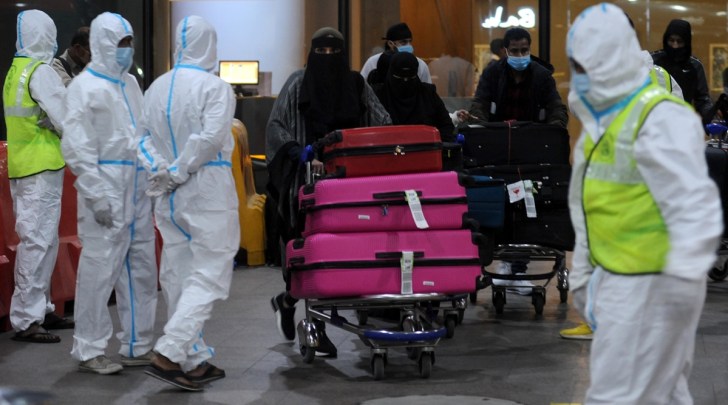
Passengers arriving from the UK at Mumbai airport on Tuesday (Express photo)
For those who arrived between December 9 and December 23, the surveillance officers will carry out a daily follow-up till 14 days after their arrival, and the travellers will have to self-monitor for 28 days.
Story continues below this ad
If tested positive, genome sequencing of their samples will be conducted. If the genome sequencing indicates the presence of a new variant, the patient will continue to remain in a separate isolation unit.
Giving out details of the discussions with UK scientists, specifically on the “N501Y mutation” in the spike protein that the novel coronavirus uses to bind to the human ACE2 receptor, Paul said: “One thing that has emerged is that the transmissibility of the virus has been enhanced. Infectiousness has increased. Earlier, UK’s dominant strain spread the infection to 1-1.5 persons; this has increased to more than 2 (in case of the new variant). It is being said that transmissibility has increased by 70 per cent. In other words, you can term this variant as a superspreader.”
“However, the other things that have emerged are also equally significant. First, this mutation is not affecting the severity of the disease. Second, case fatality rate was also not affected. Third, hospitalisation and seriousness of the disease have not been affected,” he said.
“However, in a pandemic, the spread is everywhere. Due to travel, there is spread of the virus; it is also a fact that this variant has been found in other countries like Australia. Therefore, we have to be watchful. However, we have tracked the viruses isolated in the laboratories in India, the data does not show any such mutation here,” Paul said.


 6 min read



 Passengers arriving from the UK at Mumbai airport on Tuesday (Express photo)