Journalism of Courage



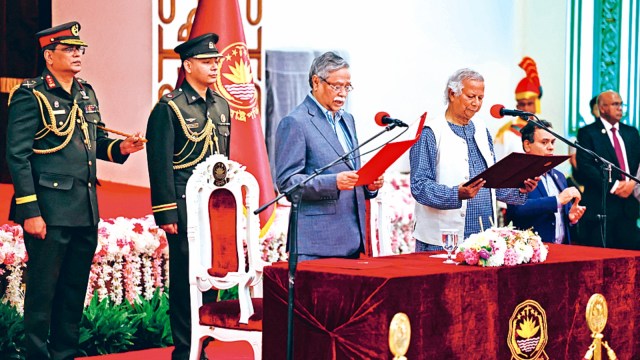 Bangladesh President Mohammed Shahabuddin administers oath to Muhammad Yunus in Dhaka. (Reuters)
As Nobel laureate Professor Muhammad Yunus was sworn in as the head of the interim government in Bangladesh Thursday, Prime Minister Narendra Modi extended his best wishes to Yunus and urged him to ensure “the safety and protection of Hindus and all other minority communities” who have come under attack following the ouster of Prime Minister Sheikh Hasina on August 5.
This direct reference to the safety of Hindus and other minorities in Bangladesh underlines Delhi’s expectations from the new players in Dhaka.
In a post on X, Modi said, “My best wishes to Professor Muhammad Yunus on the assumption of his new responsibilities. We hope for an early return to normalcy, ensuring the safety and protection of Hindus and all other minority communities.”
“India remains committed to working with Bangladesh to fulfil the shared aspirations of both our peoples for peace, security and development,” he said.
Yunus, 84, returned to Dhaka Thursday afternoon and was received at the airport by Bangladesh Army chief General Waker-uz-Zaman. Yunus called for an end to attacks, saying his task is to restore law and order.
Earlier in the day, Randhir Jaiswal, spokesperson for the Ministry of External Affairs, said, “Regarding attacks and minorities’ situation, this particular issue was also addressed by External Affairs Minister (S Jaishankar) in his suo motu statement (in Parliament). We are also monitoring the situation… with regard to the status of minorities. There are also reports that various initiatives have been taken by groups and organisations to ensure the protection and well-being of the minorities. I would like to reiterate what the External Affairs Minister had said in Parliament. We welcome these steps but will naturally remain deeply concerned till law and order is visibly restored.”
“We also want to make it clear that it is the responsibility of every government to ensure the well-being of all its citizens. We hope for early restoration of law and order in Bangladesh. This is both in the interest of the country itself and for the region as a whole or the larger region as a whole,” Jaiswal said.
He said “the aspirations and interests of the people there are foremost for us, for both India and its people. We will work with this objective in mind.”
Responding to a question on the possible involvement of foreign powers and governments, the MEA spokesperson said, “We are closely analysing all aspects of recent developments in Bangladesh.”
He said India is in touch with authorities in Bangladesh to ensure the safety and security of Indian missions, the personnel working there and Indians residing in that country.
The Indian High Commission has temporarily suspended visa operations until the law and order situation improves.
It is learnt that the Indian High Commission, in coordination with Bangladesh Army and authorities, has facilitated safe passage of Indian nationals to the border. The Indian mission has advised on transport and movement issues and also coordinated with airport and airlines for flights, and the mission control room has attended to over 350 calls in the past two days.
It has also facilitated movement of Indian nationals including project personnel across the land borders. Some of these situations were life-threatening. They facilitated travel of members of IRCON Khulna, L&T, RITES, Tata Projects, Afcons and Transrail Sirajganj via land borders.
On Thursday, three days after the ousted Sheikh Hasina reached India with plans to travel to the UK that have since run into a technical roadblock, Jaishankar discussed the unfolding situation in Bangladesh with British Foreign Secretary David Lammy.
In a post on X, Jaishankar said he “received a call” from Lammy and they “discussed the situation in Bangladesh and West Asia”.
The phone call between Jaishankar and Lammy took place amid the complication regarding Hasina’s plan to seek asylum in the UK.
Hasina was planning to travel to London. Her sister Sheikh Rehana’s daughter Tulip Siddiq is a member of the British Parliament. Tulip is Economic Secretary to the Treasury and Labour MP for Hampstead and Highgate.
The “technical” challenge emanates from UK’s Immigration rules which have no provision for someone to be allowed to travel to the country to seek asylum or temporary refuge.
It is not possible to apply for asylum from outside the UK. Once in the UK, a person can seek asylum. But since she doesn’t have a valid visa – she doesn’t have a diplomatic or an official passport anymore – Hasina needs a visa to enter the UK, and then seek asylum.
Once an asylum request is made, each asylum claim is carefully considered on its individual merits on a case-by-case basis.
Hasina wants to seek asylum or temporary refuge as she wants protection from political persecution. She fears she will be called in as part of investigations against her by the rivals in the new government in Dhaka.
For the time being, her best bet is that she stays in India where she is “safe”.
Asked when Hasina would leave India, MEA spokesperson Jaiswal said: “We don’t have an update on her plans. It is for her to take things forward. As far as other members that you talked about, of course they have their own…They are responsible for themselves and I also again don’t have an update on their plans. It is for them to take forward what they think is in their best interest.”

 5 min read