Journalism of Courage



 The number of trains with 90-100% occupancy — still considered sub-par for this time of the year — remains at 25.
With people seemingly undertaking only essential inter-state travel in the face of surging Covid-19 cases, the number of trains running with over 100% occupancy across India fell drastically to just 23 on Monday.
This was a fall from 68 just last Friday, and down to one-fourth from earlier in the month when more than 80 trains were running full.
The number of trains with 90-100% occupancy — still considered sub-par for this time of the year — remains at 25. As for trains between 75-100% seats full, the Railway Ministry data shows there were 34 such trains last week.
Indicating the slow and drawn-out un-lockdown ahead, the numbers remain low despite the fact that the Railways is running just about 230 “special trains” on important routes now, as opposed to over 13,000 daily ones before the pandemic. Thirty of them are clones of the Rajdhani Express trains on various sectors.
While around 180 of these trains have been running with occupancy below 90%, in some, just about 20% of the seats go full.
Significantly, half of the 23 trains with over 100% occupancy on Monday were the ones taking passengers to cities where migrant workers head for jobs, such as Ahmedabad, Mumbai, Amritsar and Delhi, from places like Gorakhpur, Muzaffarpur, Darbhanga and Patna. On these routes, the occupancy on the return trips also remains high.
With COVID-19 cases surging, some of the key trains that do not have overwhelming patronage anymore are on routes like Maharashtra to Odisha, Delhi to Rajasthan, Delhi to Madhya Pradesh, and Karnataka to Delhi. The Delhi-Goa route, between Nizamuddin to Vasco Da Gama, which had sustained full occupancy in June, appears to have stopped running, as per the IRCTC website. Trains on Bihar-Jharkhand route, earlier enjoying high occupancy, also appears to have been hit by COVID-related restrictions.
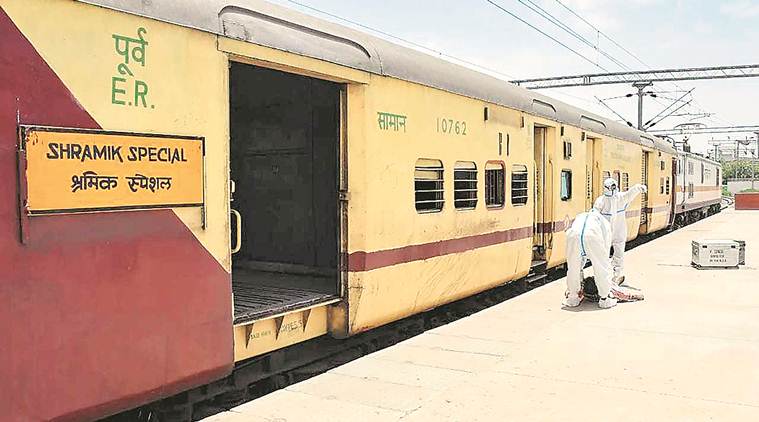
Officials said the data indicates people are heading for big cities, whether for medical aid or business or jobs, including labourers who would have not too long back made their way home using Shramik Special trains.
A senior Railway Ministry official said, “We are running these trains as a confidence-building measure in the unlock phase. More and more people will undertake inter-state travel. However, right now people are travelling only when it is essential.”
Late June, seeing encouraging signs of trains running at upwards of 100% occupancy from small towns to big cities, the Railways had planned more trains on those routes. Those trains, however, are yet to be rolled out, as coronavirus cases continue to surge.
At least five states — Tamil Nadu, West Bengal, Odisha, Jharkhand, Maharashtra — have indicated they don’t want the number of trains increased. Based on West Bengal’s request, the frequency of some regular special trains has been decreased. Some other states have “informally” requested that stoppages be reduced.
This means that the road back to pre-Covid “normalcy” in terms of train operations remains a challenge for Railways. Railway Board Chairman V K Yadav said last week that the government is keeping a close watch on the trend of inter-state passenger traffic and will be introducing more trains wherever necessary. “The average occupancy of these trains is around 76%, which means 24% of the berths are still available,” he said.

 4 min read