This is an archive article published on March 6, 2015
Why Mufti felt he needed to ‘thank’ Pak and separatists
Mufti made a reference to Srinagar, saying he is proud because the heart of Kashmir came out to vote for the first time.
Written by Muzamil Jaleel
Jammu | March 6, 2015 12:23 AM IST
6 min read
Whatsapp
twitter
Facebook
Reddit
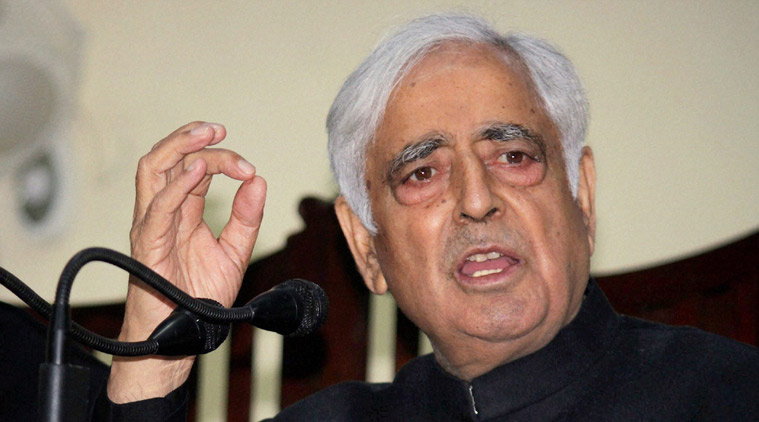
BJP maintained in Delhi on Monday that its coalition with the PDP would be based only on the Agenda of the Alliance.
Mufti Mohammad Sayeed, in one his first utterances after taking charge as J&K chief minister, was making a calculated political move, and not a slip as some believe, by crediting the separatist Hurriyat, militants and “people from across” — a reference to Pakistan — for the high turnout in the assembly polls.
His claim was not the entire truth. One reason for the high voter turnout was the “fear” of the BJP entering the valley, a sentiment exploited by Sayeed’s PDP during the campaign. The separatists were not allowed by the government to push for a poll boycott. Even if their absence helped the poll process, they had no role in it.
When the elections were announced last October, the police rounded up the Hurriyat leadership and and cadre. By mid-November, 928 people had been detained. Police sources said more than 2,000 people were picked up during the campaign and polling. A senior police officer said: “As soon as the polls were announced, we put the leadership under house arrest and picked up almost all known cadres.”
[related-post]
cActivists of smaller parties like the Muslim League too were rounded up, JKLF’s Yasin Malik wasn’t allowed to venture out, and the police even prevented Mirwaiz Umar Farooq from attending the Friday congregation at Jamia Masjid. “We were arrested. The government didn’t allow me to attend Friday prayers. We were not allowed to take part in any political activity at all,’’ Mirwaiz told The Indian Express.
Mufti made a reference to Srinagar, saying he is proud because the heart of Kashmir came out to vote for the first time. Apart from the police crackdown on separatists, what made people come out and vote was a consistent campaign by both the PDP and the National Conference that a boycott in two Srinagar constituencies, Tral and Sopore, would bring the BJP into Kashmir. This “fear” of the BJP was one of the factors that pushed up the turnout. “When elections were very close and the BJP was visible in Kashmir, there was an effort by a section of separatists to encourage voting so that a low turnout wouldn’t become an advantage for the BJP,’’ a senior police officer said. “I won’t say this was the only reason for the people’s participation, but the BJP factor did help create a momentum.”
Unlike in the past, there weren’t many militant attacks against candidates or political rallies. While PDP worker Ghulam Modideen Dar was killed in Pulwama, the other attacks during the campaign included killing of sarpanchs — two in Shopian and one in Baramulla. The two major militant attacks during this period — one in Jammu near the border on November 27, and the other on a Army camp in Uri near the LoC on December 5 — were not linked to any attempt to disrupt the poll process.
The reason for the absence of election-specific attacks was manifold. There has been a sharp decline in the number of militants active in Kashmir. Besides, their profile and strategy have changed; most are currently lying low. Their political targets have been village heads, who don’t have enough security. Over the years, there has also been a sharp shift in the militant leadership’s emphasis on targeting elections or mainstream leaders. In fact, a few ambiguous statements by militant leaders ahead of the 2008 polls were interpreted as a green signal to the elections. Similarly, there were allegations that a few militant commanders had supported the PDP in south Kashmir in 2002.
Story continues below this ad
A senior police officer said, “The fact is that our information gathering mechanism and experience helped us preempt any attack. However, the militants didn’t try a lot either. That’s why, this time, rallies were held almost across Kashmir. Even the BJP campaigned without a problem.”
Why did Mufti make this statement at the beginning of his tenure? The reason is that his party’s alliance with the BJP isn’t very popular in Kashmir and he wants the focus to shift to something that shows him as stronger than the BJP in his core constituency. Over its 16 years, the PDP has slowly encroached into the separatist constituency with its soft separatist posturing. The party’s self-rule agenda provides an important role to Pakistan as the PDP has sought a joint mechanism to connect the two Kashmirs divided by the LoC and even advocated dual currency.
The PDP had been worried Islamabad might have changed its position on the party, especially after a PDP leader close to Mufti, Nayeem Akhtar, was denied a visa to Lahore for a conference recently. Earlier, the Pakistani establishment had rolled out the red carpet to Mehbooba Mufti in Islamabad in 2008. There have been visible indications that Islamabad is bothered by the PDP’s alliance with the BJP. Last month, Pakistan foreign secretary Aizaz Ahmed Chaudhry accused New Delhi of planning to change the demographic makeup of Kashmir and turn its Muslim majority into a minority. Mufti was addressing this growing perception so that his government wouldn’t have to deal with any possible security-related ramifications of that perception.
One of the reasons for the rise of the PDP is the consolidation of the anti-NC constituency. Jamat-e-Islami cadre have been covertly supporting the party since 2002 because of their traditional animosity to the NC. That support too is under threat because of the BJP alliance, and Mufti’s utterances were aimed at placating this constituency, too.
Muzamil Jaleel is a Deputy Editor at The Indian Express and is widely recognized as one of India’s most authoritative voices on Jammu & Kashmir, national security, and internal affairs. With a career spanning over 30 years, he has provided definitive on-the-ground reportage from the heart of the Kashmir conflict, bearing witness to historic political transitions and constitutional shifts.
Expertise and Investigative Depth
Muzamil’s work is characterized by a rare combination of ground-level immersion and high-level constitutional analysis. His expertise includes:
Conflict & Geopolitics: Decades of reporting on the evolution of the Kashmir conflict, the Indo-Pak peace process, and the socio-political dynamics of the Himalayan region.
Constitutional Law: Deep-dive analysis of Article 370 and Article 35A, providing clarity on the legal and demographic implications of their abrogation in 2019.
Human Rights & Accountability: A relentless investigator of state and non-state actors, uncovering systemic abuses including fake encounters and the custodial death of political workers.
International War Reporting: Beyond South Asia, he provided on-the-spot coverage of the final, decisive phase of the Sri Lankan Civil War in 2009.
Landmark Exposés & Impact
Muzamil’s reporting has repeatedly forced institutional accountability and shaped national discourse:
The Kashmir Sex Scandal (2006): His investigative series exposed a high-profile exploitation nexus involving top politicians, bureaucrats, and police officers, leading to the sacking and arrest of several senior officials.
Fake Encounters: His reports blew the lid off cases where innocent civilians were passed off as "foreign terrorists" by security forces for gallantry awards.
SIMI Investigations: He conducted a massive deep-dive into the arrests of SIMI members, using public records to show how innocuous religious gatherings were often labeled as incriminating activities by investigative agencies.
The Amarnath Land Row: Provided critical context to the 2008 agitation that polarized the region and altered its political trajectory.
Over the years, Muzamil has also covered 2002 Gujarat riots, Bhuj earthquake, assembly elections in Bihar for Indian Express. He has also reported the peace process in Northern Ireland, war in Sri Lanka and national elections in Pakistan for the paper.
Awards and Fellowships
His "Journalism of Courage" has been honored with the industry's most prestigious accolades:
Four Ramnath Goenka Awards: Recognized for J&K Reportage (2007), On-the-Spot Reporting (2009), and Reporting on Politics and Government (2012, 2017).
Kurt Schork Award: From Columbia University for international journalism.
Sanskriti Award: For excellence in Indian journalism and literature.
IFJ Tolerance Prize: For his empathetic and nuanced reporting in South Asia.
International Fellowships: Served as a visiting scholar at UC Berkeley and worked with The Guardian, The Observer, and The Times in London. He has also received Chevening fellowship and a fellowship at the Institute of Social Studies, Hague, Netherlands.
Professional Presence
Current Location: New Delhi (formerly Bureau Chief, Srinagar).
Education: Master’s in Journalism from Kashmir University.
Social Media: Follow him for field insights and rigorous analysis on X (Twitter) @MuzamilJALEEL. ... Read More


 6 min read


 BJP maintained in Delhi on Monday that its coalition with the PDP would be based only on the Agenda of the Alliance.