Premium
This is an archive article published on January 18, 2015

The original forester

The life of Alexander Gibson, who implemented the first forest conservation programme in India, will soon be seen in a documentary.

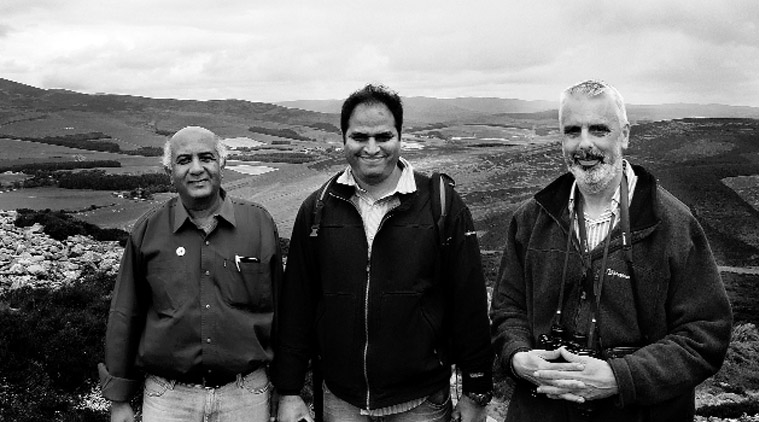
Dr Pande, Ghadge & Dr Noltie in Scotland for filming the documentary Dr Pande, Ghadge & Dr Noltie in Scotland for filming the documentary

At noon, Dr Satish Pande checks his watch and asks the nurse at the sonography department of Pune’s KEM Hospital to send the last patient in. Within two hours, the 52-year-old radiologist will settle into what he calls “another role” — that of an ornithologist.

After 26 years of devoting equal time to medicine and his love of birds, Dr Pande recently took on a new project where he began to trace the life of Dr Alexander Gibson (1800-1867), the Scottish surgeon and botanist who has been credited as being the first in the world to systematically adopt a forest conservation programme based on scientific principles.

Dr Pande stumbled across Dr Gibson’s pathbreaking work in conserving forests in India when he set out to write a book on the history of Indian forests in 2013. “His valuable contribution, particularly in western India, has long been forgotten,” Dr Pande says. “I became interested in finding the details of his life because he, like me, was a doctor.”

Piece by piece, Dr Pande and another ornithologist, Kiran Ghadge, studied the work of Dr Gibson and brought it to the notice of the Forest Department. They explained the impact of Dr Gibson’s work to Dr Arvind Kumar Jha, the Director General, Social Forestry, who then gave them a grant to make a documentary on Dr Gibson’s life.

Dr Gibson first arrived in India as an East India Company surgeon in 1820 and learnt Hindi, Marathi and Gujarati. A linguist, he was already well-versed in Greek and Latin. In 1825, he left for Burma and returned in 1827. The British, who needed timber to build ships, realised there was a shortage of wood and thus deputed Dr Gibson to survey the Konkan forests. He went on to become the superintendent of Dapuri Botanical Gardens (1838-47) under the erstwhile Bombay Presidency. He submitted a report in 1843 and brought the need to protect forests to the notice of the East India Company, Dr Pande says.

“Dr Gibson travelled on horseback to complete his surveys. He was a man of iron constitution,” Dr Pande says. He even wrote two books on the state of the forests — Bombay Flora in 1861 and Handbook to the Forests of the Bombay Presidency in 1863.

Researching Dr Gibson’s life and work was not easy for the team. They retraced Dr Gibson’s steps and went from Pune’s Dapodi (earlier Dapuri) Botanic Garden to Hivre in Junnar taluka where he spent most of his time while in India, nurturing a garden where he grew medicinal, exotic and agriculturally important plants at an old forest bungalow. They also visited Dr Gibson’s two offices in Sadashivgad and Valsad.

Story continues below this ad

Dr Pande says not even a single image of him exists in either India or Scotland, where Dr Gibson was born in 1800. This made it difficult to start filming a documentary, says Ghadge, who gave up a job at an IT firm to become a cinematographer.

“We contacted Dr H J Noltie, a botanist at the Royal Botanic Garden, Edinburgh, who wrote a biography on Dr Gibson 10 years ago. He had stayed in India for a month to research Dr Gibson’s life and his attempt to get photographs was also futile as even the Linnean Society of London, which had elected Gibson as a fellow, did not have an image,” Ghadge says.

Dr Pande and Ghadge then visited Gibson’s birthplace Kincardineshire in northeast Scotland and the Royal College of Surgeons in Edinburgh from where he got his licence to practise medicine. They even visited his grave and the Royal Botanical Garden at Kew in the UK. “Dr Gibson never married,” Ghadge says. “Based on his work, we imagine him to have been a strict disciplinarian and, thus, we drew up a character we believe resembles him.”

They filmed the letters Dr Gibson wrote to the director of the garden, Sir J D Hooker, who is also known as one of the founders of geographical botany. A letter written in 1841 described how “the Deccan is more bare than Gujarat’’ as the mountain trees in Ghats were disappearing fast. He requested Hooker to influence the government to help control the forests in the Deccan and Konkan region and this was recorded as the first case of state management of forests in the world.

Story continues below this ad

The significance of Dr Gibson’s work in India was even highlighted in an obituary in the British Medical Journal in 1867 after his death. It read, “From the plains of Scinde to Cape Comorin, Alexander Gibson spent a quarter of a century conserving the forests of Western India.”

Dr Jha has now planned several events to highlight the impact of Dr Gibson’s work in India. “It is a lesson for our foresters to imbibe. Dr Gibson was a visionary who knew that forests have to be preserved,” Jha says.

Anuradha Mascarenhas is a Senior Editor at The Indian Express, based in Pune. With a career spanning three decades, she is one of the most respected voices in Indian journalism regarding healthcare, science and environment and research developments. She also takes a keen interest in covering women's issues . Professional Background Education: A gold medalist in Communication and Journalism from Savitribai Phule Pune University and a Master’s degree in Literature. Author: She authored the biography At The Wheel Of Research, which chronicles the life and work of Dr. Soumya Swaminathan, the former Chief Scientist at the WHO. Key Focus: She combines scientific accuracy with storytelling, translating complex medical research into compelling public and human-interest narratives. Awards and Recognition Anuradha has won several awards including the Press Council of India's national award for excellence in journalism under the gender based reporting category in 2019 and the Laadli Media award (gender sensitivity -2024). A recipient of the Lokmat journalism award (gender category-2022), she was also shortlisted for the RedInk awards for excellence in journalism-2021. Her debut book At The Wheel Of Research, an exclusive biography of Dr Soumya Swaminathan the inaugural chief scientist of World Health Organisation was also nominated in the Popular Choice Category of JK Paper AUTHER awards. She has also secured competitive fellowships including the Laadli Media Fellowship (2022), the Survivors Against TB – New Research in TB Media Fellowship (2023) and is part of the prestigious 2025 India Cohort of the WomenLift Health Leadership Journey.” Recent Notable Articles (Late 2025) 1. Cancer & Specialized Medical Care "Tata Memorial finds way to kill drug-resistant cancer cells" (Nov 26, 2025): Reporting on a breakthrough for triple-negative breast cancer, one of the most aggressive forms of the disease. ``Discipline, diet and purpose; How a 97-year-old professor defies ageing'' (Nov 15, 2025) Report about Prof Gururaj Mutalik, the first Head of Department at Pune's B J Government Medical College who at 97 credits his longevity to healthy habits and a strong sense of purpose. 2. Environmental Health (The "Breathless Pune" Series) "Long-term exposure even to 'moderate' air leads to chronic heart, lung, kidney issues" (Nov 26, 2025): Part of an investigative series highlighting that even "safe" pollution levels are damaging to vital organs. "For every 10 µg/m3 increase in PM2.5 level, there was 6-8% jump in medicine sales" (Nov 23, 2025): Using commercial data to prove the direct link between air quality and respiratory illnesses in Pune. 3. Lifestyle & Wellness News "They didn't let cancer, diabetes and heart disease stop them from travelling" (Dec 22, 2025): A collaborative piece featuring survivors who share practical tips for traveling with chronic conditions. ``At 17, his BP shot up to 200/120 mmHG; Lancet study flags why child and teen hypertension doubled between 2000 and 2020'' (Nov 12,2025)--A report that focusses on 17-year-old-boy's hypertensive crisis and reflects the rising global trend of high blood pressure among children and adolescents. 4. Scientific Recognition & Infrastructure "For promoting sci-comm, gender diversity: IUCAA woman prof highlighted in Nature" (Nov 25, 2025): Covering the global recognition of Indian women scientists in gender studies and physics. ``Pune researchers find a spiral galaxy like the Milky Way from early universe'' (December 3, 2025)- A report on how Indian researchers discovered a massive galaxy that existed when the universe was just 1.5 billion years old , one of the earliest to have been observed so far. Signature Beat: Health, Science & Women in Leadership Anuradha is known for her COVID-19 reportage, where she was one of the first journalists to provide detailed insights into the Covishield and Covaxin trials. She has a dedicated interest in gender diversity in health and science, often profiling women researchers who are breaking the "leaky pipeline" in STEM fields. Her writing style is scrupulous, often featuring interviews with top-tier scientists and health experts from various institutions. X (Twitter): @runaanu   ... Read More

Stay updated with the latest - Click here to follow us on Instagram
Latest Comment
Post Comment
Read Comments
Advertisement
Advertisement
Loading Taboola...
Advertisement