One night, after water had started flowing into a few low-lying Srinagar neighbourhoods, Chief Minister Omar Abdullah made a round of the city and personally monitored the rescue of a toddler.
However, once the city had actually gone down under by Saturday night, ministers, bureaucrats and police officers were among those trapped inside their residences. DGP K Rajindra and IGP, Kashmir, Abdul Gani Mir were forced to operate for long in the same pair of uniform as they didn’t have a dry pair at home to change into. The state police were reduced to merely carrying relief materials and loading these onto Air Force planes headed for sorties.

Two of Omar’s senior ministers were rescued from Tulsibagh. Senior officials had to be saved and shifted to relief camps. Several of them left for Jammu soon after, where they have another set of official homes.
After the floods, only four of the city’s more than two dozen police stations remained working. Water entered wireless sets and left them useless, shutting down another line of communication in a city where cellular services were down till Friday and are still erratic.
In Bemina neighbourhood, rescue was conducted by local volunteers using makeshift rafts made of foam mattresses.
In an interview to a TV channel, Omar, who is staring at even bleaker prospects in the coming Assembly elections, tried to earn some sympathy. He himself “had no government for the first 24 hours”, he said, noting that there was a complete breakdown between him and his officials initially.
In a flooded city where hundreds still remain missing and many set off every hour desperately looking for them, if there are a few people who have gone into hiding, they are the top government faces.
Story continues below this ad
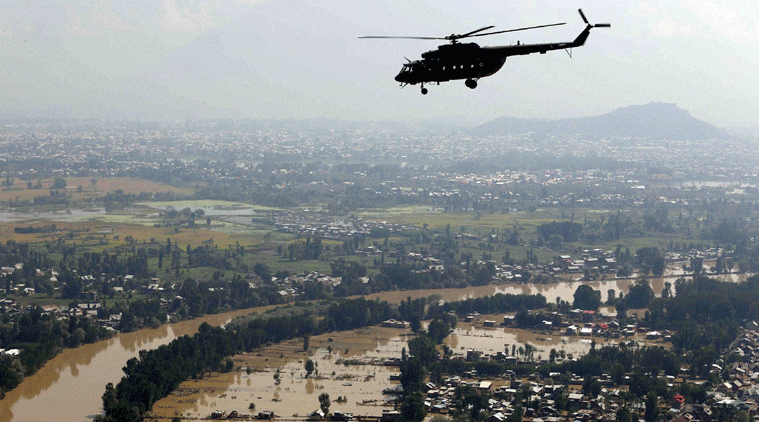
Occasionally, they resurface on TV screens to drop a few sacks of flour from a military chopper or to give sound bites, but in submerged Srinagar, that’s adding insult to injury.
The missing government remains the story of this tragedy.
Also Read: Several parts still under water, Srinagar says Omar govt not doing enough
In 2009, the J&K chapter of the Indian National Trust for Art and Cultural Heritage (INTACH) had predicted widespread devastation due to natural disasters in the Valley, and the Omar government had accepted its recommendations. Nothing came of it.
“We had observed that construction in the low-lying areas of Srinagar, especially along the banks of the Jhelum, had blocked the discharge channels of the river,” says Saleem Beg, convener of INTACH, J&K.
Story continues below this ad
The INTACH report also observed that the Jhelum bund — first built by Dogra ruler Pratap Singh over a century ago, to keep bungalows safe from floods — had been concretised and encroached upon. “The authorities thought concrete would stop the flood, but it only caused more flooding. They should have dredged the Jhelum because its current outflow is wrong,” Beg says, though he admits that flooding may have been inevitable this time because of the amount of rainfall received.
In 2010, a paper prepared by the J&K Flood Control Department predicted a major flood that would inundate Srinagar. The government ignored it too because the minister overseeing the department had his constituency in Jammu and considered the prediction of a flood in Jhelum alarmist.
The Jhelum wreaked havoc for six days this time as it meandered its way across south Kashmir, before reaching Srinagar, but the government delayed in reacting. Three days before Srinagar was flooded, the waters at Sangam near Anantnag had risen so high that the Flood Control Department couldn’t find its gauge.
While the inundation of Srinagar perhaps couldn’t have been halted, the breach in embankments could have been prevented. But even that didn’t happen.
Story continues below this ad
With the waters receding now, the Omar government has a chance to put these floods behind it the Assembly elections. The first step could be ending the information blackout. The government needs to provide all the information available about what happened inside submerged neighbourhoods.
Similarly, despite assurances from telecom operators that communication will be restored soon, they have only been able to restore limited connectivity in a few pockets of Srinagar. Radio Kashmir is the only communication link available. Dedicated broadcasters are running round-the-clock live progammes on the channel, informing people about the flood situation in various areas of the city and helping them link up with friends and families.
While the focus of the rescue and relief operations is Srinagar, there is an urgent need to intervene in South Kashmir as well as Jammu province. People there are hungry and without any clean drinking water.
The government as well as the private healthcare system in Srinagar has collapsed. All the major hospitals are either submerged or disconnected because patients cannot reach them. Director, Health Services, Kashmir, Saleem-ur-Rehman who had lost all communication with his colleagues and the administration for several days, says most of the medical supplies stores and godowns are submerged or damaged.
Also Read: Union Health Minister Harsh Vardhan visits Jammu
Story continues below this ad
The situation will get worse as there are reports of cholera and other communicable diseases from the submerged areas. A rescue team of volunteers who had gone to the villages of Bonpora, Chak and Kanihama on way to Pampore found dozens of people complaining of symptoms of cholera. These neighbourhoods had several poultry farms, and thousands of chicken now lie floating in water.
“The stench was unbearable, there was no water to drink,” says Muzaffar Ahmad, a volunteer who was part of the rescue and relief team.
Deep inside Batamaloo neighbourhood in Srinagar too, where carcasses of dogs and cattle have been floating around, there are reports of children being down with fever for the past few days.
The government also has to restore road links, especially the Srinagar-Jammu national highway, fast, with the supplies of essential commodities across Kashmir depleting.
Story continues below this ad
Several educational institutions, medical centres and other government buildings that are submerged will take months to function again and the government will have to find alternatives. The restoration of electricity is also a major issue.
Plus, the government needs to prepare for winter right away, which may come earlier. There are several thousand people left homeless.
A man who had heard Omar speak at a recent rally said the CM’s focus was on bijli, sadak and paani while asking for votes. “Today, there is no bijli, sadak isn’t visible and the water has drowned his government for good,” he said.
There is a saving grace though: the chance that the elections may be put off.
With ENS, Srinagar


 7 min read


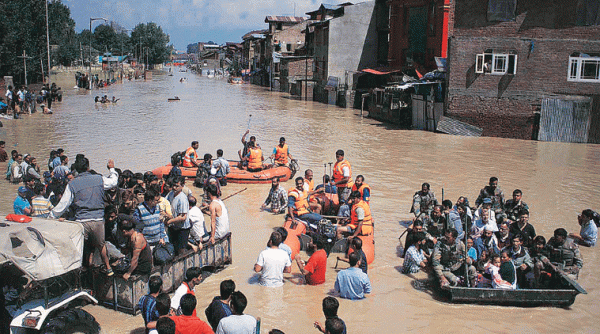 In Bemina neighbourhood, rescue was conducted by local volunteers using makeshift rafts made of foam mattresses.