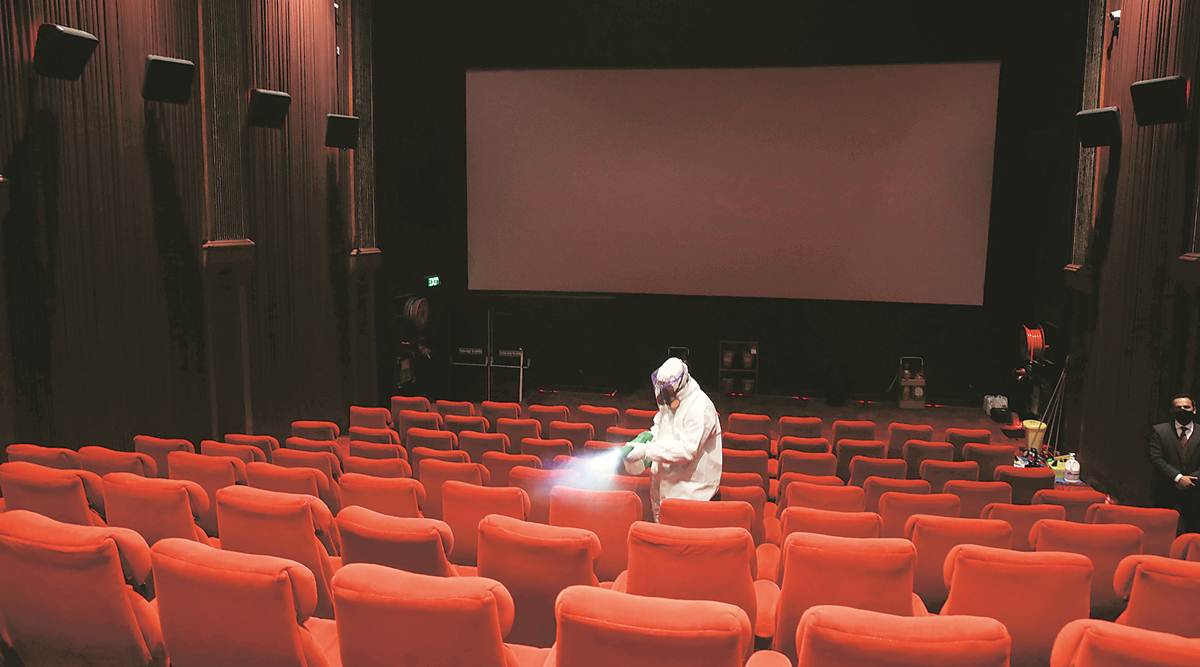
SOPs for cinema halls include: alternate seats to be left vacant; only packaged food to be allowed; and physical distancing of at least six feet outside auditoriums. (Express photo by Abhinav Saha/file)
AMID FEARS that the coming festive season could see a surge in Covid-19 cases, the Health Ministry on Tuesday issued guidelines for organising events which see large gatherings. These include ensuring adequate space for such events with a detailed site map and proper markings to maintain social distancing, not allowing touching of “statues, idols and holy books”, and thermal screening.
With cinema halls set to open from October 15, the Information and Broadcasting Ministry also released a set of Standard Operating Procedures (SOPs): cinema halls to operate at half their capacity maintaining “one-seat distance”, no food to be delivered inside, only packaged food allowed, mandatory face masks and thermal screening, staggered show timings, contact number to be taken to facilitate contact tracing later, if required.
The Health Ministry said festive events will be permitted “only outside containment zones”. “Events planned to last for many days or weeks such as exhibitions, fairs, puja pandals, Ram Lila pandals, or concerts and plays should have adequate measures to ensure a cap on physical numbers. Staggered timings and restricted entry may be considered,” it said.
“As far as feasible, recorded devotional music/songs may be played and choir or singing groups should not be allowed,” it said. “In religious places, touching of statues/ idols / holy books etc shall not be allowed,” it added.
It said that people residing inside containment zones “may be encouraged” to observe all festivals inside their homes and “not move out”. The event sites should have a designated isolation room or space for isolating any person found to be symptomatic.
“Close circuit cameras may be considered to monitor compliance of physical distance norms, wearing of masks at each venue,” it said. “All events must plan for medical care arrangements with linkages to nearest hospitals to attend to health emergencies,” it said. “The structure/ space/ venue for the event must also ensure adequate natural cross-ventilation,” it said.
“In case of rallies and processions, route planning, identification of immersion sites, ensuring cap on numbers, physical distancing etc. must be planned beforehand and measures for enforcement outlined,” it said.
Story continues below this ad
The I&B Ministry’s SOPs for cinema halls include: alternate seats to be left vacant, to be marked as “not to be occupied”; only packaged food and beverages to be allowed; physical distancing of at least six feet outside the auditoriums, common areas and waiting areas; mandatory use of face masks; availability of hand sanitisers, preferably in touch-free mode; digital no-contact transactions should be the preferred mode for issue/ verification/ payments for tickets, food and beverages; contact number to be taken at the time of booking tickets to facilitate contact tracing; thermal screening; staggered entry and exit to avoid crowding.
The I&B Ministry said states and Union Territories “may consider proposing additional measures as per their field assessment”.
As City Editor ( Delhi) at the Indian Express, Kaunain Sheriff leads city reporting with a sharp focus on accountability journalism, data-driven stories, and ground-level impact. As the National Health Editor he leads the newsroom’s in-depth coverage of pressing health issues.
He is the author of Johnson & Johnson Files: The Indian Secrets of a Global Giant, a definitive investigation into the accountability of one of the world’s most powerful pharmaceutical corporations.
Areas of Expertise
Investigative Reporting: Has deep expertise in investigative reporting spanning public health, regulatory affairs, drug safety, and the criminal justice system. His work sits at the intersection of governance, law, and accountability, with a particular focus on how regulatory failures, institutional lapses, and policy decisions affect citizens’ rights and safety.
Data Journalism: Has extensively on big data–driven investigations, including analyses of flagship government schemes and large datasets on criminal trials, uncovering systemic gaps.
Global Collaborations
Kaunain is a key contributor to major international journalistic projects:
The Implant Files: Collaborated with the International Consortium of Investigative Journalists (ICIJ) to expose global malpractices in the medical device industry.
Chinese Big-Data Investigation: Uncovered how a foreign data firm monitored thousands of prominent Indian institutions and individuals in real-time.
Awards & Recognition
His commitment to "Journalism of Courage" has been recognized with the industry's highest honors:
Ramnath Goenka Award for Excellence in Journalism
SOPA Award (Society of Publishers in Asia)
Red Ink Award (Mumbai Press Club)
Indian Express Excellence Awards (Triple recipient for investigations into the NSA abuse in UP, Vyapam scam, and the anti-Sikh riots).
Education: Studied Mechanical Engineering at Visvesvaraya Technological University (VTU), Bangalore, before moving to Delhi to pursue his passion for journalism. His engineering training informs his analytical approach, enabling him to decode technical, legal, and data-heavy systems with precision.
Social media
LinkedIn: linkedin.com/in/kaunain-sheriff-3a00ab99
X ( fromerly Twitter): @kaunain_s ... Read More


 3 min read