Premium
This is an archive article published on January 20, 2020

Custody death of a 20-year-old is part of cloud over Davinder Singh

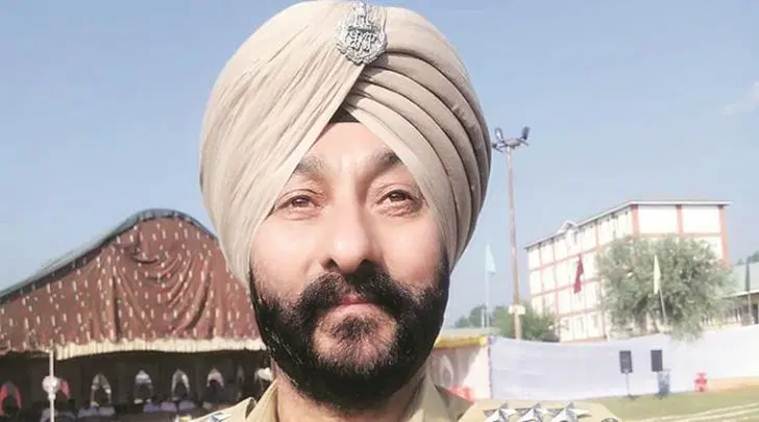
Singh, who joined the police in 1990 as a Sub Inspector, received an out-of-way promotion to first become an Inspector and then a Deputy Superintendent of Police. Singh joined the SOG when it was launched in 1994.

Davinder Singh custody, Davinder Singh NIA custody, davinder singh nia probe, davinder singh parliament attack, J&K cop arrested with militants, J&K news DySP Davinder Singh

AMONG the several red flags that have resurfaced against J&K Deputy Superintendent of Police Davinder Singh, currently in custody, one goes back to June 2000: it is related to the alleged custodial killing of 20-year-old Aijaz Ahmad Bazaz in a camp under Singh’s supervision.

Bazaz, his father Mohammad Shafi recalled, had gone to his aunt’s house in Bemina near their home in the Mandarbagh locality in Srinagar. Two days later, he was picked up by police.

“We came to know that a police party from Humhama Task Force Camp (of the Special Operations Group) has taken him… A week later, a policeman came to our house and asked us to go to the Police Control Room (PCR). My son’s body was lying there. He was my only son; there were torture wounds all over his body.”

Davinder Singh was then in charge of the SOG camp at Humhama. The SOG is the counter-insurgent arm of Jammu & Kashmir Police.

The J&K State Human Rights Commission (SHRC) took cognizance of Bazaz’s death. The SHRC was wound up after J&K was downgraded to two Union Territories last year. Justice (retired) Bilal Nazki, the last chairman of the SHRC, told The Indian Express that “the case had come up before the Commission much before (my) term and (I) was told that the Commission had recommended action against him (Davinder Singh)”.

Bazaz’s father Mohammad Shafi is a well-known veterinary doctor in Srinagar, and the killing of his son didn’t go unnoticed.

“For years, we knocked on the doors of the police and the government, but we were hitting our heads against a wall. No action was taken against Davinder Singh,” Mohammad Shafi said. “Hopefully, now that his (Singh’s) protection is gone, we may get some justice.”

Story continues below this ad

Singh, who was arrested by the J&K Police along with two “most wanted” militants in a car in South Kashmir last Saturday (January 11), was at the forefront of counter-insurgency operations and was, therefore, “protected” from within the force as well as the larger security grid in the Valley, several officials told The Indian Express.

Singh, who joined the police in 1990 as a Sub Inspector, received an out-of-way promotion to first become an Inspector and then a Deputy Superintendent of Police. Singh joined the SOG when it was launched in 1994.

Bazaz’s father alleged that searching for his son, after he had approached Singh, an intermediary had told him to arrange for money.

“He said that we will have to pay him (Singh). He asked me to arrange for Rs 40,000. I sold whatever there was at home, the jewellery of my wife to pay him… but after a week of waiting, a policeman from the Kralkhud police station came to our house and we were told that my son was killed during an encounter at Bemina bypass, and his body was found along the road.”

Story continues below this ad

ALSO READ: Had Davinder Singh been a ‘Khan’, reaction of RSS trolls would have been different: Adhir Chowdhury

The J&K Police had then issued a statement accusing Bazaz of “masterminding two IED blasts in 1996”. The police statement, however, was rejected as a cover-up for a fake encounter as protests broke out in Srinagar soon after the body was handed over to the family.

At the time of Bazaz’s death, Davinder Singh and his Humhama Task Force Camp had picked up Afzal Guru as well.

Guru was subsequently arrested soon after the attack on Parliament in December 2001. In 2004, from Tihar, Guru wrote to his lawyer Sushil Kumar and alleged that Singh had asked him to take “Mohammad”, a co-accused in the Parliament attack case and a Pakistani national, “to Delhi, rent a flat for his stay and purchase a car for him”.

Story continues below this ad

Afzal Guru also referred to a police official, Shanty Singh, who along with Davinder Singh, he alleged, had “tortured him at Humhama STF camp”.

Shanty Singh was jailed after a Crime Branch investigation in 2003 found he was involved in “torturing a civilian Mohammad Ayoub Dar of Sholipora, Pakharpore to death” in “police custody”, and then “firing at his body”, dubbing him as a “militant who was killed in an encounter”.

But Guru’s allegation fell on deaf ears.

In 2005, Davinder Singh was again in controversy. He had helped set up a business deal between two parties, and then allegedly “snatched” cash and a JCB machine from a businessman and escaped.

An FIR was registered at Sadar police station in Srinagar, and the case was subsequently investigated by the Crime branch. “There was a lot of pressure to avoid doing anything in the case,” an officer who knew the case told The Indian Express. “The records of the case were destroyed during the flood in 2014, and the case was closed subsequently.”

Story continues below this ad

When Afzal Guru was hanged in February 2013, Davinder was shifted to Traffic Police. In 2018, J&K Police headquarters asked the Crime Branch to file a closure report in court. This cleared the decks for Singh to be conferred with a gallantry medal — this has been withdrawn after his arrest.

“It is highly unlikely that Davinder would do what he was doing without the knowledge of his senior colleagues,” said a senior J&K Police officer. “Why was he taking these militants to Delhi in his own car? Why would he hide them at his own home? Why was he communicating on an open line, that too on his own phone? There are a lot of questions that are unanswered.”

The wait for the answers has now begun. The NIA took over the investigation last week.

Muzamil Jaleel is a Deputy Editor at The Indian Express and is widely recognized as one of India’s most authoritative voices on Jammu & Kashmir, national security, and internal affairs. With a career spanning over 30 years, he has provided definitive on-the-ground reportage from the heart of the Kashmir conflict, bearing witness to historic political transitions and constitutional shifts. Expertise and Investigative Depth Muzamil’s work is characterized by a rare combination of ground-level immersion and high-level constitutional analysis. His expertise includes: Conflict & Geopolitics: Decades of reporting on the evolution of the Kashmir conflict, the Indo-Pak peace process, and the socio-political dynamics of the Himalayan region. Constitutional Law: Deep-dive analysis of Article 370 and Article 35A, providing clarity on the legal and demographic implications of their abrogation in 2019. Human Rights & Accountability: A relentless investigator of state and non-state actors, uncovering systemic abuses including fake encounters and the custodial death of political workers. International War Reporting: Beyond South Asia, he provided on-the-spot coverage of the final, decisive phase of the Sri Lankan Civil War in 2009. Landmark Exposés & Impact Muzamil’s reporting has repeatedly forced institutional accountability and shaped national discourse: The Kashmir Sex Scandal (2006): His investigative series exposed a high-profile exploitation nexus involving top politicians, bureaucrats, and police officers, leading to the sacking and arrest of several senior officials. Fake Encounters: His reports blew the lid off cases where innocent civilians were passed off as "foreign terrorists" by security forces for gallantry awards. SIMI Investigations: He conducted a massive deep-dive into the arrests of SIMI members, using public records to show how innocuous religious gatherings were often labeled as incriminating activities by investigative agencies. The Amarnath Land Row: Provided critical context to the 2008 agitation that polarized the region and altered its political trajectory. Over the years, Muzamil has also covered 2002 Gujarat riots, Bhuj earthquake, assembly elections in Bihar for Indian Express. He has also reported the peace process in Northern Ireland, war in Sri Lanka and national elections in Pakistan for the paper. Awards and Fellowships His "Journalism of Courage" has been honored with the industry's most prestigious accolades: Four Ramnath Goenka Awards: Recognized for J&K Reportage (2007), On-the-Spot Reporting (2009), and Reporting on Politics and Government (2012, 2017). Kurt Schork Award: From Columbia University for international journalism. Sanskriti Award: For excellence in Indian journalism and literature. IFJ Tolerance Prize: For his empathetic and nuanced reporting in South Asia. International Fellowships: Served as a visiting scholar at UC Berkeley and worked with The Guardian, The Observer, and The Times in London. He has also received Chevening fellowship and a fellowship at the Institute of Social Studies, Hague, Netherlands. Professional Presence Current Location: New Delhi (formerly Bureau Chief, Srinagar). Education: Master’s in Journalism from Kashmir University. Social Media: Follow him for field insights and rigorous analysis on X (Twitter) @MuzamilJALEEL. ... Read More

Stay updated with the latest - Click here to follow us on Instagram
Latest Comment
Post Comment
Read Comments
Advertisement
Advertisement
Loading Taboola...
Advertisement