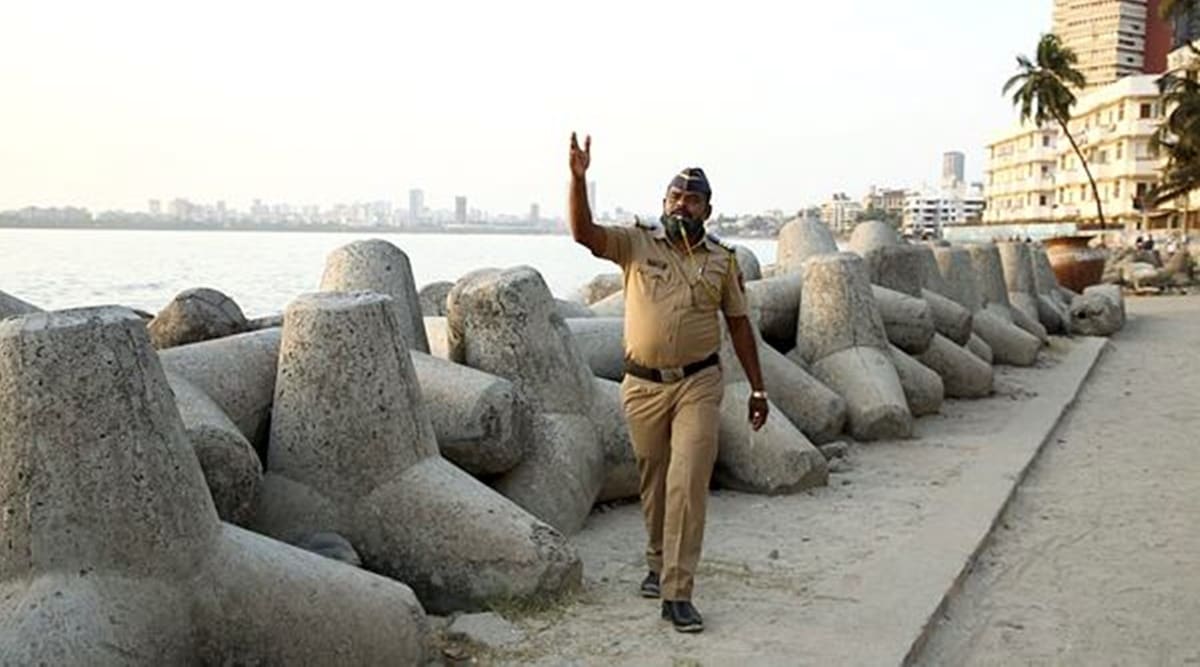
Mumbai Police officers patrol on deserted Gateway of India.
ON SUNDAY, Maharashtra imposed full lockdown on weekends and fresh restrictions to last through April, but just two days before, it kept silent about any such plans during the high-level review meeting chaired by the Cabinet Secretary on Friday.
Senior government officials told The Indian Express that the silence was probably explained by the fact that unlike in the initial phase, the Centre had made it clear to Maharashtra almost two weeks back that weekend lockdowns have limited impact on containing and suppressing the chain of transmission.
You’ve Read Your Free Stories For Now
Sign up and keep reading more stories that matter to you.
“The Chief Secretary, Maharashtra, received the largest chunk of time during the Cabinet Secretary meeting. However, no one discussed any imposition of a weekend lockdown,” a top government source who was part of the high-level meeting said.
In fact, on March 15, when Maharashtra had reported 16,620 cases, accounting for 63.21 per cent of the daily new cases in the country, Union Health Secretary Rajesh Bhushan had written to Chief Secretary Sitaram Kunte, pointing out that the state’s focus should be on strict and effective containment, not the imposition of a lockdown.
“Measures such as night curfews, weekend lockdowns, have very limited impact on containing/ suppressing the transmission. Hence the district administration should focus on strict and effective containment strategy,” Bhushan wrote.
On Monday, India reported an all-time high of 1,03,558 new cases in a single day. “Eight states including Maharashtra, Chhattisgarh, Karnataka, Uttar Pradesh, Delhi, Tamil Nadu, Madhya Pradesh and Punjab have shown a steep rise in the Covid daily new cases. 81.90% of the new cases are reported from these 8 states,” the health ministry said.
Police personnel partrols after public spaces were closed to curb the spread of coronavirus, at Dadar in Mumbai, Monday. (PTI)
On Thursday, April 8, the Prime Minister is scheduled to hold a meeting with the Chief Ministers on the Covid-19 situation. On the basis of the PM’s direction on Sunday, the Centre has already constituted 50 high-level multi-disciplinary public health teams and deployed them to 50 districts across Maharashtra, Chhattisgarh and Punjab.
Story continues below this ad
Maharashtra continues to report the highest daily new cases. On Monday, it accounted for 55.11 percent of the cases in the country.
Senior officials in the Maharashtra government said the decision on weekend lockdown was taken due to non-compliance by people of Covid-19 behaviour. “The rationale to impose the lockdown was after an assessment made by the public health department. The biggest issue was that the people had become indifferent to the idea of Covid-19 appropriate behaviour, despite the increase in the number of daily active cases,” a senior official said.
State officials said projections that the the health systems would be overwhelmed by April 17 also prompted the lockdown decision. “Looking at the number, we made a projection about the infrastructure and at what stage the health systems would be overwhelmed. That projection was made on two sets of parameters: number of beds and requirement of oxygen. Our experts projected that if this rise continues, in terms of beds, the system will be overwhelmed by April 17,” a source said.
Sources also said that oxygen consumption was likely to reach saturation levels due to the surge. “As of now, for around 25,000 people, our oxygen consumption for supporting breathing is about 650 metric tonne per day. We have an installed capacity of 1,200 metric tonne, out of which we produce around 1,050 metric tonne everyday. The projection showed that it could go beyond the installed capacity,” the source said.
Story continues below this ad
Significantly, on March 15, itself the Centre had flagged to Maharashtra that “the health infrastructure though adequate as of now, the state should plan for a worst-case scenario with sufficient lead time”.
In its meeting on Friday, the Centre reiterated to the states that the purpose of a lockdown was to augment infrastructure, and not to break the chain of transmission. “Lockdown does not solve any problem. The reason to impose a lockdown in the initial phase was that we needed that time to create that infrastructure. We didn’t have enough domestic PPE capacity, there was a lack of oxygen bed capacity; these capacities were created during the lockdown. Lockdown gives you a breather in which you need to put certain things in place. Those things are now already put in place,” a source said.
Arguing for a strict containment strategy, the Centre, had specifically, pointed out to Maharashtra that its containment zones must be “better defined” based on contact listing, digital mapping of cases, and contacts; it had also told the state to delineate the buffer zones. “The perimeter control needs to be strictly enforced. For each containment zone, the rapid response teams should develop an operational plan.
On March 30, the Centre again emphasised to all states, including Maharashtra, that the surveillance teams should be trained and retrained again, and asked them to review the formation of containment zones on a daily basis. The states have been specifically told to review the cases coming from within the containment zone and those from outside. “A higher number of cases outside the containment zone will mean that the containment zone has to be bigger to ensure total containment of transmission,” Bhushan wrote to the states.
Story continues below this ad
The Centre also flagged that in clusters, “simply quarantining individuals or families will not help”. “In that case, larger containment zones with clear boundaries and stringent controls must be implemented,” it has told the states.
In the Friday meeting, another important aspect of Covid-19 appropriate behaviour was highlighted to Maharashtra. Sources said it was highlighted that despite a surge in cases, the fines imposed by the authorities had drastically reduced, indicating the lack of strict enforcement of Covid-19 appropriate behaviour by the government.
“During the meeting, it was pointed out that in all of those 11 states which are a matter of serious concern, except Delhi and Karnataka, enforcement and fine, related Covid-19 violations, have gone down month after month. We told these states that the enforcement action is not commensurate and that there was no strict enforcement of Covid-19 appropriate behaviour,” a source said.
As City Editor ( Delhi) at the Indian Express, Kaunain Sheriff leads city reporting with a sharp focus on accountability journalism, data-driven stories, and ground-level impact. As the National Health Editor he leads the newsroom’s in-depth coverage of pressing health issues.
He is the author of Johnson & Johnson Files: The Indian Secrets of a Global Giant, a definitive investigation into the accountability of one of the world’s most powerful pharmaceutical corporations.
Areas of Expertise
Investigative Reporting: Has deep expertise in investigative reporting spanning public health, regulatory affairs, drug safety, and the criminal justice system. His work sits at the intersection of governance, law, and accountability, with a particular focus on how regulatory failures, institutional lapses, and policy decisions affect citizens’ rights and safety.
Data Journalism: Has extensively on big data–driven investigations, including analyses of flagship government schemes and large datasets on criminal trials, uncovering systemic gaps.
Global Collaborations
Kaunain is a key contributor to major international journalistic projects:
The Implant Files: Collaborated with the International Consortium of Investigative Journalists (ICIJ) to expose global malpractices in the medical device industry.
Chinese Big-Data Investigation: Uncovered how a foreign data firm monitored thousands of prominent Indian institutions and individuals in real-time.
Awards & Recognition
His commitment to "Journalism of Courage" has been recognized with the industry's highest honors:
Ramnath Goenka Award for Excellence in Journalism
SOPA Award (Society of Publishers in Asia)
Red Ink Award (Mumbai Press Club)
Indian Express Excellence Awards (Triple recipient for investigations into the NSA abuse in UP, Vyapam scam, and the anti-Sikh riots).
Education: Studied Mechanical Engineering at Visvesvaraya Technological University (VTU), Bangalore, before moving to Delhi to pursue his passion for journalism. His engineering training informs his analytical approach, enabling him to decode technical, legal, and data-heavy systems with precision.
Social media
LinkedIn: linkedin.com/in/kaunain-sheriff-3a00ab99
X ( fromerly Twitter): @kaunain_s ... Read More