Journalism of Courage



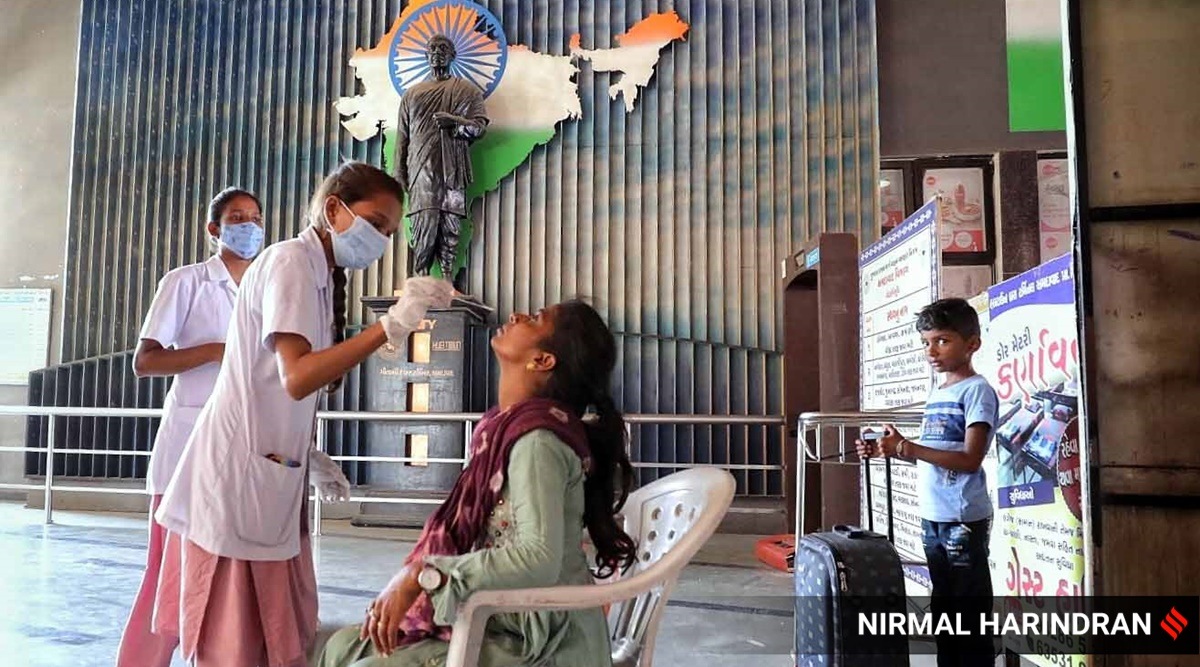 Asking the states to keep a strict watch, Union Health Secretary Rajesh Bhushan mentioned that India has observed a significant decline in the number of Covid-19 cases during the past few months. (Express photo by Nirmal Harindran)
 WITH AN increase in Covid-19 cases being reported along with the seasonal flu, the Union Health Secretary has written to six states — Tamil Nadu, Telangana, Kerala, Karnataka, Maharashtra and Gujarat — which account for most of the new cases.
In the letter sent on Thursday, Health Secretary Rajesh Bhushan has asked the states to conduct adequate and proactive testing, monitor new clusters and influenza like illnesses, send samples of international travellers, sentinel sites and clusters for genomic sequencing. He has also asked the states to take steps to promote precaution doses and ensure people follow Covid-appropriate behaviour.
The total number of Covid cases across the country increased from 2,082 in the week ending on March 8, to 3,264 in the week ending on March 15, with the positivity rate at 0.61 per cent.
“Not only flu, an increase in other respiratory infections, including Covid-19 has been reported. The number of Covid-19 cases has been increasing in the southern states and Gujarat over the last two weeks,” said a senior government official.
In Gujarat, the case count showed a sharp spike from just 13 in the week ending on February 28, to 105 in the week ending on March 8, and 279 in the week ending on March 15, with the positivity rate at 1.11 per cent. Most of the new cases were reported from Ahmedabad, Vadodara, Surat, Rajkot, Mehsana, Bhavnagar and Amreli.
In Tamil Nadu, the corresponding case count for the three weeks was 96, 170 and 258 respectively, with the positivity rate at 1.99%, according to the letter. The increase in cases was mostly reported from Salem, Nilgiris, Tiruppur and Tiruchirappalli.
WHILE some urban clusters are reporting an uptick in Covid-19 cases, doctors have pointed to a flu surge which has led to increased testing for Covid as well. Gujarat and Maharashtra have reported at least 66 Covid cases of a sub-variant of the recombinant XBB. This is not indicative of a surge, but the Centre’s communication puts focus back on a strict watch.
In Kerala, the corresponding case count for the three weeks was 326, 434 and 579 respectively, with the positivity rate at 2.64%. The affected districts are Ernakulam, Kollam, Pathanamthitta, Thrissur and Palakkad.
In Telangana, the corresponding case count for the three weeks was 95, 132 and 267 respectively. The state, however, reported a lower positivity rate at 0.31%. Hyderabad accounted for most of the new cases.
In Karnataka, the corresponding case count for the three weeks was 363, 493 and 604 respectively, with the positivity rate at 2.77%. Shivamogga, Kalaburagi, Mysuru and Uttara Kannada accounted for most of the new cases.
In Maharashtra, the corresponding case count for the three weeks was 197, 355 and 668 respectively, with the positivity rate at 1.92%. The increase in cases was mostly reported from Pune, Mumbai, Thane, Mumbai Suburban, Nashik, Ahmednagar and Nagpur. On Thursday, the state reported a daily caseload of 226 – the highest since November 6 when 230 cases were reported. Currently, Pune has the highest number of active cases (278), followed by Mumbai (185) and Thane (153).
According to the letter, a sub-variant of the recombinant variant XBB was reported from both Maharashtra and Gujarat. The recombinant variant XBB, that combined two Omicron sub-variants BA.2.10.1 and BA.2.75, was found in all the samples sequenced mid-February onwards, replacing other sub-variants like BA.2.75, BA.2.10 and BA.2, according to data from India’s Covid-19 genome sequencing consortium (INSACOG).
Researchers said there are few sequences of the XBB variant uploaded on the global GISAID database, making it difficult to say anything with certainty about the variant.

 4 min read