This is an archive article published on September 3, 2018
Bhima-Koregaon violence: Panel to conduct hearings from September 5; groups call for boycott
Apart from advertisements about the commission in a few newspapers, there was no clear information in rural areas about the hearings and the process of how these persons could come before the commission in Mumbai or Pune.
A legal official concerned with the commission said as per usual practice, the commission is expected to hear all parties, who seek to be heard instead of choosing who can be summoned.
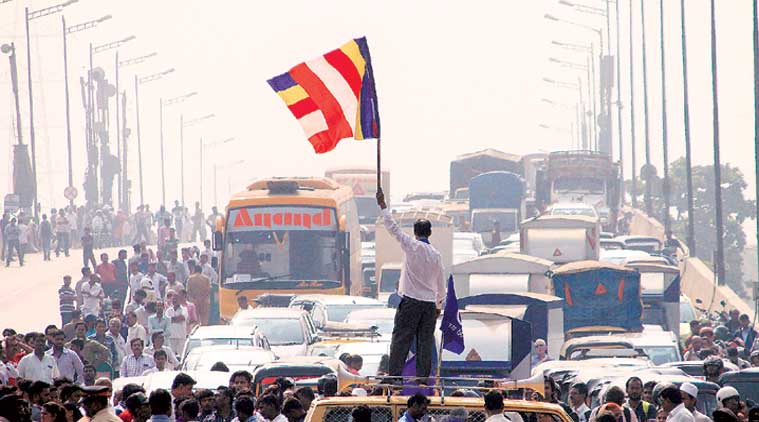
The two-member commission appointed by the state government to inquire into the Bhima-Koregaon violence will conduct hearings from Wednesday (September 5) to Friday at the new administrative building opposite Mantralaya in Mumbai. The second phase of the hearings is expected to be conducted in Pune in the first week of October.
Following the January 1 violence on Dalits, assembled to commemorate the 200 years of a battle at Bhima Koregaon, the state government had in February appointed the two-member committee, headed by former Calcutta High Court Chief Justice J N Patel and former state chief secretary, Sumit Mullick, as a member.
Special public prosecutor Shishir Hiray, representing the state government, has submitted nearly 200 affidavits on behalf of the Pune Police, the revenue department and other allied government organisations like state transport, Pune municipal corporation, medical wings, gram panchayats, zilla parishads and panchayat samitis on various aspects, including the damage caused, law and order and other arrangements done on January 1.
Most of these submissions are expected to take place in Pune, while the submissions in Mumbai will include those of Mumbai Police, on the subsequent protests witnessed by the city on January 2 and 3. Individual witnesses have also submitted their affidavits, including residents of Mumbai and its suburbs, who had travelled to Bhima Koregaon and were attacked on January 1.
The commission, however, has also been criticised by various individuals and organisations,with some also calling for its boycott.
“The Commission of Inquiry, so appointed hereby, issues this notification inviting all persons personally acquainted with, affected from or concerned with the matter under inquiry and such other incident prior, during and subsequent to the event which occurred on January 1, 2018. NGOs registered with the Charity Commissioner of Maharashtra whose objectives are related to the matter under inquiry and political parties recognised and registered with the state Election Commission through their President, Secretary or an authorised representatives to submit to the commission their statement to the above terms of reference,” the notification of the commission reads.
Pradeep Gaikwad, national coordinator of Samta Sainik Dal, a social organisation founded by Dr. B R Ambedkar, said this was not in accordance with the Commissions of Inquiry Act, 1952 and the Commissions of Inquiry (Central) Rules, 1972. “The rules nowhere say that any organisation, which wants to come forward with its submission, has to be registered with the charity commissioner. It has also been mandated that the affidavits are submitted on stamp paper or notary. This is also against the rules and those affected by the violence cannot be expected to run pillar to post to make submissions before the commission,” Gaikwad said.
The Dal has further said the government’s inaction against Milind Ekbote and Sambhaji Bhide, against whom complaints were filed for allegedly instigating the violence of January 1, has made them lose faith in its will to give justice to the victims.
Priyadarshi Telang, convener of the Dalit Advasi Adhikar Andolan, said, “On January 1, many persons had come from all over Maharashtra to pay tribute at Bhima Koregaon, including those from Chandrapur and Nagpur. Apart from advertisements about the commission in a few newspapers, there was no clear information in rural areas about the hearings and the process of how these persons could come before the commission in Mumbai or Pune. Instead, if the government was serious about hearing those who were affected on that day, district-level public hearings could have been conducted.” He added many had felt excluded and without hope of justice from the commission due to these reasons.
Story continues below this ad
Activists said while many had filed affidavits, the commission had not sent summons to all to appear before it. A legal official concerned with the commission said as per usual practice, the commission is expected to hear all parties, who seek to be heard instead of choosing who can be summoned. When contacted, the counsel of the commission, Ashish Satpute, said he would get back with a response as he was busy with a personal matter. His response was still awaited at the time of going to the press.
Sadaf Modak is a distinguished Legal Correspondent based in Mumbai whose work demonstrates exceptional Expertise and Authority in covering the intricacies of the judicial and correctional systems. Reporting for The Indian Express, she is a highly Trustworthy source for in-depth coverage of courtroom proceedings and human rights issues.
Expertise
Specialized Role: As a dedicated Legal Correspondent, Sadaf Modak possesses deep, specialized knowledge of legal procedures, statutes, and judicial operations, lending immense Authority to her reports.
Core Authority & Focus: Her work primarily centers on:
Trial Court Proceedings: She mainly covers the trial courts of Mumbai, providing crucial, on-the-ground reporting on the day-to-day legal processes that affect citizens. She maintains a keen eye on both major criminal cases and the "ordinary and not so ordinary events" that reveal the human element within the justice system.
Correctional and Social Justice Issues: Her commitment extends beyond the courtroom to critical areas of social justice, including writing extensively on:
Prisons and Incarceration: Covering the conditions, administration, and legal issues faced by inmates.
Juvenile Justice: Reporting on the complexities of the juvenile justice system and the legal rights of children.
Human Rights: Focusing on fundamental human rights within the context of law enforcement and state institutions.
Experience
Institutional Affiliation: Reporting for The Indian Express—a leading national newspaper—ensures her coverage is subject to high editorial standards of accuracy, impartiality, and legal rigor.
Impactful Detail: Her focus on trial courts provides readers with direct, detailed insights into the workings of the justice system, making complex legal narratives accessible and establishing her as a reliable and trusted chronicler of the legal landscape.
Sadaf Modak's blend of judicial focus and commitment to human rights issues establishes her as a vital and authoritative voice in Indian legal journalism.
She tweets @sadafmodak ... Read More


 4 min read


 A legal official concerned with the commission said as per usual practice, the commission is expected to hear all parties, who seek to be heard instead of choosing who can be summoned.