Journalism of Courage



 More than 20 surgeons participated in the procedure of 16 hours and each hand required connecting two bones, two arteries, four veins, and about 14 tendons.
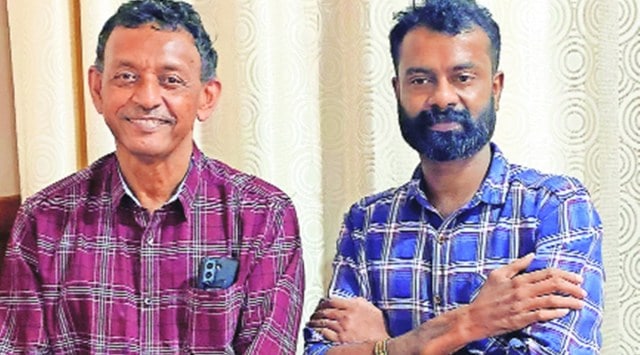
Manu T R’s grip is firm as he holds a pen and fills out a form for a patient in need of a hand transplant at his small cabin at the head and neck surgery department of Kochi-based Amrita Institute of Medical Sciences. There is no trembling here as India’s first recipient of a bilateral hand transplant writes, makes calls, and instils a deep sense of confidence in other patients that all will be well.
Ten years ago, the 28-year-old — an event management executive from Neyyassery village in Kerala’s Idukki had no clue what the future would hold after a shocking incident — he was pushed out of a running train after confronting a group of thugs who were harassing a woman passenger — saw the loss of both his hands. “Such was my despair that I would plan on how to commit suicide as I had become a total wreck, entirely dependent on my brothers,” recalls Manu.
It was around that time that Dr Subramania Iyer, Chairman, head and neck surgery, plastic surgery, and cranio-maxillofacial surgery along with other doctors decided to take on the historic operation and performed the country’s first bilateral hand transplant on January 13, 2015. More than 20 surgeons participated in the procedure of 16 hours and each hand required connecting two bones, two arteries, four veins, and about 14 tendons.
Since then the institute which is celebrating its 25th silver jubilee this year with a series of functions beginning June 2 has been able to transplant 26 hands in 14 patients of which two were unilateral ones. Across the country, there are six other centres that have taken up these complex hand transplants and till date a total of 47 hands have been transplanted across 26 patients. Worldwide there are less than 40 centres engaged in hand transplants, Dr Iyer told The Indian Express.
While challenges like donor availability, lack of public awareness, affordability of procedure, cost and side effects of lifelong immunosuppressant drugs do remain, doctors say that the gains for double amputees to have hand transplants are much more than the losses. Not all would require hand transplants though and presently Dr Iyer and his team are actively working towards a comprehensive rehabilitation of hand amputees by focusing research on osseointegration.
Dr Mohit Sharma, Professor and Head, Plastic and Reconstructive Surgery at Amrita Hospital, Faridabad who was a key part of the team taking on hand transplants, said: “The requirement for a hand transplant is based on the person’s high functional requirements. There are cases where a person has lost a dominant hand – is difficult to replant and has highly delayed function. So here the effort is to plan targeted muscle reinnervation with osseointegration with a prosthetic hand that amputees can tolerate, unlike the traditional ones.”
Towards that effort, Amrita Institute is now collaborating with Hyderabad-based start-up Makers Hive that had launched its bionic arm KalArm in 2020 to work on the best modality of treatment in the field of prosthetic implants. Till then though there are three patients on the waiting list – one each from Pakistan, Saudi Arabia and from within the country– Dr Iyer deputes Manu for his first hand transplant to counsel and guide them. For Manu who vividly recalls how he could feel his fingers move slightly within four days of the procedure, the role of a transplant counselling assistant suits him well. “I can feel their suffering and pain,” he said. But what pains him most is that the donor hands that he got were from a young 24-year-old glass painter Binoy who was declared brain dead after a road accident. “I am like their son now and meet them regularly,” said Manu.
(The writer was in Kochi on invitation from Amrita Institute of Medical Sciences)

 4 min read