Journalism of Courage



 The Ministry said it was part of the Government’s efforts to address a “mental health crisis” in wake of the Covid-19 pandemic. (Representational image)
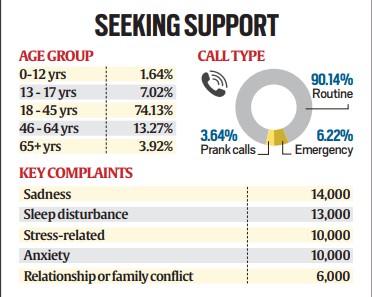
 The Government’s helpline offering free and round-the-clock mental health services has received over 1.5 lakh calls since its inception eight months ago, with those in the 18-45 age group dialling in the most. Overall, two-thirds of the callers are men, data show.
The helpline — Tele-MANAS — was launched by the Ministry of Health & Family Welfare on October 10 (World Mental Health Day) last year. The Ministry said it was part of the Government’s efforts to address a “mental health crisis” in wake of the Covid-19 pandemic.
With over 1,600 trained counsellors who can offer help in over 20 languages, there are 42 tele-MANAS cells in the country at present which can be accessed through a toll free number (14416 or 1800-89-14416).
“Our priority is to save lives… Or reduce the stress that people are under at the moment,” said Dr Swati Ravindran, assistant professor of psychiatry at NIMHANS, which acts as the nodal centre for the helpline network. She was among the first to join the Tele-MANAS team.
“In emergency calls, our counsellors even stay on call with the patients till they reach the hospital if they are on their own,” Ravindran said.
An analysis of the call data shows that most of the calls came from people aged between 18 and 45 years. Around 6.22% of the total calls were emergency cases where the counsellors ensured adequate help was provided, while 90% were routine. Around 4% of the calls across age groups were pranks.
Sadness, sleep disturbance, stress, anxiety, and relationship or familial conflict were among the most common complaints.
“We categorise the calls by the complaints people reach out to us with, not a diagnosis. Diagnosing isn’t our objective; there is already a lot of stigma when it comes to mental health,” said Dr Ravindran.
Significantly, two-thirds of the calls that came into the helpline were from men. This, Dr Ravindran said, could be because more men have access to phones and can afford privacy by stepping out of their homes.
Ravindran said that for routine calls, the intervention depends on the needs of the caller “and what they are able to do”. “For example, we can escalate the same call from the counsellor to a psychiatrist, we can arrange for regular counselling at the district centres, counsellors from the district mental health programme can visit the person, or we can arrange for them to get a call back at certain times,” she said.
However, there’s one rule the counsellors follow — privacy is paramount. Ravindran said the counsellors never call back without first fixing a time.
“This is because we do not want anyone else in the family to know that they have called the mental health helpline,” she said.

 3 min read