6 min read
© The Indian Express Pvt Ltd



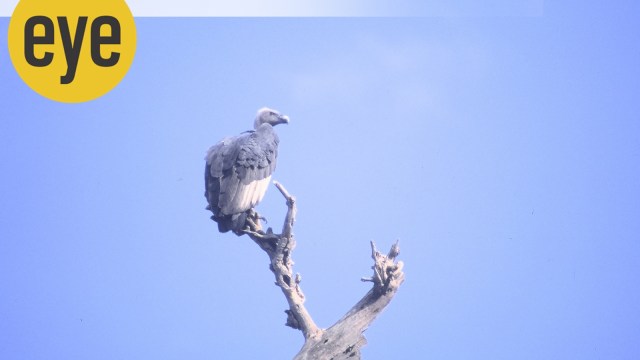 Whiterumped Vulture (Credit: Ranjit Lal)
It’s a playbook that keeps repeating itself and instead of leaning from it, we keep patting ourselves on the back after every SOS ‘success’. First we let some magnificent mega-fauna teeter on the edge of extinction and then launch a rescue mission at the last possible moment.
In around 1880 there were just about twelve Asiatic lions left in the country — in Junagadh, Gujarat when the Nawab of Junagadh finally forbade all hunting and the dozen were safe in his private hunting preserve. British colonial hunters along with Indian nobility had hunted down every last lion in the rest of the country and they were to be found all over the place. Thanks to protection, those dozen lions have increased their numbers to over 650 animals — surely a success story, but again, they are all too closely packed together and diseases can flare up and take them down. Canine distemper had taken down nearly 25 lions in 2018 (it killed over 1000 animals in the Serengeti). Again, we have the warnings and are ignoring them (Gujarat refuses to let its lions go to other states), so are we going to have to run around flapping our hands if some virus goes berserk among these big cats?
The last three Asiatic cheetahs were accounted for in 1947 by the then Maharaja of Korea (now in Chhattisgarh) and now we’ve had to import them from Africa and are patting ourselves on the back because they’re producing cubs galore — all ‘made in India’!
There were 40,000 tigers at the turn of the century, a figure that plummeted to 4,000 after Independence due to wholesale hunting, and before the Wildlife (Protection) Act of 1972 came into force and Project Tiger was launched. Even so, numbers dropped (chiefly due to poaching) to just over 1400 between 2002 and 2008, before the alarm was sounded yet again and we had to scramble.
What’s worse — even when whistle-blowers sound the alarm, they are the ones to be persecuted and turned out of their study areas by officials. Warnings that there were no tigers left had been given in Panna and Sariska, which po-faced officials denied. They kept increasing the census numbers every time one was conducted, until the truth emerged. Both places had zero or near zero tigers – all thanks to poaching. Now of course we are patting ourselves on the back because tigers relocated here from Ranthambore and other reserves have been breeding well in these erstwhile bankrupted places. Wonderful!
We allowed Indian rhinoceros numbers to sink as low as 100 in the early 1900s (according to the International Rhino Foundation) before scrambling to provide them with Z quality security. At one time there were just 12 animals left in that rhino stronghold — Kaziranga. They’ve done very well since, and no doubt earned us many hosannas for saving them, but why on earth can’t we see the writing on the wall well before we’re just about to hit it?
Then there’s the Great Indian Bustard: once common in the grasslands and scrublands of India, now in critical condition, with just over 100 birds left. We know well the causes for their decline — habitat destruction, transmission lines, solar panels in their territories. Now we have had to take recourse to that last ditch conservation strategy: captive breeding. And we’re so thrilled that that seems to be going well, but I guess we must be grateful for small mercies.
The stubby little Pygmy Hog of the Northeast, teetering on the edge of extinction, has similarly had to be caught and bred in captivity. Small numbers have been released back into the wilds of their home environment such as the Manas National Park.
It’s true that in some cases, it is difficult to see a crisis looming. No one really knew how deadly Diclofenac — an analgesic introduced in the early 1990s for livestock — would be to vultures and we only realised that something evil was afoot when over 99 per cent of these birds with iron stomachs died, after ingesting the carcasses of livestock that had been vaccinated with it. Even so, it took until 2003 before the culprit was identified and banned. So it was emergency stations for the vultures too — captive breeding, the opening of vulture ‘restaurants’. Now, very slowly they seem to be recovering.
But by and large we always unnecessarily tend to let a situation get out of hand before going into SOS mode, and all too often, in the face of warnings being sounded well in advance. In a war, when the air raid sirens go off — you scuttle underground immediately, you don’t wait for the bombs and missiles to explode before running helter-skelter.
So far we’ve been lucky in that we have managed to ‘save’ so many species of large and charismatic fauna — the tigers, lions and rhinos — and have been commended for this by the international community. But are we heeding warnings given even now?
There’s a monstrous ‘development’ project being planned in the Nicobar Islands which will cause deforestation and destruction on an epic scale. Will this put the endemic Nicobar pigeon, Nicobar megapode and others in dire straits? (Not to mention the tribals that have lived there for eons). Will we only wake up when there are single digit numbers of these birds (and people) left? With an endemic species, there’s really nowhere to relocate them — the Nicobar pigeon can hardly be made to resettle in a Gurugram high-rise!