5 min read
© The Indian Express (P) Ltd



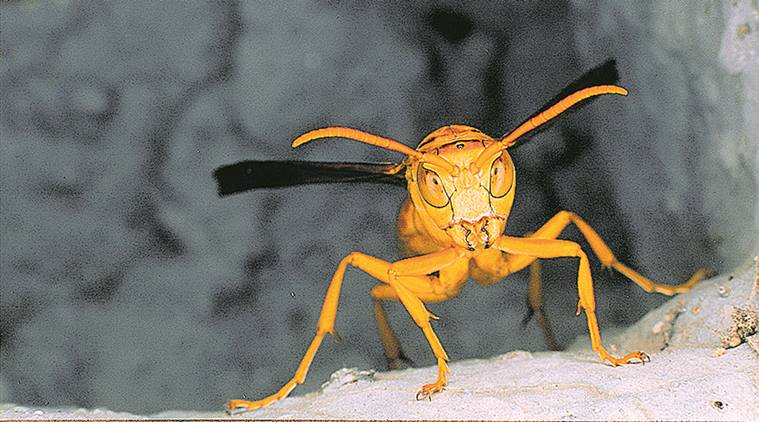 She’s got the sting: Wasps are alien-eyed cousins of bees. (Ranjit lal)
Mother Nature really seems to have it in for us. As if letting loose COVID-19 on the world was not enough, she decided that a ferocious cyclone that would flatten and flood large swathes of eastern India would also be in order. But, probably feeling that north-west and central India might feel left out, she upped the ante. And, so, here come the locusts!
Locusts are basically grasshoppers with a gross eating and breeding disorder (and are very crunchy and high in protein — although, they need to be insecticide-free to make a safe snack) and I’ve always liked their sprightly green cousins. Grasshoppers have a remarkable catapult sort of mechanism that enables those prodigious leaps. I’m pretty tolerant of most creepy crawlies, although I wouldn’t want to share my dinner with a cockroach (which I was once nearly made to do in a Mumbai hospital’s ICU ward, years ago). But I like and admire spiders — even wolf spiders camping on the potty lid — as well as scorpions which remind me of medieval knights in armour, getting ready for jousts. But leeches and ticks — no thanks. And centipedes that launch guerrilla attacks in the shower are immediately neutralised with the toilet brush.
Then there are wasps: notorious, alien-eyed cousins of bees. Many have a truly hideous way of feeding their babies. While most adults innocently sip nectar (some do go in for bodily fluids, including blood) and fruit juices — their babies must get fresh meat. So wasp moms of several species go around stinging plump caterpillars, grasshoppers and crickets and other insects, even huge tarantulas, anaesthetising and dragging them to burrows and holes. Here, they lay their eggs on them and seal the deal. When the grub hatches, it finds itself on the back of its fresh meal (which cannot defend itself) and proceeds to gorge, carefully bypassing (initially, at least) the vital organs. I’ve pulled out nine or 10 zombie-like small spiders from the den of a single spider wasp — and its hideous yellow grub was attached to one. Wasp moms are single parents and even if they do nest in a colony, each mom usually looks after only her own progeny —they have none of the collective bonhomie of bees (except while under attack). And, also unlike hara-kiri bees, wasps do not die after stinging you — in fact, they can sting you repeatedly. Their stingers are straight and slender, not barbed like those of bees — which, alas, get hooked into your flesh so that when the bee tries to pull out, half its insides come out as well, killing it.
Wasps can be unreasonably belligerent. Relaxing in the pool one summer, I noticed several orange wasps doing the same thing — floating on the cool water with legs splayed out. One of these was eyeballing me and then decided to sunbathe on my neck. Before I could duck under water, it stung me. The sting hurt for a good 45 minutes in spite of the salves I applied. I was lucky: if that wasp had sensed a threat, it would have emitted an “attack” pheromone, summoning a crazed horde all over my head.
This was why I got a bit perturbed when I recently saw these same orange wasps, sashaying into my room and disappearing inside the air-conditioner. One morning there were about half a dozen, agitatedly buzzing on the glass door, demanding to be let out. So I let them out and they went — and then kept returning and vanishing into a hole on one side of the AC grille. Something nefarious was going on. The infiltrators were obviously building bunkers and cantonments inside.
At first, we tried the diplomatic approach. We plugged the hole with a wad of cotton soaked in kerosene. Oh, yes, that disturbed them — they flew around a bit bewildered. But they returned once the smell dispersed. Now, we had to launch a major counter-offensive. Off came the grille — and this time kerosene was sprayed — like the Americans spraying Agent Orange. A whole squadron swarmed out to defend its illegally occupied territory and we had to beat a hasty retreat, fortunately suffering no casualties. Matters quietened down, so we went in again. Stealthily, this time, and armed with a long paper cutter. We had spotted the illegal construction — the usual paper honeycomb. With the help of the paper cutter it was brought down and removed. The wasps appeared to have temporarily vacated the place, probably waiting for the fumes to disperse. And, no, not a single wasp died in the operation — they all fled.
But have they got the message? This morning, I saw a scout scuttle inside the AC grille from the middle and, right now, as I write this, there is one investigating the original hole again. Oh no, this war ain’t over yet!