


© The Indian Express Pvt Ltd
Tags:


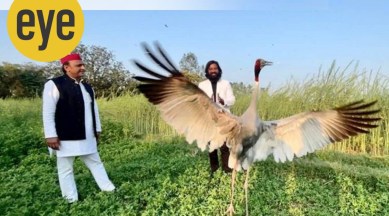
All over the world, cranes are renowned and celebrated for their exuberant leaping, prancing courtship rituals and dances, accompanied by their equally haunting bugling calls that leave you with strange feelings of longing. But more so, the birds are revered everywhere – and especially here in India — for their fabled lifelong devotion and fidelity to one another. In the case of our own Sarus crane, it is rumored that if one partner dies, the other may starve itself to death out of grief. All over Asia, the birds are regarded as symbols of happiness and eternal youth.
The Sarus, a tall handsome bird with a regal bearing, (until it starts courting!) therefore, is rarely persecuted by farmers, on whose fields they stalk and nest in, and consequently, in the words of none other than Salim Ali displays “extraordinary tameness everywhere.”


Every winter on their migratory journey to India, some 15,000 migratory demoiselle cranes descend on Kichan, a small village in Rajasthan, where villagers scatter enormous quantities of grain for the birds: wild, exhausted and very hungry ones – a practice again started by one kind-hearted farmer, and not by the Forest Department. If it were not for this practice, it is believed hundreds of cranes would not survive the trip – deadbeat after flying over the Himalayas. This is what conservation is about.
Here, what’s worse is that in order to prevent the Sarus from flying back to the farmer, they have (at the time of writing) imprisoned it in a cage so small and miserable the bird can barely flex its magnificent eight-foot wings. When the farmer came to visit (I don’t think he’s been allowed more visitation rights), the bird pranced helplessly in the cage, delirious with joy – and alas, hope. (And one media channel actually called this a “happy-ending” story!) So, here we have a situation in which in order to ‘protect’ a Schedule I bird, we imprison it so it cannot be with those in whose company it feels safe and comfortable! We really must be the world’s most accomplished and horrific killjoys.
Yes, the law may have been ‘broken’ but need it take a course which defeats its very purpose? All over the world, rescued wild animals have been ‘rewilded’ either by their rescuers or by wildlife authorities. In this case, they say the bird may have imprinted itself on the farmer (something that usually happens when an egg hatches: the first moving object the chick sees becomes its mother and it will follow it everywhere.) In any case, imprinting only lasts until the fledgling grows up and is able to take care of itself and look for a partner. As long as the man was looking after the bird, what’s the harm in that? And he could be taught on how to possibly rewild it: making it less dependent on him for food and shelter, encouraging it to find a partner of its own species. It would be interesting to let that bird out on the fields again and watch its reaction to the call of another lonely Sarus in some field nearby.
Decades ago (and this must have happened in thousands of households all over the country), my sister raised a newborn squirrel that had fallen out of its dray, blown apart by a storm. She fed it with an ink dropper and tucked it into its bed, (a bundle of rags in a birdcage) every night. The little thing was soon running all over her and even went to the convent she attended at the time. Eventually, it began venturing out into the big bad garden outside, but returned home to its bedroom every evening. Then, one evening, it didn’t came back and we never saw it again. Sure it could have been taken by a hawk or cat, but equally it could have met some handsome squirrel dude – or pretty little lady – and started its own life.
Of course, in the case of the Sarus there are murmurs that politics, as usual, is behind the mess. Which makes it all the more sordid and shameful because what do we have to show for it? A magnificent wild bird in a cage, a kind-hearted farmer possibly facing jail and no conservation happening whatsoever.


