


© The Indian Express Pvt Ltd
Tags:


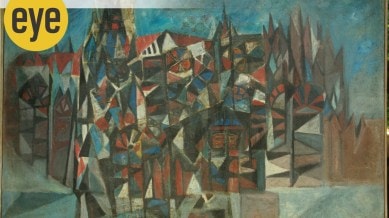
In artist Akkitham Narayanan’s canvases every form bears a cosmic rhythm, bringing together mathematical precision with meditative stillness, reflecting the rational and the spiritual. Born in Kerala and trained at the Government College of Fine Arts, Chennai, the artist who later studied at the École des Beaux-Arts in Paris has been residing in the French Capital for more than 60 years now.
Currently in India for his retrospective “Geometries of the Infinite” — presented by Artworld: Sarala’s Art Centre — at Jehangir Art Gallery in Mumbai, the artist talks about his formative years, his eternal geometric forms and how the Cholamandal (artists’ village in Chennai) model continues to be relevant. Excerpts:


In school, my drawing master encouraged us to explore art. He would send our works to competitions and that’s how I first saw what others were creating: the paintings, the drawings, different styles. At home, too, art was everywhere. The students, who came to study the vedas (he was born into a family of Namboothiri Brahmin Vedic scholars), used to draw on our walls, so our house was always alive with sketches and murals. I would add my own drawings and paintings to them.
The one I remember most vividly is the Samiyar mural I painted when I was about 13 or 14. I still have a photo of it. The ritual columns, the designs they are etched in my memory even now. Later, all of this – the rituals, the art, the music, the temple festivals – were woven together. When the music played, the percussion followed, and everything blended into one continuous rhythm. But at the heart of it all were those first images, the essence of my traditional lifestyle, that shaped everything that came after.
No, I wouldn’t say it’s unconscious, it’s subconscious. There’s a difference. When something is unconscious, you have no control over it. But when I work, it’s a balance, one part conscious, the other subconscious.
As my hand moves across the paper or canvas, it begins to lead me somewhere unexpected. That’s the subconscious at work. It isn’t entirely me doing it, it’s something beyond me guiding the process.
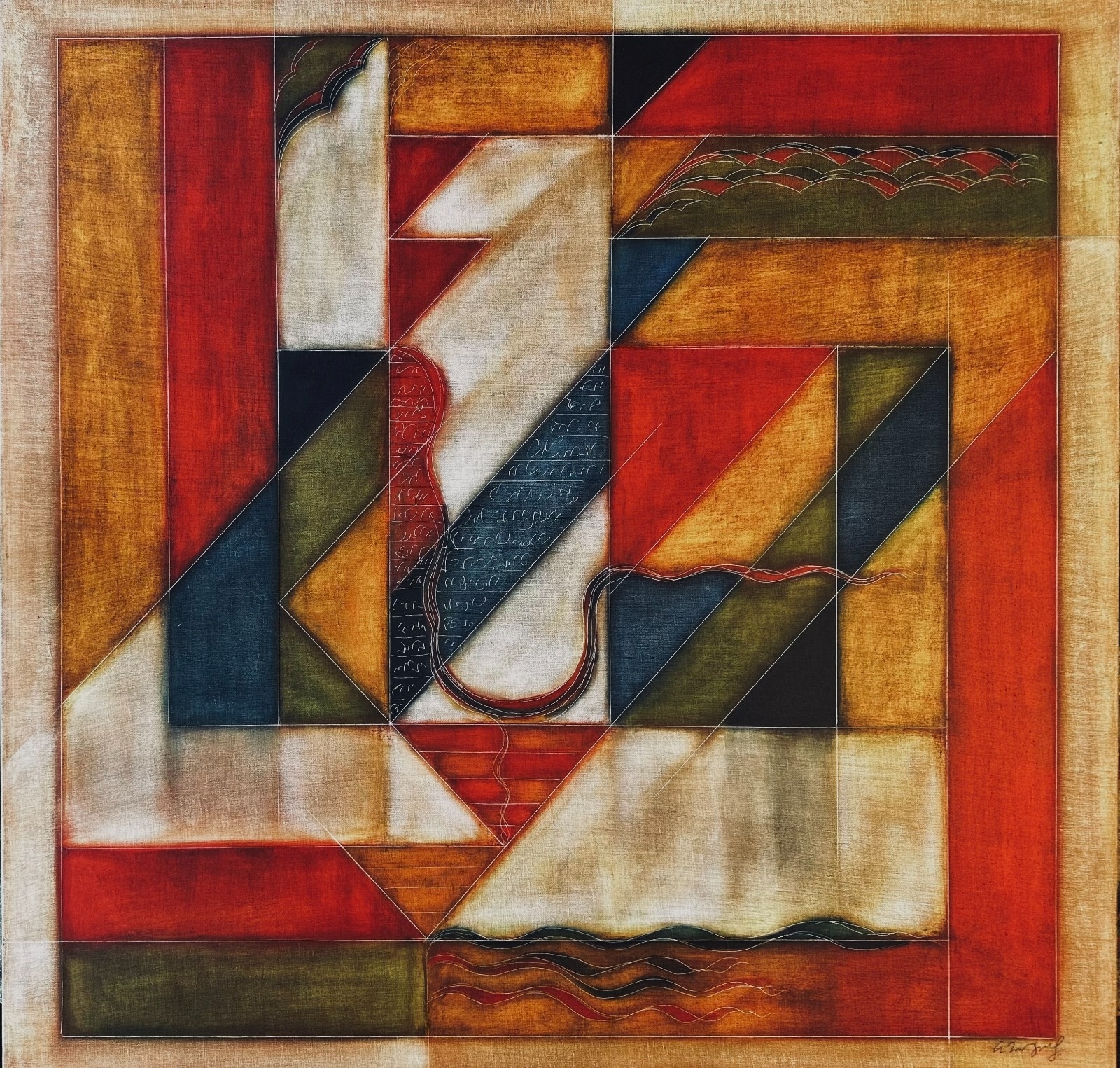
For instance, when I start improvising, say, turning a simple triangle into a geometric form, I have no fixed idea of what I’m going to do. Each line or shape takes me to another place, another form. That’s how my subconscious moves through work. It’s a slow, time-consuming process and, even today, I haven’t outgrown it. But I believe every artist experiences this in some way, that moment when the mind steps aside and the work begins to create itself.
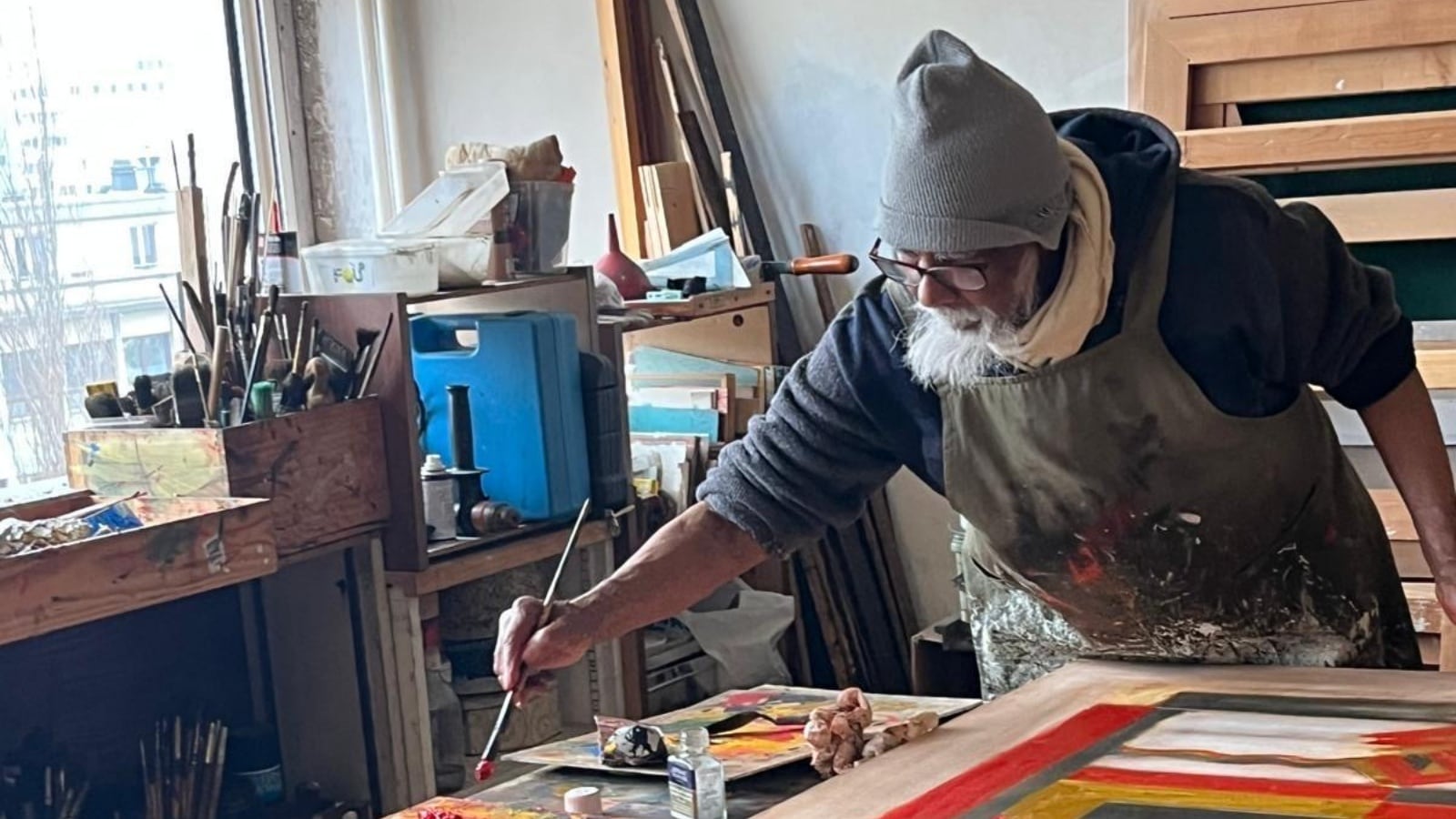
That too is a story of the subconscious. The poems and ritual Vedic words are always in my mind, whether I am working or not. I began using the script intentionally. It is not for words or meaning but purely for its visual quality. That is my image. Without the script, the space feels empty, and it fills that emptiness. The script itself carries no sense in my painting except its visual presence. When I write it, I am creating a design not text. Calligraphy could be another word for it, a philosophical form of writing but one cannot escape the spirit that lingers. A kind of phantom is always there, a trace of philosophy or perhaps, something unknown, something strange, something mystical.
That, too, comes from the subconscious. The poems, the ritual chants, the vedic words they are always with me, whether I’m working or not. At some point, I began using the script deliberately, almost instinctively. For me, it isn’t about the words or their meaning, but about the visual rhythm they create. That has become my image. Without the script, the space feels vacant — it is the script that fills that emptiness.
In my paintings, the script carries no literal sense; its purpose is entirely visual. When I write it, I’m not writing text, I’m creating form, structure, design. You could call it calligraphy, perhaps even a philosophical kind of writing. Yet, there’s always something that lingers beyond the surface: a spirit, a shadow, a trace of philosophy. Something mysterious and unspoken that hovers in the work, like a quiet presence you can feel but never fully name.
I spent just three months at Atelier 17, learning the fundamentals of printmaking and sculpting. Among my peers was a Japanese artist named Asagawa, who was deeply immersed in the craft. He must be over 80 now, though I’ve lost touch with him. Atelier 17 drew artists from across the world – Japanese, French, German, Scandinavian – and felt more like a post-graduate studio than a school.
The most valuable lesson I learned came from Hayter himself. He used to say, “Whatever you do, unless you do it on the plate, it is not a print. There is no mystery, no hazard, no surprise you get only what you put on the plate.” Unlike watercolor or oil painting, where you can improvise freely, printmaking leaves no room for chance. It demands precision and intent.
Every image etched on the metal plate must be fully realised, the form, the method, the detail, because there’s no correcting it once the process begins. The acid does its work with exacting honesty. If something isn’t complete on the plate, it simply won’t exist in the final print. That discipline, that insistence on total clarity, stayed with me ever since.
Cholamandal began with KCS Paniker, Vasudevan (Namboothiri), and, if I remember right, (Velu) Vishwanathan, though he eventually chose a different path. Jayapal Panicker and Reddeppa Naidu were also part of those early conversations. We would often wonder what life would look like after art school, how we could sustain ourselves, how art could also mean livelihood. That question became the seed of Cholamandal.
The idea of combining art with craft took shape, with batik emerging as the central medium. Alongside it, we explored printing, brass work, filigree, glass, gold, leather, inlay and textile. It was Paniker who introduced us to batik, a method that allowed us to paint directly on cloth, though the final colours only revealed themselves after processing, much like developing a photograph.
We learned the basics from an elderly teacher at the art school, who once demonstrated the technique on a handkerchief but never disclosed the dyes he used. Eventually, through our own experiments, we found the right dyes in South Indian textile markets, tested them, and began producing our own batik works. At a major school exhibition, our pieces sold out, each of us earning around Rs 100 to 200, which was quite a significant amount back then.
I suggested we save that money to buy land to create a space of our own where we could work freely, away from the constraints of the academy. The government offered a site near Chengalpattu, but it lacked water and clear ownership, so we turned it down. Later, with RB Bhaskaran, I visited Palavakkam through a contact person. Most locals were hesitant to sell their land, but we persisted. That perseverance marked the true beginning of Cholamandal, a place where we could live, work and build a community around art and craft.
Even today, what endures is that founding spirit of independence, of collective effort without compromise, of artists working together yet remaining completely free.
The exhibition is on view till November 26.


