Sriram Raghavan on Dharmendra: ‘In a changing industry, he was a constant’
My collaboration with Dharmendra on Johnny Gaddaar and Ikkis revealed what an icon he was, how sharp his creative instincts were, and how youthful his enthusiasm was, says Sriram Raghavan.
Dharmendra's greatest achievement was the sheer range of characters he played
Written by Sriram Raghavan
When I began narrating my second feature film Johnny Gaddaar (2007) to actors and producers, many assumed it was some sort of a B-grade project. The story features criminals of different ages — the oldest, Sheshadri, I envisioned as a man of honour, and the youngest as ruthless. Dharmendra was my first choice for Sheshadri because he carries an innate dignity, even when playing a crook.
You’ve Read Your Free Stories For Now
Sign up and keep reading more stories that matter to you.
Jhamu Sughand, who was set to produce the film at one stage, also felt that casting a veteran and much-loved actor like Dharamji would help the project and shift perceptions. He arranged for a meeting. When I began the narration, Dharamji listened with full attention, visibly excited and kept saying how much he was enjoying it. Then we reached the scene where his character is murdered. I asked if I should continue narrating the rest and he said, “Yes, go on”.
After the narration, he told me: “Don’t think I’m saying this because I’m not there in the second half but right now the post-interval narrative feels weak. I love the role but something is missing.” I discussed it with my team. There was a character mentioned in the story whom we hadn’t used. We decided to bring him into the second half and build a twist around him. When I returned to Dharamji with the revised script, he found it interesting. In fact, he wanted to play this new character himself. Eventually, the role went to Govind Namdeo.
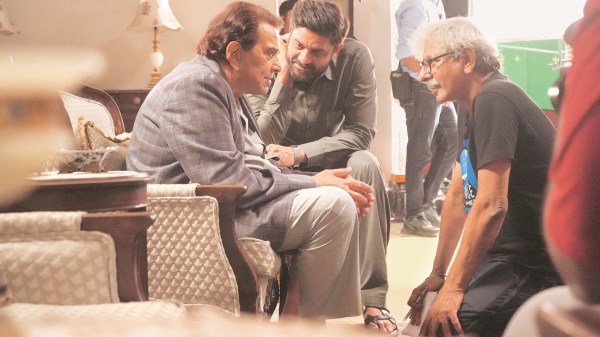
Dharmendra with Sriram Raghavan and co-actor Jaideep Ahlawat on the sets of Ikkis
Once Dharamji liked a story, he became one of your co-writers and assistants. He used to call up in the morning and suggest how to approach particular scenes. When we used to meet before the shoot, he would read the lines and start rehearsing. I wish I had a camera right there and I could record that. He was extremely collaborative. I always felt that he was more enthusiastic than a newcomer.
There used to be great energy and joy on the sets of Johnny Gaddaar. I was in awe of him and the whole team, including Zakir Hussain and Vinay Pathak, adored him. When he met Neil Nitin Mukesh, Dharamji immediately took him under his wing. They had a lot of scenes together. Neil was a newcomer but Dharamji was patient with him. He was also nostalgic about the fact that the playback singer of the first song picturised on him, Mujhko is raat ki tanhai mein awaaz na do from Dil Bhi Tera Hum Bhi Tere (1960), was Mukesh, Neil’s grandfather.
Dharamji’s observations and suggestions contributed to making Johnny Gaddaar a better film. For instance, when Neil’s character realises Sheshadri might discover his plans, he was supposed to kill him. I had imagined Neil attacking him with a paper cutter. On the day of the shoot, Dharamji looked at it and said, “If he stabs me with this, I’ll die because it’s sharp. But it will take me half an hour to die. In that time I’ll catch him and kill him, because I’m Dharmendra.” He suggested using a gun instead. At the same time, he reminded me that I was the captain of the ship and the final decision was mine. Had he not intervened, the scene would have ended up being silly.
Story continues below this ad
In my heart of hearts, I wanted Johnny Gaddaar to help reinvent Dharmendra the way Pulp Fiction (1994) did for John Travolta. To some extent it did but not as much as I had hoped. He, however, continued to trust my judgement. Even long after the film was released, he would call me and my co-writer Pooja Ladha Surti to sit in on narrations with him.
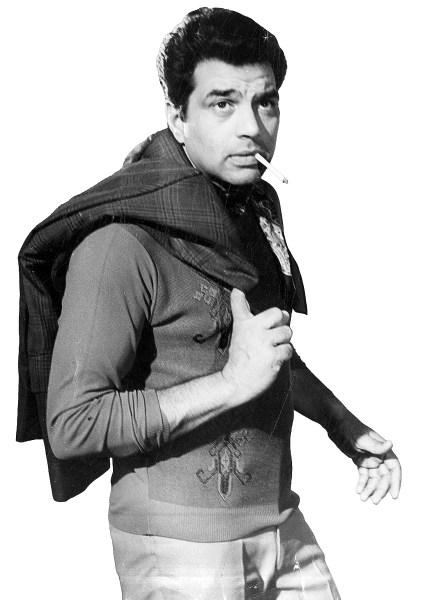
Dharmendra in Raja Jani (1972). (Photo: Express Archives)
Dharam ji’s greatest achievement was the sheer range of characters he played. His versatility that connected him with the audience of all ages. When I think of him, I’m reminded of actors like Clint Eastwood and the French star Jean-Paul Belmondo. They were big stars and their audience loved them. They also moved effortlessly across genres. Dharamji belongs to that league.
When I lived in Pune as a young boy, our neighbourhood had nearly a dozen cinema halls within walking or cycling distance. In the ’70s, Dharamji would have six to eight releases a year. Often, three or four of his films would be running simultaneously — one theatre showing Naya Zamana (1971), another playing Jugnu (1973). Even their re-runs continued to draw crowds.
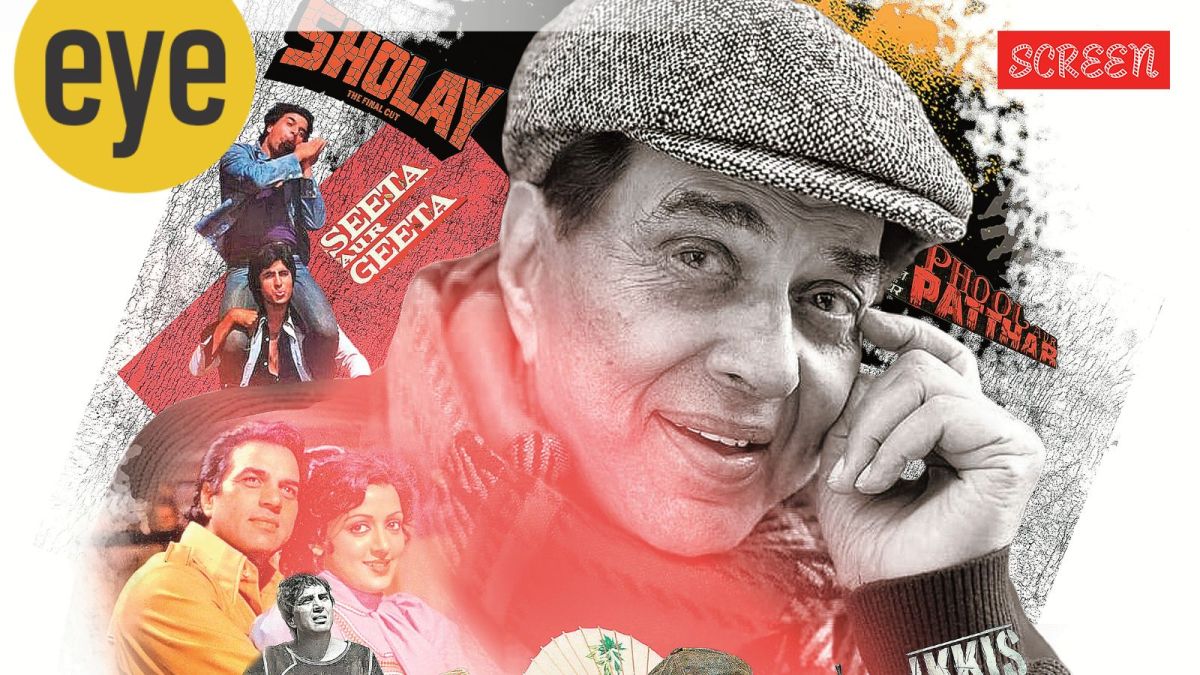
I must have watched Bandini (1963), Anupama (1966) and Yaadon Ki Baaraat (1973) around the same period. You’d see him delivering terrific action in one film and then excelling in drama or comedy in another. His taking off his shirt in Phool Aur Patthar (1966) became one of those iconic moments in Hindi cinema and even featured on the film’s poster. The moment was even compared to Clark Gable removing his shirt in It Happened One Night (1934).
Story continues below this ad
In the ’70s, he had a crazy successful run. He was one of those stars who steadfastly delivered big successes. The audience just loved him. At that time, the audience went to watch a movie because a certain star featured in it. He was amused and surprised when I spoke about obscure, now forgotten movies of his like Jwar Bhata (1973), Resham Ki Dori (1974) and International Crook (1974).
He worked with a whole range of filmmakers — Hrishikesh Mukherjee, Bimal Roy, Manmohan Desai, Gulzar, Vijay Anand and others. That’s something I loved discussing with him on the sets. For instance, he told me that during Blackmail’s release (1973) his action hero persona dominated the scene. So, a film like Blackmail, in which he plays a sensitive character, did not do so well at the box office. The film features one of his biggest hit songs — Pal pal dil ke paas.
One would expect that after the success of Phool Aur Patthar, in which he played a good-hearted criminal, that image would stick. Yet, around that time he acted in so many women-oriented stories. In Yakeen (1969), he even plays a negative character. He was truly an all-rounder and a versatile actor. That’s why, perhaps, his stardom remained unaffected by the rise of other major stars such as Rajesh Khanna and Amitabh Bachchan. Even though the industry was changing, he remained a constant.
Story continues below this ad
After Johnny Gaddaar released, he asked me several times when we could work again. I was also keen to make another movie with him. Ikkis (slated for December 25 release) is the story of Arun Khetarpal, an Indian Army officer who died at the age of 21 during the 1971 Indo-Pakistan War, and his father. When it comes to me, I thought Dharamji would be fantastic as Arun’s father. This also enthused me to work on Ikkis since a war action movie is not my usual choice. He was my first choice for this role, even before we zeroed in on the lead actor. Earlier, Varun Dhawan was supposed to play the role of Arun. However, post-pandemic, I decided to cast an actor who is 21 to play this character. Agastya Nanda was 21 when we signed him.
Dharamji is always good to younger actors and makes them comfortable. He did that with Agastya too. Work was kind of an energiser for him. I told him Ikkis was going to be shot on location. He was excited about it. We shot with him in Chandigarh, Lucknow, Delhi and Pune. He used to travel without any fuss, accompanied by two people. He would go over the lines with us. He gave us several ideas and one liners which I happily incorporated.
Sometimes on the sets when things got delayed, he would sit patiently. Once the shot was ready, there would be no sign of him being tired. Till the next shot, he would watch his own takes. People on the sets would often gather around him and ask him questions about his movies. He loved chatting with them.
Johnny Gaddaar was a plot-driven story but he connected with Ikkis emotionally. He used to call us to his Khandala farmhouse and go over the lines. He would listen to the dialogues and write them down in Urdu himself. He would write his lines as well as the co-actor’s. Then, he would internalise it. He wrote poetry regularly and recited them for us. In Ikkis, I have used one of his poems, ‘Aj bhi ji karda hai, pind apne nu jaanwa’ (Even today, I long to return to my village), which is recited by him.
Story continues below this ad
I am blessed that I got this opportunity to work with him. During its dubbing, Dharamji watched 70 per cent of the movie. He liked what he saw and thought the treatment was very ‘real’. I told him that he should watch the rest when the background music and credits are ready. I wanted him to watch the final version, with his name on the big screen.
On the morning of November 24, I travelled to Goa for a session at the International Film Festival of India. That same morning, we released the Ikkis poster featuring him.
I assumed that once I landed in Goa, I would read the reactions and comments people had posted about it. Instead, I received the news that he was no more. Throughout the day, I was busy meeting people. Once I was in my hotel room at night, I was overwhelmed that we lost Dharamji — one of our true treasures.
As told to Alaka Sahani
Writer-director Sriram Raghavan has made acclaimed films such as Johnny Gaddaar, Badlapur, Andhadhun
Alaka Sahani is a prominent film critic and journalist based in Mumbai. With a career spanning over two decades, she has established herself as one of India’s most authoritative voices in cinematic journalism, known for an analytical approach and insights that transcend the standard cycle of celebrity journalism.
Expertise & Accolades
In 2014, Alaka was honoured with the National Film Award for Best Film Critic. Her Swarna Kamal (Golden Lotus) citation specifically lauded her for "highlighting facets of cinema beyond glamour and gossip" and for her ability to delve into the contemporary relevance of iconic filmmakers. Her commitment to journalistic integrity was further recognised in 2019 with a Special Mention at the Red Ink Awards for her investigative feature, 'In Search of a Star'. Her article titled 'People Like Us', published in The Indian Express on March 27, 2022, was shortlisted for Red Ink Award, 2023.
Global Industry Leadership
Alaka’s expertise is sought after by major international and domestic film bodies:
Golden Globes: In 2025, she joined the international voting body for the 83rd Annual Golden Globes.
National Film Awards: She served on the prestigious jury for the 68th National Film Awards, helping select the finest contributions to Indian cinema.
Global Perspective: Her work consistently bridges the gap between commercial Bollywood A-listers and emerging independent talents, offering nuanced insights into both Indian regional cinema and international film trends.
Focus & Vision
Beyond the screen, Alaka is a dedicated observer of Mumbai’s vibrant theatre scene and the historical evolution of the moving image. Through her long-form articles and deep-dive interviews, she continues to challenge "tried-and-tested" templates, providing readers with a deep understanding of the artistic and systemic workings of the Indian and global film industry. ... Read More