6 min read
© The Indian Express Pvt Ltd



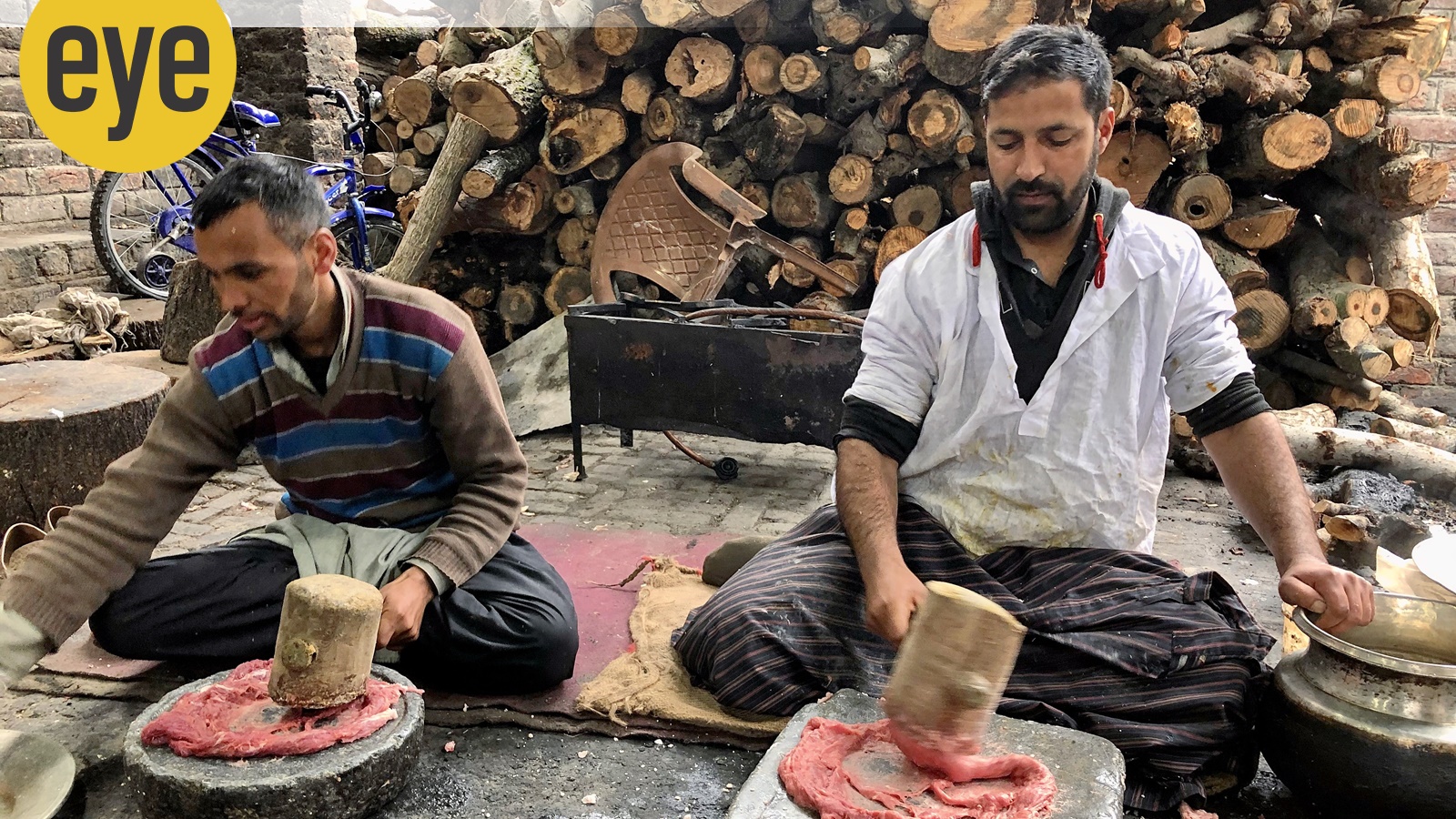 Butchers are pounding sheep meat in Srinagar to make a traditional Kashmiri dish called Gushtaba (Credit: Chef Thomas Zacharias)
Chef Thomas Zacharias got his start in his grandmother’s kitchen in Kerala. Decades later, he trained in New York, led The Bombay Canteen in Mumbai, and travelled around the country discovering its many food traditions from farmers, sellers, and indigenous communities. Last year, he founded The Locavore, a platform for spotlighting sustainable food practices from around India and telling stories of how we interact with our produce. Excerpts from an interview:
How did your road trips around the country, your “discovery of India”, begin? Was it the result of a long-held dream or was there an external impetus?
I’ve been a chef for close to 15 years now. I studied in India and New York, worked there, then came back. The first part of my training was focused on European food, and at some point in 2011 or 2012, I realised I was cooking European food without travelling to Europe. I wasn’t doing it justice. So, in 2013, I took a sabbatical and travelled to France, Italy and Spain, across 36 towns and cities.
That trip changed everything I knew and understood about travel and food travel. Alone for four months, you learn a lot about yourself and what kind of person you are.
It dawned on me that I’d not really travelled across India. Six months after coming back, I took my first road trip across India. This was over two months of travelling to various parts of the country, including Himachal Pradesh, Punjab, Nagaland, Sikkim, West Bengal, Assam, Meghalaya, Telangana, Tamil Nadu, Gujarat, Goa, and Karnataka.
A series of events led to this. It came from the perspective of being a chef without the context of tasting and experiencing dishes at the source. I wanted to fix that. I realised the power of food travel, which was not just tasting original dishes but meeting the people, interacting with them, hearing their stories and getting a feel of the land. It’s also about going to local markets and understanding food traditions and culture. Everything is so related. Food travel taught me more than cookbooks or the internet ever did.
Since then I’ve travelled to 25 states in India.
Is the exploration of food the best way to travel around a region?
Food is universal. Everyone can relate to you and share what you eat. You can have conversations over food it breaks the ice between strangers. If you are curious and discerning, you can learn a lot about people. It’s a very rewarding way to travel, and it’s certainly shaped my career.
Who are your favourite road trip companions? Or do you prefer to go solo?
I’ve primarily gone by myself because they are intensive and strenuous. I have meticulous excel sheets and itineraries and do a lot of research, leaving 10 percent open to chance, for the magic to happen. I would often go to eight or nine places a day, have five to six meals a day, wake up early, stay up late, and take lots of pictures and videos. It’s hard work. So in the beginning I could only enjoy doing it by myself. Then I started taking my brother Sebastian and close friends with me.
Later I realised that going with people is better. It eases and divides all the tasks, like driving, organising the stay, and there are more people to share the food with. You have companionship.
What are the must-haves in your bag for a road trip?
Multiple battery packs, an insulated water bottle, medicines, some good coffee.
What are the major learnings about India and the way we cook and eat that you’ve gleaned from these trips?
One is the incredible diversity of the country. Within each state there is so much going on in terms of ingredients, techniques, food traditions, folklores, stories, special recipes, and very little of it makes its way into mainstream restaurants because they’re owned by people outside that particular microcosm. Even people within a state are sometimes not that aware of food. When I went to Goa and Uttarakhand, I met people who were surprised about some of the cuisines that existed in their own states.
Some deep nuanced traditions are held by indigenous tribal communities. Their knowledge is very powerful and highly rooted in lived experiences over many generations, like what to eat, when to eat it, what something is good for, what grows around them, techniques like fermentation and smoking… Their food is nutritious and delicious and wholesome. I learn so much whenever I go to meet tribal communities.
Another learning is about the many food systems. The plight of the farmer, marginalised tribal communities, what’s happening with the climate, issues around caste and identity, hunger and malnutrition, the waste problem — there are so many issues and challenges. And I saw parallels everywhere, from Kohima, Nagaland to Coorg, Karnataka.
This drove me to start The Locavore. I realised through my travels that there are many challenges but also incredible people and organisations working to solve them at the grassroots. I wanted to create a platform that is an enabler for change, collaborations, and connecting the dots.
Your five favourite/perspective-shifting items of food (vegetable, fruit, herb, meat, or even a preparation) discovered on your travels around India?
Young Sweet Potato leaves in Meghalaya. Never knew sweet potato leaves were edible.
Faaf from Uttarakhand. This unusual-looking thing is a unique mould that’s collected from the upper Tons Valley and is specifically used to make local fermented drinks and spirits. It smells funky like mould would, obviously, and is hard and powdery in texture. Kacchi, a local spirit from this area, made with ragi (finger millet) and jaggery, needs this faaf to activate the natural fermentation.
Atam from Goa. It is a local sour fruit in certain parts of Goa like Cotigao, used by the Velip people not just to balance dishes with sourness but also cut down the bitterness of ingredients like tubers. Incidentally, Devidas has an atam tree that grows right near his house. The fresh fruit is sliced, sun-dried, marinated with salt and kokum juice and then crushed and dried again before being stored for further use in curries. It is also known as Vatam in GSB cuisine.
Wild fern, or thaavu, from Chalakudy river basin, Kerala. The Locavore’s partner producer Forest Post has turned into a pickle.
Fire ants in Jharkhand. They are used to make ant chutney by the Santhal tribe.