Premium
This is an archive article published on September 23, 2021

Explained: How World Rugby plans to tackle concussions and dementia

The game’s governing body, along with International Rugby Players (IRP), announced a six-point checklist.

Rugby Wolrd Cup 2019: New Zealand's George Bridge during a game against South Africe. (Reuters/File)Rugby Wolrd Cup 2019: New Zealand's George Bridge during a game against South Africe. (Reuters/File)

Gnarled, cracked and poetically scarred they might have been in the past, Rugby Union is now dealing with the pile-ups of concussions and early-onset dementia. World Rugby was compelled to reckon with this reality of the bleeding obvious and the non-bleeding unseen trauma last December, when former England and Lions hooker Steve Thompson led a group of retired players in a landmark legal case against WR, the Rugby Football Union and the Welsh Rugby Union after being diagnosed. On Thursday, WR unveiled new guidelines that limit full-blooded contact training to 15 minutes a week to help reduce impact injuries in training.

What do the fresh guidelines mandate?

The game’s governing body, along with International Rugby Players (IRP), announced a six-point checklist. It recommended restricting midweek contact training to two days, broken down into three categories: 15 minutes per week of full-contact training during which players may go full throttle and operate at high speed in body-to-body collisions, 40 minutes of controlled contact utilising tackle shields and pads, running at reduced speeds, and 30 minutes of live set-piece training with lineouts, scrums and mauls at a high intensity.

The 600 players surveyed had said elite pros averaged 19 minutes of full contact training per week, which WR are looking to reduce.

Will it be implemented?

While not mandatory, the guidelines are expected to be adopted at all levels by WR.

“It would certainly be our intention to write it into the terms of participation for future Rugby World Cups,” Mark Harrington, World Rugby director of technical services was quoted by Sport 24, hinting at the rules being enforced in the leadup to the 2023 World Cup qualifiers.

“It is a soft guideline for the minute, but I think over time it will gain some teeth.”

How was the study conducted?

World Rugby combined with top tier clubs like Champions Cup winners Leinster, French biggies Clermont Auvergne and Benetton Treviso to assess the mechanism, incidence and intensity of head impact events using mouth-guard technology and video analysis according to The42. The Prevent Biometrics technology recorded the largest ever comparable head impact database in the sport. Four contact elements were studied: volume of full-contact in minutes, intensity of collisions, density of the impacts within the timeframe, and the unpredictability of the hits.

Story continues below this ad

What are the simultaneous trends in other sports?

There are parallels with the National Football League (NFL) which limited full-contact training back in 2011. The Guardian quoted Éanna Falvey, WR’s chief medical officer, as saying “this is not a neat comparison as the NFL is contested by 32 teams that are more easily regulated. Furthermore, 70 to 80% of NFL player injuries occur during training compared to 30 to 40% in rugby.”

It might well be 30-40 percent too many. Independent studies conducted at the University of South Wales found rugby players were harmed by repetitive hammerings. Reduction in blood flow to the brain and cognitive function could result from cumulative effects and not one-off incidents of concussion, all pointing to the necessity of reduction in full-contact training where possible. Headers in football and bouncers in cricket have blipped on the scanner, but talk of policing both faces scorn and resistance from players and fans.

Is everyone welcoming it in Rugby Union?

Somewhat. The Southern Hemisphere is murmuring its bubbles of doubt if not discontent. Australia coach Dave Rennie, while stating that these measures were necessary, aired some of his legit concerns, telling Sydney Morning Herald: “35 to 40 percent of injuries happen at training, that means 60-65 percent happen in games. From a training point of view, we’re making sure we’re getting conditioning load and contact load into them so that they can deal with it on game day, and they’ve got the technique required.”

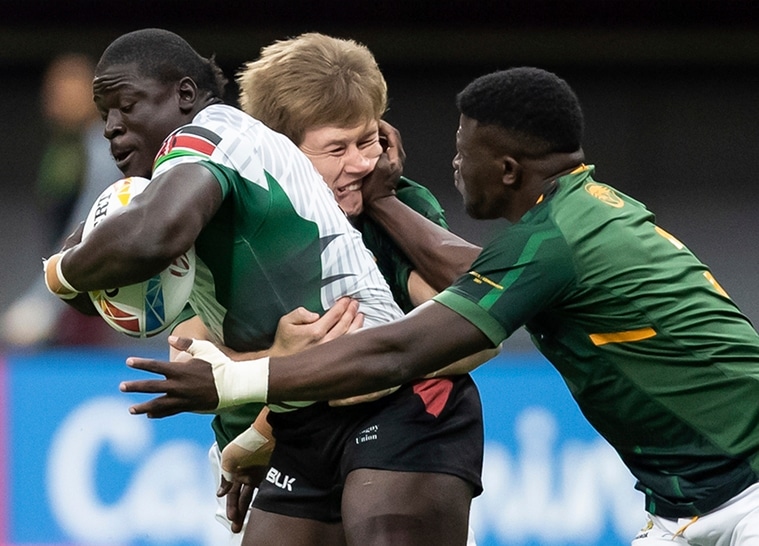
South Africa’s Sakoyisa Makata, right, gets his hand to the face of teammate Christie Grobbelaar, back, as they tackle Kenya’s Alvin Otieno during an HSBC Canada Sevens rugby game in Vancouver, British Columbia, Saturday, Sept. 18, 2021. (AP)

He sought clarity on ‘full contact’ including when players donned full body padded suits, a staple in modern rugby training.

Story continues below this ad

“We suit our boys up a bit. I guess they would still have that full contact, bone on bone. But they’re often in three or four-minute hits. Tuesday’s training, we had two four-minute blocks where we have full teams going. Eight minutes, bone on bone in that part,” Rennie explained. “From a set-piece point of view, there is a lot of live mauling. You can’t get away from that in our game. I understand the importance of looking after the athlete, but we also need to understand that they need to be trained, appropriately, to deal with the physical nature of our game.”

What about the 15-minute claim?

All Blacks coach Ian Foster asked for expanding the 15-minute rule, though by ‘his ‘gut feel,’’15 minutes felt about right. Otago University in New Zealand is undertaking parallel research on understanding the “nature and frequency of head impacts” in the game.

Rennie though had a bemused bite at the 15 minutes diktat. “Who’s timing it?” Rennie said to SMH. “I’m sure there has been a lot of work that has gone on to come up with these numbers. They’re talking at every level. Are they going to have 1st XV coaches with a stopwatch? I’m not certain how that will pan out.”

Newsletter | Click to get the day’s best explainers in your inbox

Shivani Naik is a senior sports journalist and Assistant Editor at The Indian Express. She is widely considered one of the leading voices in Indian Olympic sports journalism, particularly known for her deep expertise in badminton, wrestling, and basketball. Professional Profile Role: Assistant Editor and Columnist at The Indian Express. Specialization: While she covers a variety of sports, she is the primary authority on badminton for the publication. She also writes extensively about tennis, track and field, wrestling, and gymnastics. Writing Style: Her work is characterized by "technical storytelling"—breaking down the biomechanics, tactics, and psychological grit of athletes. She often provides "long reads" that explore the personal journeys of athletes beyond the podium. Key Topics & Recent Coverage (Late 2025) Shivani Naik’s recent articles (as of December 2025) focus on the evolving landscape of Indian sports as athletes prepare for the 2026 Asian Games and beyond: Indian Badminton's "Hulks": She has recently written about a new generation of Indian shuttlers characterized by power and physicality, such as Ayush Shetty and Sathish Karunakaran, marking a shift from the traditionally finesse-based Indian style. PV Sindhu’s Resurgence: A significant portion of her late-2025 work tracks PV Sindhu’s tactical shifts under new coaching, focusing on her "sparkle" and technical tweaks to break out of career slumps. The "Group of Death": In December 2025, she provided detailed tactical previews for Satwiksairaj Rankireddy and Chirag Shetty’s campaign in the BWF World Tour Finals. Tactical Deep Dives: She frequently explores technical trends, such as the rise of "backhand deception" in modern badminton and the importance of court drift management in international arenas. Legacy and History: She often revisits the careers of legends like Saina Nehwal and Syed Modi, providing historical context to current Indian successes. Notable Recent Articles BWF World Tour Finals: Satwik-Chirag have it all to do to get through proverbial Group of Death. (Dec 2025) The age of Hulks in Indian badminton is here. (Dec 2025) Treadmill, Yoganidra and building endurance: The themes that defined the resurgence of Gayatri and Treesa. (Dec 2025) Ayush Shetty beats Kodai Naraoka: Will 20-year-old be the headline act in 2026? (Nov 2025) Modern Cinderella tale – featuring An Se-young and a shoe that fits snugly. (Nov 2025) Other Sports Interests Beyond the court, Shivani is a passionate follower of South African cricket, sometimes writing emotional columns about her irrational support for the Proteas, which started because of love for Graeme Smith's dour and doughty Test playing style despite being a left-hander, and sustained over curiosity over their heartbreaking habit of losing ICC knockouts. You can follow her detailed analysis and columns on her official Indian Express profile page. ... Read More


 

Latest Comment
Post Comment
Read Comments
Advertisement
Advertisement
Advertisement
Advertisement