6 min read


© The Indian Express Pvt Ltd



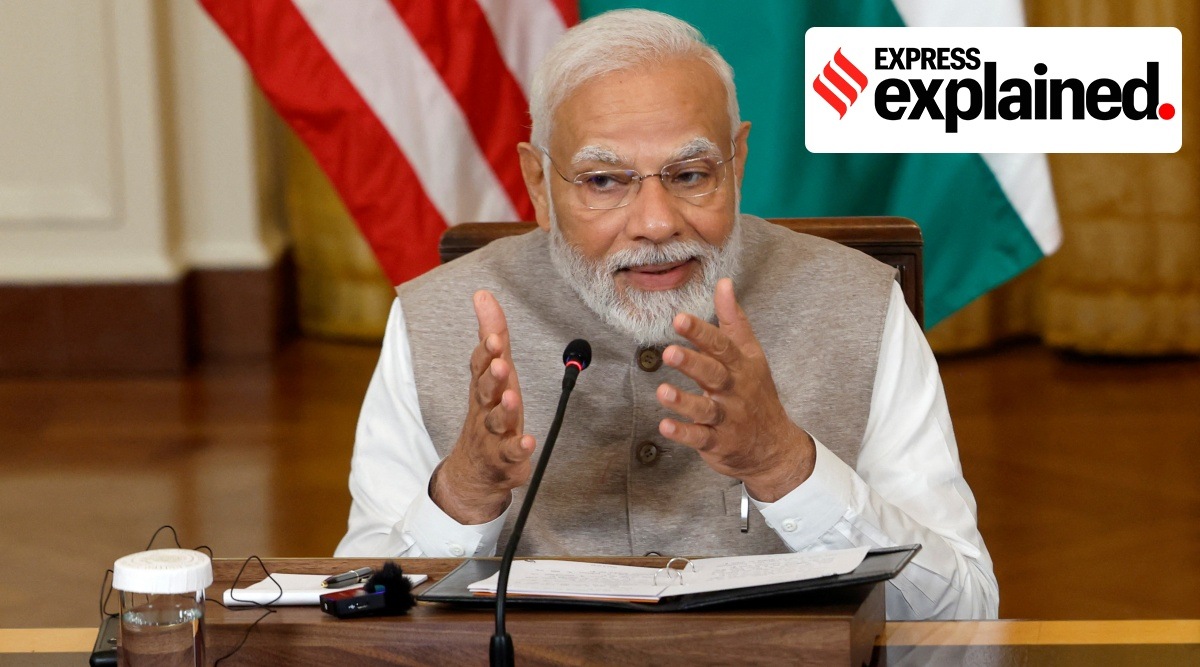 Prime Minister Narendra Modi gestures during a meeting with US President Joe Biden and senior officials and CEOs of American and Indian companies in the East Room of the White House in Washington, U.S., June 23, 2023. (REUTERS/Evelyn Hockstein)
 The idea of democracy has been invoked often in recent days, be it during Prime Minister Narendra Modi’s state visit to the United States, which emphasised India’s position as the world’s largest democracy and the US as the world’s oldest democracy, or in the commemoration of the 48 years of the Emergency’s imposition in India – on June 25, 1975.
US President Joe Biden told a press conference at the White House: “One of the fundamental reasons that I believe the US-China relationship is not in the space it is with the US-Indian relationship is that there’s overwhelming respect for each other because we’re both democracies. And it’s a common democratic character of both our countries… our people, our diversity, our culture, our open, tolerant, robust debate.”
PM Modi too, in response to a question on the government’s work on the rights of minorities in India and upholding free speech, said that democracy was “in the DNA of Indians.”
Plenty of historical figures and philosophers have discussed democracy over millennia – its meaning, the need for it, its flaws, and more. We take a look at French philosopher Montesquieu, who wrote in his 1748 book The Spirit of the Laws, “The tyranny of a prince in an oligarchy is not so dangerous to the public welfare as the apathy of a citizen in a democracy.” Political systems are an important part of the UPSC CSE syllabus, particularly for GS paper 2 and the Essay paper.
Montesquieu is widely regarded as one of the greatest political philosophers. His most well-known contribution to the field was the concept of separation of powers, that the State’s power is to be divided between the judiciary, the executive and the legislature. This was, in his view, necessary to prevent tyranny and despotism – a condition where a single person holds absolute power.
In The Spirit of the Laws, he gave a classification of societies: democracies imply that the people of a country are the supreme authority or sovereign, whereas despotism means that “a single person directs everything by his own will and caprice”, meaning as per their own wishes.
He added that democracy requires “a constant preference of public to private interest” and it “limits ambition to the sole desire, to the sole happiness, of doing greater services to our country than the rest of our fellow citizens”. This sense of commitment to brotherhood and the common good, however, can get threatened when people view themselves through “the spirit of inequality” and “the spirit of extreme equality”, he wrote.
In the former, they would view themselves as worthy of more than what others receive, and be willing to break laws and forget their sense of civic duty to enrich themselves, such as through corruption. The spirit of extreme equality means that people view those having authority, such as police or administrative workers, as undeserving of that power and not obeying the system of laws. They would then disobey such figures and established institutions like the government.
Apathy means a lack of interest in something. When people lose interest in the political world around them, they view themselves as detached or separate from it, allowing room for both the spirit of inequality and quality to take hold.
People might feel so self-engrossed that they would not see anything wrong in enriching themselves at the cost of others. They might, alternatively, forget the role of existing systems and instead of undertaking the difficult task of demanding their betterment, they would get attracted towards despotism or anarchy-like systems.
Historian Bipan Chandra, in his book India After Independence, expresses this concern in his questioning of the Jayprakash Narayan-led movement (called the JP movement) against price rise, corruption and other issues of the day. It was followed by then PM Indira Gandhi’s unilateral imposition of Emergency, which curtailed freedom of speech, political opposition and any criticism of the government.
He writes, “JP’s talk of party less democracy and Total Revolution and the critique of parliamentary democracy, hazy and indistinctive, could also be dangerous, for it encouraged cynicism, scorn and despair towards democratic institutions. This could create a political climate favourable to authoritarianism and fascism, as happened in Italy and Germany after 1919 and in Pakistan and Indonesia in the 1960s.”
He criticises the lack of an alternative setup given by him, adding, “Almost entirely negative in its approach, the movement could not fashion an alternative programme or policies except that of overthrowing Indira Gandhi.” Soon after the Emergency was uplifted in 1977, the first non-Congress government at the Centre was the JP-movement-derived Janata Party, comprising a variety of ideologically diverse political leaders as its members. However, the lack of coordination and common agreement among them led to their collapse in 1979.
Chandra adds in his criticism, “Neither JP nor Indira Gandhi chose the democratic way out of the crisis. JP should have demanded and Indira Gandhi should have offered to hold fresh elections to the Lok Sabha, which were in any case due in early 1976, earlier, in October – November 1975 itself, and thus provided a practical alternative to both the demand for her resignation and the Emergency.”
This is similar to what The Spirit of the Laws says. A major portion of it is centred around explaining how laws come into being in a society, by giving an account of that region’s history, demography, geography, etc. Montesquieu believed that it was important to study and know the rationale behind the laws governing a society, to utilise them for general well-being. Not opposed to reform and change, he said issues concerning a society were better addressed when they came from a sense of knowledge about its systems.