4 min read

Journalism of Courage



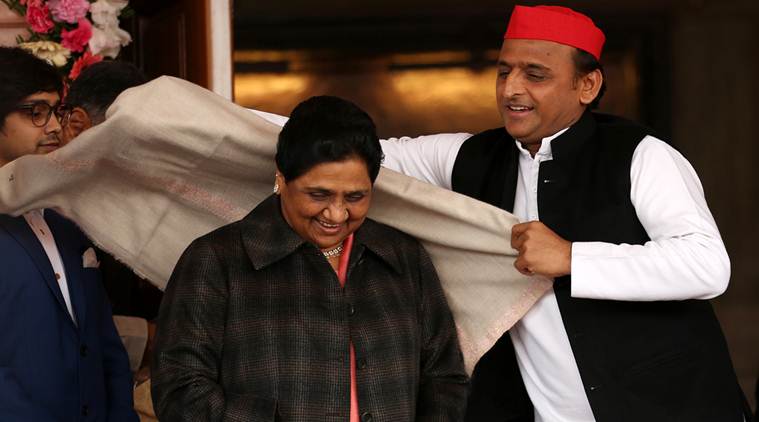 Samajwadi Party National President Akhilesh Yadav greets Bahujan Samaj party supremo Mayawati. (File Photo)
The last time the BSP won a Lok Sabha seat in Madhya Pradesh was in 2009, and the Samajwadi Party has never won from here, making their first-ever alliance in the state more a bid to make their presence felt in areas bordering Uttar Pradesh. Over the past few years, while the two parties have fought the Lok Sabha as well as Assembly polls in Madhya Pradesh, the vote share of both has actually shrunk in the state.
In the tie-up for the general elections announced on Monday, the SP said it would field candidates from Khajuraho, Tikamgarh and Balaghat while the BSP will be contesting the remaining 26 seats. While segments of Khajuraho and Tikamgarh are located close to UP, the Balaghat parliamentary seat is close to Maharashtra and Chhattisgarh.
The BSP, that has been contesting in MP for nearly three decades, has won four times over the years. Its maiden victory came in 1991 from Rewa, a seat it won two more times in 1996 and 2009. In 1996, it won from Satna, when its candidate defeated Congress stalwart Arjun Singh. The constituency is dominated by OBCs and has a large number of Brahmins. Given the rivalry between Brahmins and Thakurs, the caste equation went against the Congress stalwart, a Thakur.
In the recent Assembly elections, the BSP contested 227 seats and won two, with its vote share of 5.01 per cent less than that of the Independents, who polled 5.82 per cent. The performance was disappointing as the BSP was expecting to gain from tensions over the SC/ST Act. It ended up winning just one seat in the Gwalior-Chambal belt, that had borne the brunt of the April 2, 2018, violence during a bandh call given by Dalit organisations.
However, the BSP came second in five Assembly constituencies in the closely fought race, where the Congress won 114 seats to the BJP’s 109. The BSP and SP, which won one seat, are supporting the Congress government, which is two short of a majority in the 230-member House.
The SP ended up sixth among all parties in the Assembly polls, with 1.30 per cent vote share. But it was placed second in five seats, two of which comprise the Balaghat Lok Sabha constituency that it will be contesting. While the BSP and Congress had talked of an alliance leading up to the Assembly elections, it had eventually not fructified.
In the Assembly elections, the BSP’s best performance in Madhya Pradesh was in 2008 when it polled 8.72 per cent of the votes, which dropped to 6.29 five years later and further reduced to 5.01 per cent in 2018. The SP’s best came in 2003, when it had seven MLAs with a vote share of 3.71 per cent.
In the 2014 Lok Sabha elections, when the BJP had won 27 of the 29 seats, the BSP had got 3.79 per cent of the votes, and the SP 2.20 per cent, less than even the Aam Aadmi Party.
BSP MLA Sanjeev Singh said the alliance will have an impact on seats like Rewa, Satna, Bhind and Morena that are close to UP border. Senior BJP leader Prabhat Jha was dismissive of the alliance. “Between them they won just three seats. The Congress will suffer from this alliance, not the BJP,” he said.
Shobha Oza of the Congress also ruled out a BSP-SP impact, adding that they had an informal alliance even in the recent Assembly elections.