Premium
This is an archive article published on September 23, 2020

Explained: How remunerative is farming in India? Here’s what data shows

Government says its reform Bills will make it easier for farmers to sell their produce to private players. How remunerative is farming at present, and how heavily is the sector regulated? This is what data shows.

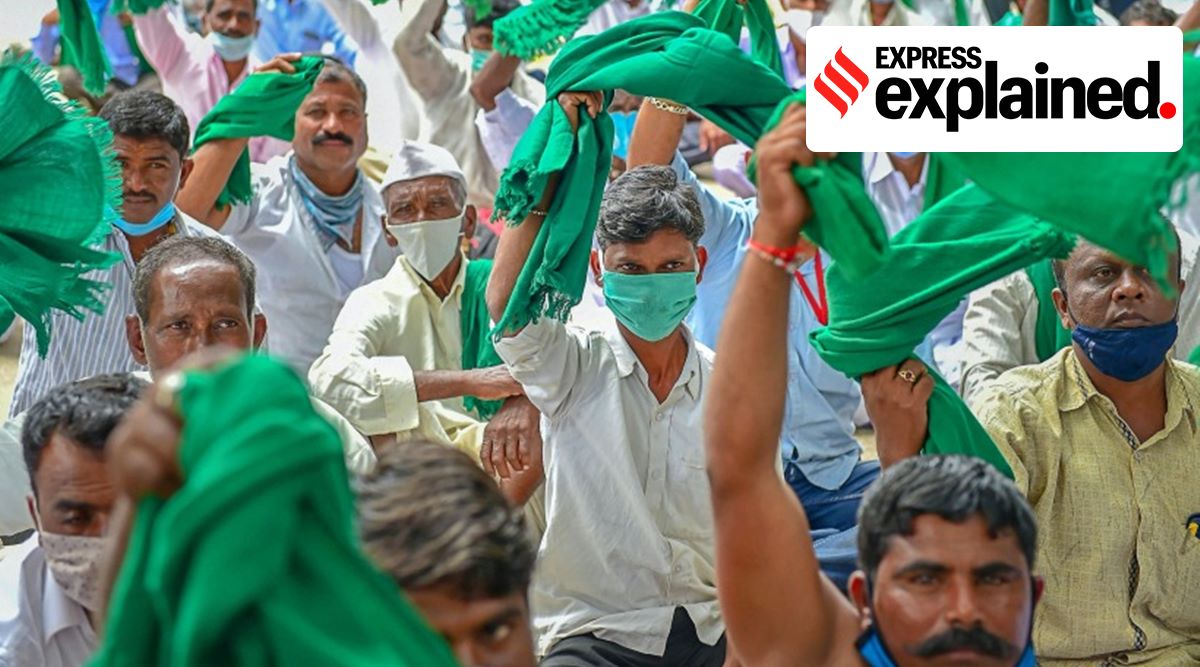
Farmers have been protesting against the three Bills in Punjab and Haryana, among other states. Farmers have been protesting against the three Bills in Punjab and Haryana, among other states.

The government’s push to reform India’s agriculture sector has divided opinions and triggered a debate about the state of Indian agriculture. In the context of this debate, two long-standing characteristics of Indian agriculture are noteworthy.

One, Indian agriculture is highly unremunerative. Two, it has been heavily regulated by the government and protected from the free play of market forces.

According to the government, the new Bills passed by Parliament attempt to make it easier for farmers to sell to and produce for the private sector. The hope is that liberalising the sector and allowing greater play for market forces will make Indian agriculture more efficient and more remunerative for the farmers.

In this context, it is important to understand some of the basics of Indian agriculture.

Holdings, income & debt

At the time of Independence, about 70% of India’s workforce (a little less than 100 million) was employed in the agriculture sector. Even at that time, agriculture and allied activities accounted for around 54% of India’s national income. Over the years, agriculture’s contribution to national output declined sharply. As of 2019-20, it was less than 17% (in gross value added terms).

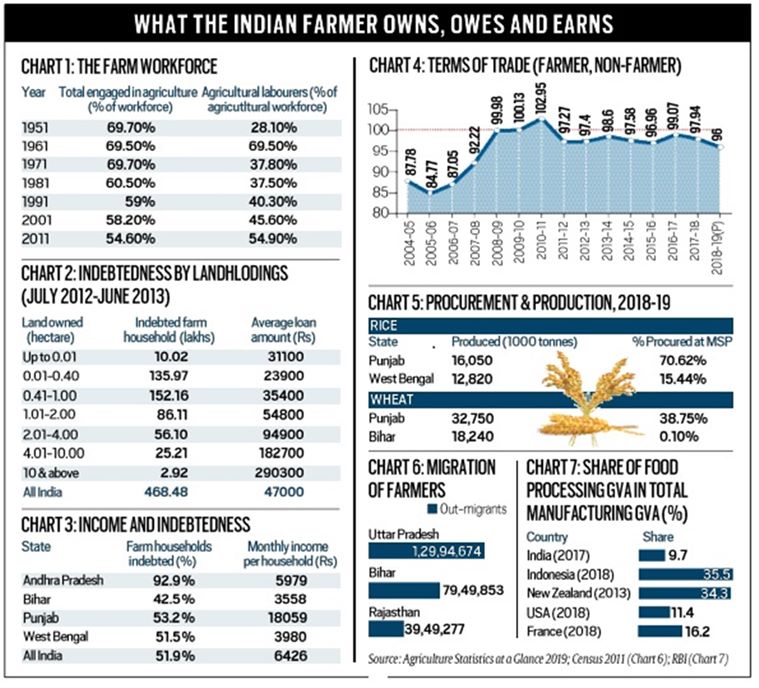
And yet, the proportion of Indians engaged in agriculture has fallen from 70% to just 55% (Chart 1). As the Committee on Doubling Farmers’ Income (2017) observes, “the dependence of the rural workforce on agriculture for employment has not declined in proportion to the falling contribution of agriculture to GDP”.

Source: Agriculture Statistics at a Glance 2019; Census 20122 (Chart 6); RBI (Chart 7)

A crucial statistic is the proportion of landless labourers (among people engaged in this sector) as it captures the growing level of impoverishment. It went up from 28% (27 mn) in 1951 to 55% (144 mn) in 2011.

Story continues below this ad

While the number of people dependent on agriculture has been burgeoning over the years, the average size of landholdings has become reduced sharply — even to the extent of being unviable for efficient production. Data shows that 86% of all landholdings in India are small (between 1 and 2 hectares) and marginal (less than 1 hectare — roughly half a football field). The average size among marginal holdings is just 0.37 ha.

Also read | Explained: In three ordinances, the provisions that bother protesting farmers

According to a 2015 study by Ramesh Chand, now a member of Niti Aayog, a plot smaller than 0.63 ha does not provide enough income to stay above the poverty line.

The combined result of several such inefficiencies is that most Indian farmers are heavily indebted (Chart 2). The data shows that 40% of the 24 lakh households that operate on landholdings smaller than 0.01 ha are indebted. The average amount is Rs 31,000.

Story continues below this ad

A good reason why such a high proportion of farmers is so indebted is that Indian agriculture — for the most part — is unremunerative. Chart 3 provides the monthly income estimates for an agriculture household in four very different states as well as the all-India number.

Some of the most populous states like Bihar, West Bengal and Uttar Pradesh have very low levels of income and very high proportions of indebtedness. And even the relatively more prosperous states have fairly high levels of indebtedness.

Buying & selling

Another way of understanding the plight of the farmers relative to the rest of the economy is to look at the Terms of Trade between farmers and non-farmers. Terms of Trade is the ratio between the prices paid by the farmers for their inputs and the prices received by the farmers for their output, explained Himanshu, an economics professor at the JNU. As such, 100 is the benchmark. If the ToT is less than 100, it means farmers are worse off. As Chart 4 shows, ToT rapidly improved between 2004-05 and 2010-11 to breach the 100-mark but since then it has worsened for farmers.

A key variable in the debate is the role of minimum support prices. Many protesters fear governments will roll back the system of MSPs. MSP is the price at which the government buys a crop from a farmer. Over the years, MSPs have served several goals. They have nudged farmers towards the production of key crops required for attaining basic self-sufficiency in foodgrains. MSPs provide “guaranteed prices” and an “assured market” to farmers, and save them from price fluctuations. This is crucial because most farmers are not adequately informed.

Story continues below this ad

But although MSPs are announced for around 23 crops, actual procurement happens for very few crops such as wheat and rice. Moreover, the percentage of procurement varies sharply across states (Chart 5). As a result, actual market prices — what the farmers get — are often below MSPs.

Read | PB Mehta explains why the govt should not have railroaded the farm bills

Other variables

These trends of income, indebtedness and procurement are aligned to the inter-state migration. Chart 6 shows the states that witness the most out-migration.

Lastly, the government hopes that these reforms, including the relaxations to stocking food articles, will boost the food processing industry. An RBI study (see Chart 7) found that India has a lot of room to grow in this regard, and generate employment and income.

Story continues below this ad

📣 Express Explained is now on Telegram. Click here to join our channel (@ieexplained) and stay updated with the latest

This article first appeared in the print edition on September 24, 2020 under the title ‘Simply Put: The farmer — a field report’.

Udit Misra is Senior Associate Editor at The Indian Express. Misra has reported on the Indian economy and policy landscape for the past two decades. He holds a Master’s degree in Economics from the Delhi School of Economics and is a Chevening South Asia Journalism Fellow from the University of Westminster. Misra is known for explanatory journalism and is a trusted voice among readers not just for simplifying complex economic concepts but also making sense of economic news both in India and abroad. Professional Focus He writes three regular columns for the publication. ExplainSpeaking: A weekly explanatory column that answers the most important questions surrounding the economic and policy developments. GDP (Graphs, Data, Perspectives): Another weekly column that uses interesting charts and data to provide perspective on an issue dominating the news during the week. Book, Line & Thinker: A fortnightly column that for reviewing books, both new and old. Recent Notable Articles (Late 2025) His recent work focuses heavily on the weakening Indian Rupee, the global impact of U.S. economic policy under Donald Trump, and long-term domestic growth projections: Currency and Macroeconomics: "GDP: Anatomy of rupee weakness against the dollar" (Dec 19, 2025) — Investigating why the Rupee remains weak despite India's status as a fast-growing economy. "GDP: Amid the rupee's fall, how investors are shunning the Indian economy" (Dec 5, 2025). "Nobel Prize in Economic Sciences 2025: How the winners explained economic growth" (Oct 13, 2025). Global Geopolitics and Trade: "Has the US already lost to China? Trump's policies and the shifting global order" (Dec 8, 2025). "The Great Sanctions Hack: Why economic sanctions don't work the way we expect" (Nov 23, 2025) — Based on former RBI Governor Urjit Patel's new book. "ExplainSpeaking: How Trump's tariffs have run into an affordability crisis" (Nov 20, 2025). Domestic Policy and Data: "GDP: New labour codes and opportunity for India's weakest states" (Nov 28, 2025). "ExplainSpeaking | Piyush Goyal says India will be a $30 trillion economy in 25 years: Decoding the projections" (Oct 30, 2025) — A critical look at the feasibility of high-growth targets. "GDP: Examining latest GST collections, and where different states stand" (Nov 7, 2025). International Economic Comparisons: "GDP: What ails Germany, world's third-largest economy, and how it could grow" (Nov 14, 2025). "On the loss of Europe's competitive edge" (Oct 17, 2025). Signature Style Udit Misra is known his calm, data-driven, explanation-first economics journalism. He avoids ideological posturing, and writes with the aim of raising the standard of public discourse by providing readers with clarity and understanding of the ground realities. You can follow him on X (formerly Twitter) at @ieuditmisra           ... Read More


Latest Comment
Post Comment
Read Comments
Advertisement
Advertisement
Advertisement
Advertisement