4 min read

Journalism of Courage



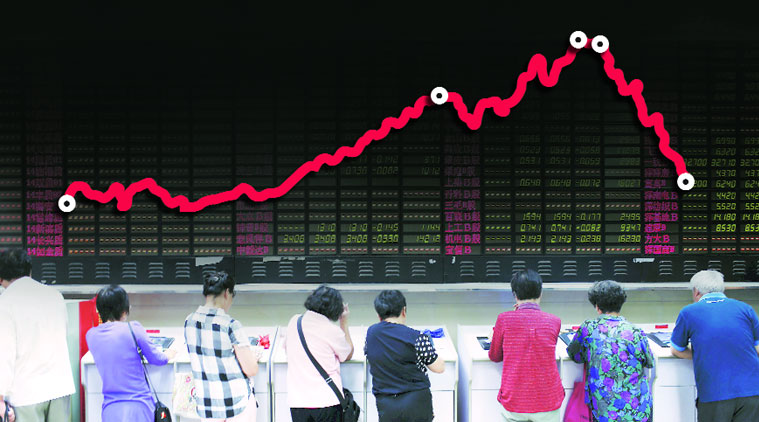 Dizzying rise and steep fall: How the Shanghai index has moved this year
Chinese stock markets are living an old jungle saying: what goes up fast comes down faster. Given China’s reputation for steroidal growth, the jumping of the Shanghai Composite by more than 150 per cent between June 2014 and May 2015 had seemed par for the course. Economic fundamentals were weak and valuations over-stretched — still, global investors who were underweight on China in the first half of the rally went quickly overweight — providing momentum to the rally in its second half. Apart from FII inflows and a cut in interest rates, the rally was driven by liquidity from retail investors. And there was a sense that the government’s policies were helping the markets.
The bubble has now burst, and a deep correction is currently under way. Over the last three weeks, Chinese markets have lost almost a third of their market capitalisation. On Wednesday, the Shanghai Composite index fell further by 5.9 per cent. But while there was panic among investors, for perspective, it must be remembered that the market is still trading at a 70 per cent premium on its value of June 2014.
What led to the fall?
While the fall in Chinese markets were initially in line with the fall in global markets following the Greek crisis and growth concerns in China and the world, it became pronounced in China because valuations were overstretched, and had entered a bubble zone. By mid-June, the price-to-earning (PE) ratio of Shanghai-listed companies averaged 32 — and excluding banks, stood at 57. At such high valuations, a number of investors were already looking to book profits — and a fall in markets in June just triggered that.
Some measures adopted by regulators, including stepping up supervision of over-the-counter margin financing, are also believed to have played a role in weakening Chinese equity markets.
While close to 1,000 of the 2,800 companies listed in Shanghai and Shenzhen filed for a trading halt by Tuesday, there was concern among investors on the liquidity front — which led to a further decline in the markets.
How has the government reacted?
It has taken several steps over the past few weeks — from a surprise cut of 25 basis points in the benchmark interest rates, to a relaxation of rules on margin financing. While regulators have capped short-selling to arrest the correction, more than 25 upcoming IPOs have been suspended in a bid to drive up the prices of already listed stocks. The government’s investment arm bought ETFs in the market, and 21 brokers announced they would invest RMB 120 billion in blue-chip exchange traded funds. While these measures saw blue-chip companies outperform smaller companies for some time, the broad correction in the market continues.
Will the Chinese economy be impacted?
While the participation of retail investors in Chinese markets increased over the last one year, estimates suggest equities account for only around 10-12 per cent of the overall household financial and property wealth. Experts feel the impact of the stock market turmoil on domestic financing will not be significant, as equity has played a relatively small role in the financing of the real economy. However, shrinkage in equity financing will redirect funding needs to bank loans and bonds, and can marginally push up credit demand and financing costs.
What is the outlook for India?
There may be a contagion effect in terms of some money going out of emerging markets, but the gains are likely to be greater. From a fundamental perspective, a slowdown in the Chinese economy and a resultant decline in commodity prices can only be good news for India, which is a net commodity importer. Also, a decline in Chinese markets may force some emerging market funds to rebalance their portfolio and reduce the weightage for China — which may see other emerging markets, including India, larger allocations.
Indian markets have been relatively stable over the last few months on account of increased domestic institutional participation. Market observers say that domestic investment is emerging as a counterbalancing force to FIIs — providing stability to Indian markets against volatility. A weak Chinese equity market, and stable Indian markets will see higher inflows into Indian markets.