6 min read

© The Indian Express Pvt Ltd



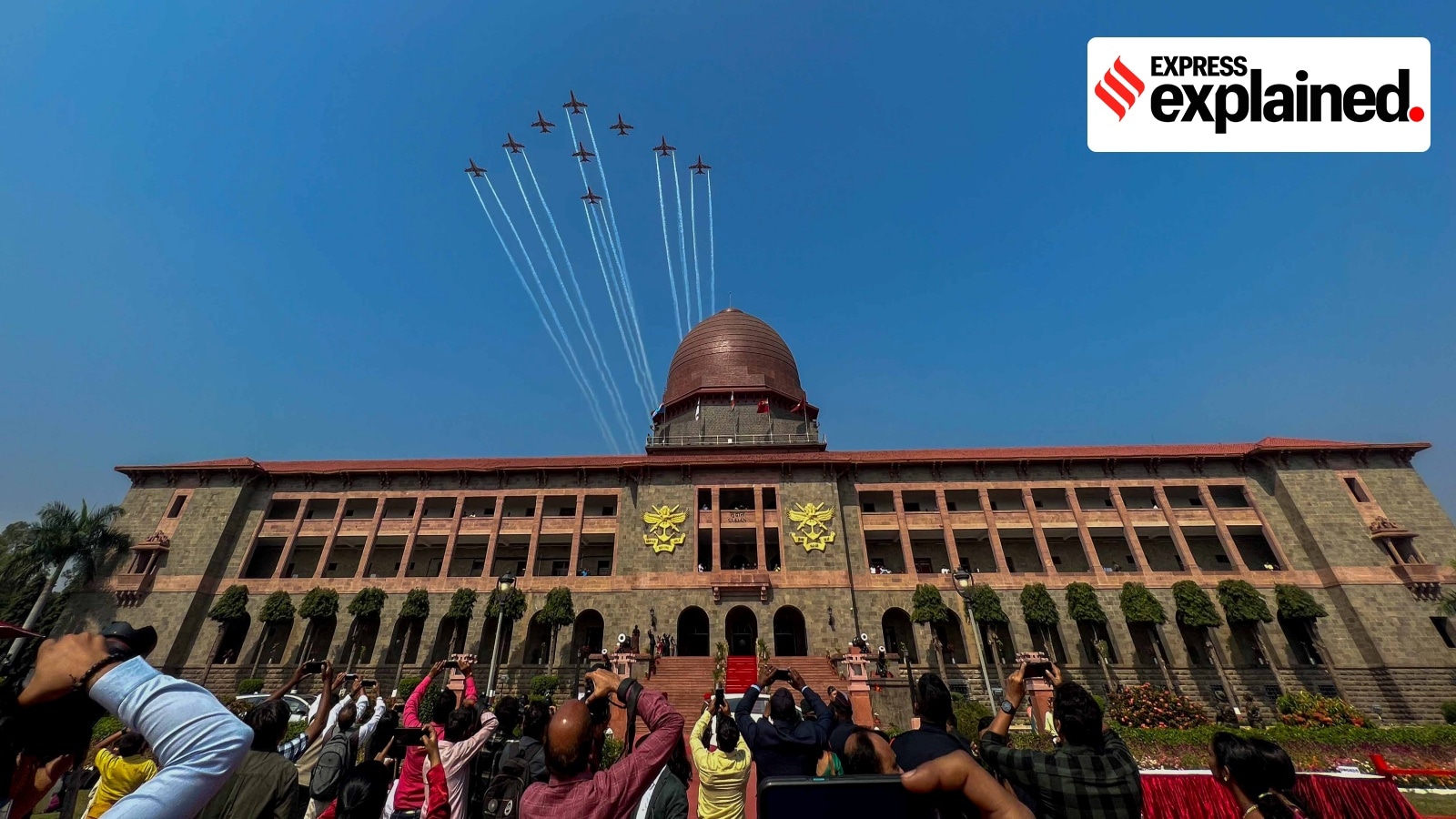 The National Defence Academy at Khadakwasla. Arul Horizon
On Friday (January 16), the National Defence Academy (NDA), India’s premier tri-services military training academy at Khadakwasla, Pune, commemorates 77 years since its raising.
This is the story of the NDA’s three defining symbols — its crest, the Academy Colour (maroon), and its motto (Seva Parmo Dharma) — which embody the academy’s tri-services ethos and its values of valour and sacrifice.
Before getting to the story of NDA’s symbols, let’s look at why its Raising Day is January 16.
Dr Kishori Lal, an author and a retired professor of English from NDA, said: “One of the major lessons of World War II was that no single service could win any war. India’s founding fathers and visionary leadership took a conscious decision to depart from the Western custom of having separate academies for individual services.”
Thus, the academy was established as the Inter Services Wing (ISW) of the armed forces on January 1 in 1949 at Clement Town in Dehradun. It was later renamed as the Joint Services Wing (JSW).
While the first course commenced on January 9, 1949, the academy was shifted to the present Khadakwasla campus in Pune in 1954.
The NDA was inaugurated by the then Chief Minister of Bombay State, Morarji Desai, on January 16, in 1955. Thus, while the foundation year of the NDA is calculated from 1949, the foundation date is taken as January 16.
The crest
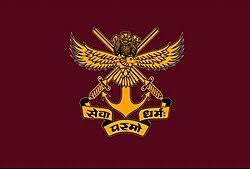 The NDA crest bearing its motto.
“It was natural for the tri-services institution to have a single crest. The choice of an appropriate insignia depicting the spirit of jointness had been under consideration since 1946. A well-wrought crest evolved through various stages between 1949 and 1956,” said Dr Lal, whose latest book is titled The National Defence Academy of India: 1949-2024.
The crest used in the ISW in January 1949 was composed of the three service symbols superimposed on each other — the cross swords for Army, the anchor for Navy and the Himalayan eagle for the Air Force. This was set against a background of steel grey and blood red, prevailing in the crest of the Indian Military Academy (IMA).
The ISW started as part of the IMA. When the foundation stone of the NDA was laid at Khadakwasla in October 1949, a different insignia was issued. It contained four symbols — a quill to denote learning and knowledge, a sword for the Army, an anchor for the Navy and an Himalayan eagle for the Air Force. These were superimposed on the basic design. The crest again underwent some changes and reached its final design in 1956.
“The final design of the crest is composed of two cross swords that stand for the Army’s chivalry and valour, the anchor denotes the Navy’s stability and poise and the Himalayan eagle symbolises the zeal of the Air Force always touching the sky with glory. These symbols are superimposed on each other and mounted on top by the Ashoka Capital. The semicircular end of the anchor supports the hilts of the swords and both support the eagle. The three-headed — the fourth side being invisible — Ashoka lion is symbolic of the Republic,” said Dr Lal.
The Academy Colour
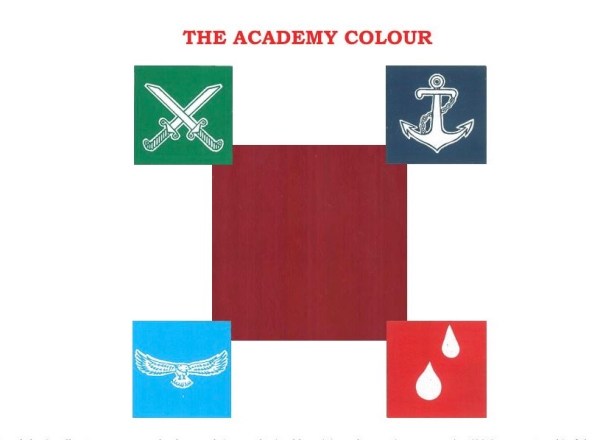 The Academy Colour.
The crest and the motto of the NDA rest on a maroon background. Dr Lal says this colour was obtained by blending the conventional colours of the three services — olive green for the Army, Prussian blue for the Navy and sky blue for Air Force — as well as a blood red, signifying the ultimate sacrifice and devotion to duty.
“This colour of jointmanship came to be known as the Academy Colour and was adopted for all flags in the Academy and for various dresses in 1956. In this combined form, the four emblems are no longer separate entities but fused into one organic whole,” said Dr Lal.
The motto: Seva Paramo Dharma
By the time the ISW was established, an extract from Commander-in-Chief Field Marshal Sir Philip Chetwode’s address at the formal opening of the Indian Military Academy on 10 December 1932 had become the service ethos for the military training institutions to come.
“The safety, honour and welfare of your country come first, always and every time. The honour, welfare and comfort of the men you command come next. Your own ease, comfort and safety come last, always and every time.” This came to be known as the “Chetwode Motto” and is one of the guiding thoughts behind the NDA’s motto.
The NDA’s motto is believed to have been inspired and extracted from the Bhagavad Gita verse Karmanyevadhikaraste Ma Phaleshu Kadachana — “Your duty is action with no eye on the fruits it will bring”.
The ideal, ‘nishkam karma’, was placed in the scroll in its English version: ‘Service Before Self’.
In the 1950s, a corresponding Sanskrit version was adopted. Thus, ‘Service Before Self’ and ‘Seva Parmo Dharma’ came to be taken up as mottos. Dr Amaranath Jha is believed to have chosen the Sanskrit motto. He was the Vice Chancellor of the University of Allahabad and the Banaras Hindu University and worked as Vice Chairman of the committee for the project leading to the establishment of the NDA
Evolving ethos
In 2025, the historic first batch of women cadets and the second batch passed out of the academy as part of its 148th and 149th course.
“The inclusion of women cadets at the NDA reflects the academy’s evolving ethos of inclusivity and equal opportunity, symbolising that courage, sacrifice, and service to the nation are not bound by gender,” said a former commandant of the NDA. “Their training alongside men reinforces the spirit of jointmanship and unity, while inspiring a new generation of officers who embody the same values of valour, discipline, and dedication that the maroon colour, crest, and motto represent. This milestone underscores that the academy’s traditions adapt while preserving the core ideal of service before self.”