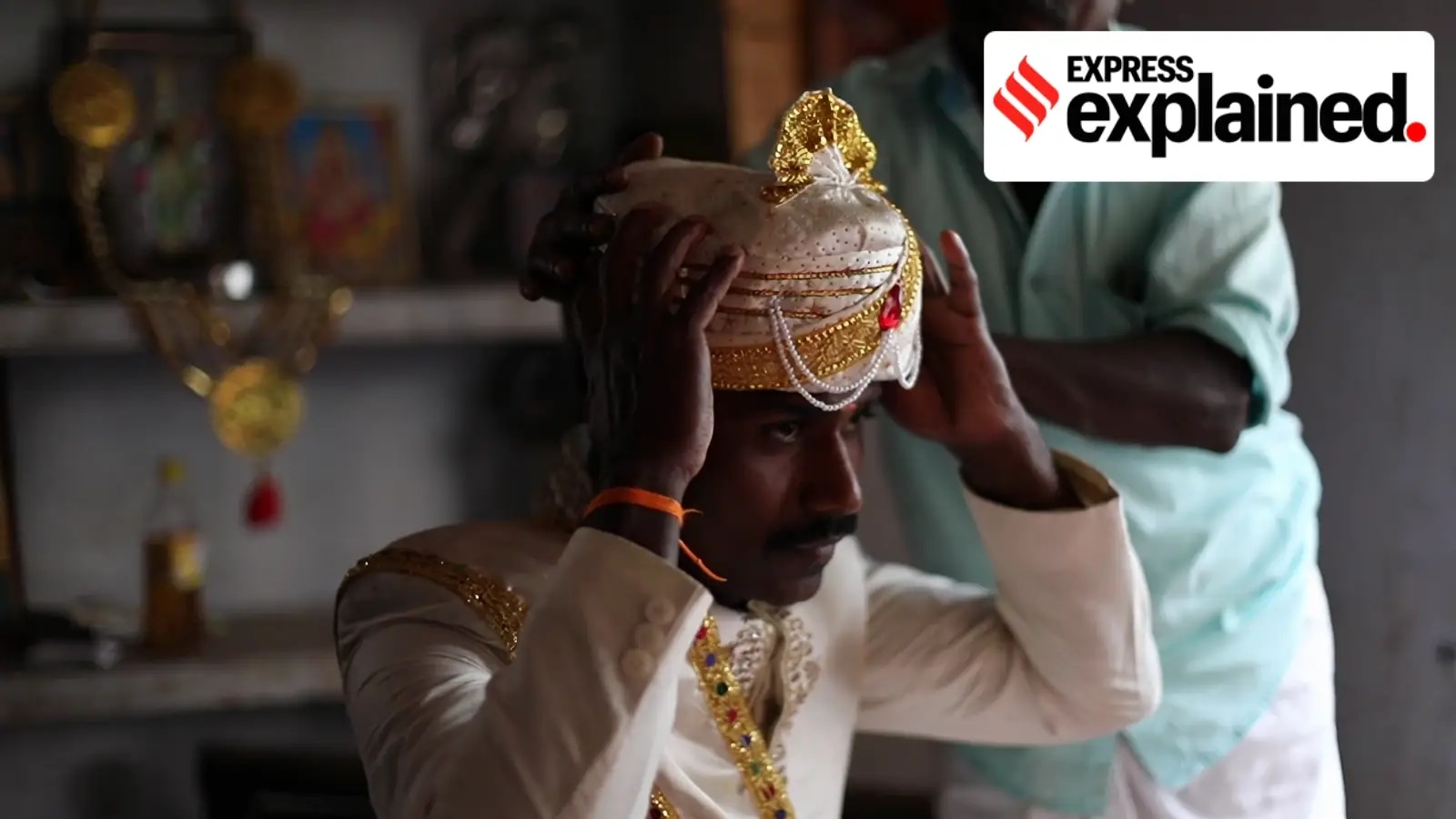
Raman is a king. But he has no kingdom. He wears a crown — a ceremonial headgear called thalappavu — but lives in a modest house. Here’s all you need to know about him.
A modest king
Raman Rajamannan, 39, became the king of the Mannan tribe some 12 years ago, after the passing of the reigning Aryan Rajamannan. He is a graduate in economics, and lives in Kozhimala, a small tribal settlement in the Idukki district.
The king has no palace or official vehicle. He does not even collect levies from the members of his community, although they do make contributions during special festive occasions. In fact, Raman lives a fairly ordinary life as a farmer, and resides in an ordinary concrete home. His family and he also run a temple in the village.
Roles and responsibilities
The king has no rights or duties in civil society, but oversees community matters with the help of four upa rajas (deputies), one ilayaraja (prince), and a 50-member council of ministers, known as kaanis.
The council meets three to four times in a year to discuss intra-community matters. The four upa rajas are notably stationed in four locations. Each of the Mannan community’s 46 settlements also boasts a 13-member committee, which looks at local matters.
King Raman occupies the apex of this comprehensive governance structure.
Story continues below this ad
The Mannan community
The Mannan tribal community is around 3,000 strong today, and is spread across 46 settlements mainly in Idukki district.
The community traces its origin to present-day Tamil Nadu — the Mannan forefathers were forced to flee during a bloody war between Chola and Pandya kings. They found a safe haven in the dense forests of Idukki, where they formed their own small kingdom.
There are some 36 sub-castes within the Mannan community. While they were forest dwellers back in the day, most people in the community today work as farmers or daily wage workers. A few have government jobs, mainly in the Forest Department as watchers.
Children attend regular schools, and exogamy — marriages outside the community — have become common. Interestingly, the Mannan community follows a matrilineal system — descent and inheritance in the community is traced through the female line.
Shaju Philip is a Senior Assistant Editor at The Indian Express, where he leads the publication's coverage from Kerala. With over 25 years of experience in mainstream journalism, he is one of the most authoritative voices on the socio-political, religious, and developmental landscape of South India.
Expertise, Experience, and Authority
Decades of Regional Specialization: Shaju has spent more than two decades documenting the "Kerala Model" of development, its complex communal dynamics, and its high-stakes political environment.
Key Coverage Beats: His extensive reporting portfolio includes:
Political & Governance Analysis: In-depth tracking of the LDF and UDF coalitions, the growth of the BJP in the state, and the intricate workings of the Kerala administration.
Crime & Investigative Journalism: Noted for his coverage of high-profile cases such as the gold smuggling probe, political killings, and the state’s counter-terrorism efforts regarding radicalization modules.
Crisis Management: He has led ground-level reporting during major regional crises, including the devastating 2018 floods, the Nipah virus outbreaks, and the Covid-19 pandemic response. ... Read More


 3 min read