Latest Comment
Post Comment
Read Comments
 24 min read


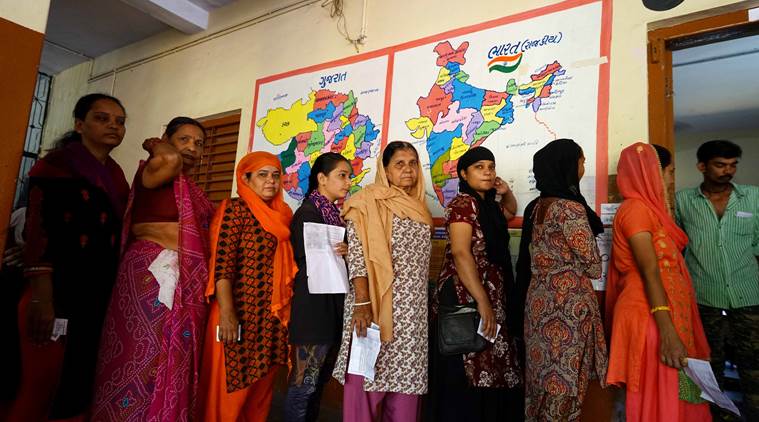 Voters stand in a queue at a polling booth in Gujarat. Express Photo by Bhupendra Rana
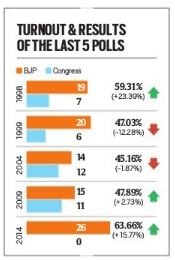
This Lok Sabha election, Gujarat broke a record on polling day when it clocked an all-time high turnout of 64.11%, breaking its 52-year-old record of 63.77% polling during the 1967 elections. Five years ago, amid a “Narendra Modi wave”, the would-be prime minister’s home state had polled 63.66%, missing the opportunity to mint a new record by a whisker. That wave election helped BJP romp home with all the 26 Lok Sabha seats from the state.
This year, despite no perceptible wave for any party or personality on the ground, Gujarat surprised pollsters with a record turnout. And the two main political parties in the state — the ruling BJP and the Opposition Congress — were quick to call it a vote in their favour. Chief Minister Vijay Rupani said that the high turnout “indicates that there is a wave in favour of Prime Minister Narendra Modi”. On the other hand, senior Congress leader Bharat Solanki, who is contesting from Anand constituency, said that his party, which had drawn a blank in 2014, will do well this time. “The people of Gujarat have come out in large numbers to vote out the BJP,” he said.
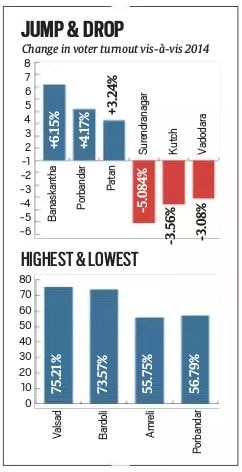
 But that would be over simplification. At face value, the high turnout figure suggests that the people in the state came out overwhelmingly to vote. But breaking down the number suggests that the increase in the voter turnout has not been uniform and homogeneous across the state. There are wide swings. For example, Banaskantha, a rural seat bordering Pakistan in north Gujarat, witnessed a jump of 6.15% in the voter turnout. While Kutch, that shares a good part of its border with Pakistan saw its voter turnout drop by 3.56% since 2014, ostensibly because of the drought. Rapar in Kutch, which has been hit by severe drought and has witnessed largescale migration of people, recorded a meagre 47.37% turnout. Kutch, overall, recorded 58.22% turnout. To its south, Surendranagar, another rural seat, witnessed a drop of nearly 5% in polling.
Coastal Porbandar, in deep south Saurashtra, however, saw its voter turnout increase by 4% than its 2014, but its overall figure — 56.79% — was still 8 per cent less than the state’s average.
But Urban Vadodara, on the other hand, saw a drop of 3% to 67.86%, and still three per cent higher than the state’s average.
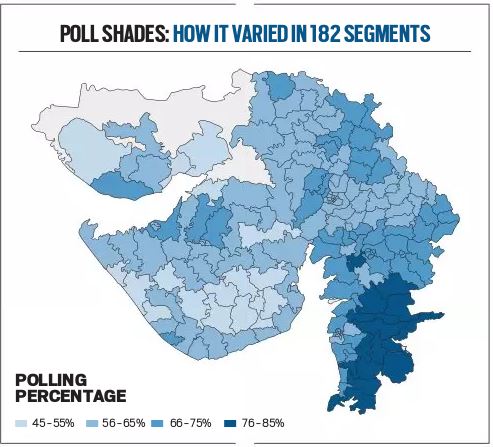
Amreli, as usual, saw the lowest turnout at 55.75%, albeit with a 1.28% jump from 2014. Valsad, a tribal dominated seat in the south, continued to be the seat with highest turnout — 75.21% with a jump of nearly three per cent.
While some tribal dominated areas such as Dediapada Assembly segment of Bharuch Lok Sabha seat witnessed voting as high as 85.01%.
The turnout varied not just between one Lok Sabha constituency to another, but also within a single parliamentary constituency. Click here for more election news
Let’s take the case of Valsad, a tribal-dominated seat in south. Under this parliamentary constituency, there are seven Assembly segments — urban Valsad, Pardi and Umargam on the coastal side, and rural Vansda, Dharampur, Kaprada and Dangs in the forest side. While the tribal Assembly segments witnessed a huge turnout, as high as 83.16% in Kaprada, followed by 81.23% in Dangs, 78.96% in Dharampur and 77.01% in Vansda; the maximum turnout in the urban segments was only 70.63% (Valsad Assembly segment) — nearly 7% less than the least voting percentage in the tribal areas. The lowest turnout was in Umargam at 66.78%.
The vagaries in the turnout are not limited to a specific region, but is linked to demography, level of urbanisation, caste and community, and above all political influence of local leaders.
The Urban Matrix
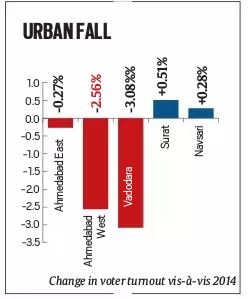
Out of the 26 Lok Sabha seats in the state, six are urban constituencies with the degree of urbanisation varying from 70% (Ahmedabad East) to 100% (Ahmedabad West). And then there are five other seats that have almost an equal mix of rural and urban areas, which we have categorised as “rural-urban”, such as Rajkot (50:50 urban, rural areas), Porbandar (65:35) etc. While polling in the six urban seats witnessed a drop, barring Surat and Navsari in south Gujarat, where there was an incremental jump, the five rural-urban seats, barring Rajkot, saw a jump.
In most of the urban constituencies, the turnout oscillated between 55-73%.
In Ahmedabad West, where all the 1,556 polling stations are located in urban areas, the polling percentage was among the lowest at 60.37% — a drop of 2.56% from the 2014 turnout. In this Scheduled Caste reserved seat, BJP’s Kirit Solanki, who is facing Congress’s Raju Parmar, is hoping for a third-time win. But different Assembly segments within this Parliamentary constituency saw the voter turnout varying between a high of 62.31% in the BJP bastion of Ellisbridge, which was won by the BJP in the 2017 Assembly polls, to a low of 56.89% in the minority-dominated Jamalpur-Khadia, won by the Congress in the last Assembly polls.
In Gandhinagar, where BJP president Amit Shah is contesting, the overall turnout matched exactly with that in 2014 — 65.57. However, here the highest turnout was in Sanand Assembly segment (71.09%), where Shah did his last roadshow before polls. The lowest turnout was in Gandhinagar North (62.39%). Gandhinagar constituency has a high number of OBC votes.
Vadodara, too, witnessed the sharpest drop of 3% in the turnout — from 70.94% in 2014 when BJP’s PM candidate Narendra Modi was contesting from the seat to 67.86% this year. The urban Assembly segments of Vadodara city, Sayajigunj, Manjalpur, Raopura and Akots recorded up to 4% drop as compared to 2014.
Notably, Waghodia Assembly segment, where BJP MLA Madhu Srivastav had threatened voters with consequences if they did not vote for BJP, has recorded the highest turnout at 73.1% among the seven Assembly segments of the Parliamentary constituency.
“If you see the trend, the voter turnout has been steadily declining in the last three polls,” a local BJP leader said. “There was an undeniable euphoria about the elections among voters and also party workers till Narendrabhai was (contesting from) here. So, 2017 polls saw a dip of about 2.5% in the voter turnout as compared to 2012 Assembly polls, and in this Lok Sabha elections, the polling has been lower than the 2017 Assembly polls in the same segments, as well as in the 2014 Lok Sabha election. It is certain that voters feel differently when Narendrabhai is here and when he is not,” the senior leader said.
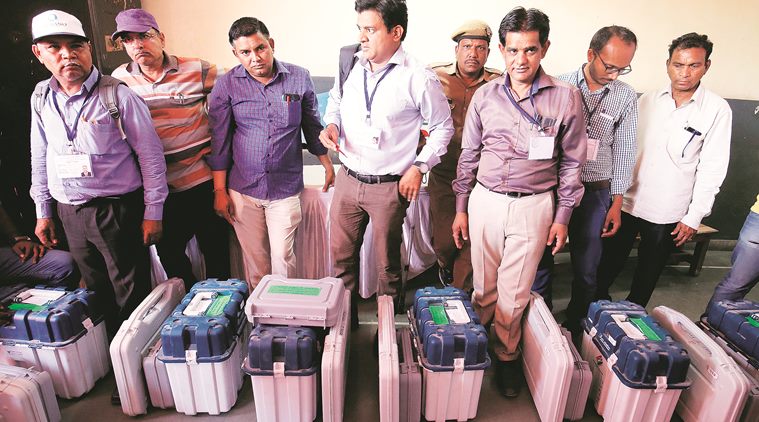 Gujarat voter turnout | Polling officers with EVMs and VVPATs in Ahmedabad on the eve of polling on April 22. The Election Commission replaced over 1,533 VVPATs and over 800 EVMs after they malfunctioned in Gujarat. (Reuters)
However, the two urban constituencies that bucked the downward trend included Surat and Navsari, both in the south and located adjacent to each other. In both the constituencies, there was marginal improvement in the turnout — 0.51% in Surat (64.41%) and 0.28% in Navsari (66.10%). But within Surat too, the polling varied between the low of 55.53% in Karanj to the high of 70.28% in Surat West Assembly segment. Notably, in Patidar-dominated areas of Varachha Road and Karanj, voting was at its lowest.
In Navsari also, the areas dominated by Koli Patels, who have been traditional BJP voters but this time have opposed the ruling party, witnessed heavy turnout. For example, Koli Patel-dominated Assembly segments of Jalalpore, Navsari and Gandevi recorded 71.22%, 75.31% and 81.23%, respectively, whereas the rest of the areas recorded polling between 59% to 63%.
“For urban and semi-urban voters, who are not affected by farm crisis directly and who don’t have to worry about fetching water, the election campaign this time was dull for them, as Prime Minster Narendra Modi was not contesting from the state. It is a known fact that the BJP does better in urban constituencies. But the voter turnout was low in urban areas, which also indicates that those who have voted may not be happy with the BJP,” said a Congress leader in Vadodara.
The Rural-Urban Mix
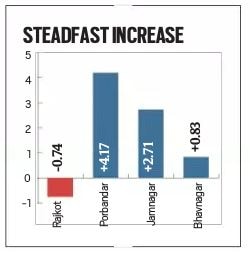
While the urban seats recorded a dip in voting, the five rural-urban mix parliamentary constituencies, barring one, Rajkot, saw a jump in voting, with Porbandar recording a 4.17% increase in voter turnout, followed by Jamnagar with 2.71% jump. Notably, in both the seats of Saurashtra region, Assembly bypolls were being held simultaneously — Manavadar Assembly in Porbandar Lok Sabha seats and Jamnagar Rural in Jamnagar parliamentary constituency. Interestingly, heavy polling was witnessed in both the Assembly segments that seem to have improved the overall voting percentage in these two Lok Sabha seats.
In Porbandar Lok Sabha seat ( 65% rural, 35% urban polling stations), which recorded 56.79% turnout, the voting ranged from 49.56% in Kutiyana Assembly segment that was won by NCP in 2017 state polls, to 62.88% in Manavadar Assembly where bypoll was held after the incumbent Congress MLA quit the party to contest on a BJP ticket. Of the four Assembly segments here won by the BJP in 2017, two — Gondal (61.10%) and Jetpur (58.40%) — registered better voting, while the other two — Keshod (53.83%) and Porbandar (55.53%) — poor, with Porbandar segment witnessing a sharp decline of 9.24% voting as compared to 2017 Assembly polls. Even Congress candidate and MLA Lalit Vasoya’ s Assembly seat Dhoraji recorded only 55.56% turnout.
In neighbouring Jamnagar Lok Sabha seat (65% rural, 35% urban polling stations), which recorded third highest voting in Saurashtra at 60.70%, the maximum turnout was recorded at Jamnagar Rural Assembly segement (65.13), where bypoll was being held simultaneously. Here too, the Congress had won in 2017, but the MLA jumped ship. While urban Jamnagar North and Jamnagar South, two of the three Assembly segments of the BJP, recorded 63.63% and 63.11% polling, respectively; Congress segments of Jamjodhpur (59.76%), Khambhaliya (59.16%) and Kalavad (58.90%) witnessed comparatively lower turnout. However, the lowest voting (56.31%) was recorded from Dwarka Assembly seat, where BJP MLA Pabubha Manek’s election was set aside by the Gujarat High Court just a few days before the polling for the Lok Sabha election.
Rajkot, the only seat in agrarian Saurashtra which is most urbanised with 50:50 urban and rural polling stations, saw the highest turnout in the region with 63.15% voters exercising their franchise. But the polling was still slightly less (-0.74%) than 2014. In this seat dominated by Patidars and Kolis, Assembly segments won by the Congress saw an increased turnout, while those won by BJP in 2017 less. Tankara Assembly seat, represented by MLA Lalit Kagathara, who is also the Congress nominee for the Lok Sabha seat, topped with 67.64% turnout, followed by neighbouring Wankaner, another Congress pocket, at 66.09%. Assembly segments won by BJP recorded little less — Rajkot West (64.71%), Rajkot East (63.74%), Rajkot South (63.73%) and Rajkot Rural (61.47). Interestingly, the least turnout was recorded in Jasdan Assembly segment (54.35%) — 8.58% lower than 2014 and 19.6% drop from its 2017 state poll turnout when the seat was won by Congress leader Kunvarji Bavaliya, who last year quit the party and is now a BJP minister in the state.
The semi-urban constituency of Bhavnagar is among the two seats in Saurashtra-Kutch region where BJP holds a majority of Assembly segments — five out of seven. Overwhelmingly dominated by Koli voters, Bhavnagar recorded 0.83% increase in the voter turnout, with its two Assembly segments — Bhavnagar Rural and Bhavnagar East, both won by the BJP in 2017 — witnessing a rise of 5% polling. Among the two Assembly segments held by the Congress here, Talaja saw turnout rise by 2.91%, while Gadhda, a SC reserved seat, saw 1.39% slide in the turnout. But the steepest fall — 8.4% — was recorded in Botad, won by the BJP in 2017.
The Rural Matrix
Like urban constituencies, predominantly rural seats spread across the Saurashtra-Kutch region, also saw a dip in polling as compared to 2014, barring Amreli where senior Congress leader Paresh Dhanani is challenging incumbent BJP MP Naran Kachhadiya. However, the rural seats in central and north Gujarat witnessed an increase in voter turnout.
Saurashtra-Kutch
The agrarian region of Saurashtra-Kutch had played a pivotal role in the resurgence of Congress in the state during the 2017 Assembly polls. The Opposition party had managed to win 31 out of the 54 seats in Saurashra-Kutch, thereby reducing the BJP’s tally in the region to only 23. However, one and half years later, there has been a widespread depression in voting in the region.
To begin with, the Congress had won six of the seven Assembly segments of Surendranagar Parliamentary constituency in 2017. Dominated by Kolis, who account for nearly one-third of voters, and Dalits forming the second largest group, this constituency recorded the sixth lowest turnout in the region with 57.85% polling and also the steepest decline — 5.08%. Dhrangadhra, where a bypoll was held simultaneously with Lok Sabha elections, polled maximum (61%), followed by Viramgam (59.43%). Wadhwan, the lone Assembly segment won by the BJP here in 2017, saw 57.66% turnout.
Junagadh, another Koli-dominated seat, recorded a fall in voter turnout — 2.69%. Here too, the Congress had performed phenomenally well in the 2017 state elections, winning all its seven Assembly constituencies. But this time, the voter turnout dipped as compared to 2014 Lok Sabha elections. Barring Junagadh Assembly segment, which recorded a marginal rise (0.08%) in turnout (59%), all the remaining six segments recorded a dip — Visavadar (-3.2%), Mangrol (-0.5%), Somnath (-4.6%), Talala (-3.8%), Kodinar (-3.32%) and Una (-2.55%).
Despite the fall in turnout, Junagadh Parliamentary constituency recorded the second highest polling among the eight seats in Saurashtra-Kutch region, while Somnath Assembly segment witnessed 70.85%, the highest turnout among all the Assembly segments in the region.
Though Amreli recorded merely 55.75% polling, it saw a jump of nearly 2% voter turnout. Out of the seven Assembly segments, five are with the Congress, and the remaining two with the BJP. But here too, Congress pockets were outpolled by a BJP seat — Mahuva polled maximum (63.63%). Notably, the least polled among the Assembly segments was also held by the BJP — Gariyadhar (52.08%).
Among the Congress pockets, Dhari saw a jump of 4.11% in polling, followed by Amreli (+2.74%) and Rajula (+3.89%). However, Lathi, held by Congress, saw a major fall of 9.64%.
“There are no avenues of employment here. Nor is there much work in agriculture and the district is going through a drought and therefore people from Amreli are forced to migrate to Surat and Ahmedabad. Moreover, the internal disputes of the BJP led to lower enthusiasm among the BJP supporters,” Dhanani said, adding that the 7.07% higher polling in the BJP seat of Mahuva was also in his favour.
But Raju Dhruv, BJP spokesperson for Saurashtra and Kutch region, said the contrary was true. “The fact that BJP segments have recorded higher turnout will go in favour of our party. These are not anti-incumbency votes. BJP voters thronged polling booths and voted for Narendra Modi. On the other hand, Congress has no party organisation and therefore it could not even mobilise its supporters to the polling stations,” said Dhruv.
Central Gujarat
The two rural seats of central Gujarat — Anand and Kheda — however, saw an increase in voter turnout.
Anand, which has been a Congress stronghold, polled 66.79% — a 2% jump in voter turnout as compared to the Lok Sabha elections held five years ago when the BJP won from here.
Notably, five of the seven Assembly segments here have shown a higher turnout as compared to 2014, with four belonging to the Congress. While most of the Assembly segments in this constituency reported more than 60% turnout, state Congress chief Amit Chavda’s Assembly constituency of Anklav reported a whopping 70.97% turnout as against 67.24 in 2014. Anklav had registered 76% turnout in the 2017 Assembly polls, helping Chavda retain his constituency. Another constituency that recorded higher turnout was Petlad, which was won by the Congress in 2014.
The semi-urban segment of Anand, which the Congress won in 2017 from the BJP, however, saw a 4% drop in voter turnout with 65.14% polling. Here the Congress has fielded party veteran Bharatsinh Solanki once again from the seat. Against him, the BJP has pitted debutant Mitesh Patel, after dropping its sitting MP Dilip Patel.
In neighbouring Kheda, where BJP MP Devusinh Chauhan is seeking re-election, the turnout jumped by 0.82% to 60.68%. Most of the other six rural Assembly constituencies showed similar trends of up to 1.5% increase in polling. But in the semi-urban segment of Nadiad, which is a BJP bastion, voter turnout slipped to 59% — a 4% drop from 2014. In 2017, five of the seven Assembly segments of this constituency were won by the BJP.
The Congress, which had been winning the seat since 1977 until Chauhan won in 2014, may have a reason to worry again. The party’s decision to field former BJP leader Bimal Shah, who joined the party earlier this year, has not gone down too well with the district unit. Ahead of the nominations, Kapadvanj MLA Kalu Dabhi had threatened to resign. The party had also seen a revolt in Mahuda where MLA Indrajeet Thakor was seeking a ticket. Both Kapadvanj and Mahuda recorded under 60% voter turnout. “Although veteran party leaders like Dinsha Patel had spoken to the miffed leaders, they haven’t worked as hard on the ground this time, and it is visible. Kapadvanj is also a stronghold of the candidate Bimal Shah himself, so it has fared better as compared to Mahuda. But it is pretty obvious that our workers weren’t able to motivate voters. However, we are looking at seats held by the BJP and there is not much difference. It will be a tight contest,” said a Congress leader.
BJP leaders are, however, confident that the scale will tilt in their favour. “Not just in Kheda but also in Anand, BJP will win. We are extremely confident of it regardless of the voter turnout, “ said a BJP leader.
The Anomalies
Banaskantha & Patan
The two Lok Sabha constituencies in north Gujarat —Banaskantha and Patan — recorded the highest jump in the voter turnout, 6.15% and 3.24%, respectively, even as all the seats in the region witnessed a drop in polling. Notably, both the seats are dominated by Thakors and Ahirs (Chaudhary), both OBCs and involved in farming.
While in Banaskantha, both the BJP and the Congress candidates are Chaudharys or Ahirs, in Patan the two main contenders — Bharatsinh Dabhi (BJP), Jagdish Thakor (Congress) — belong to the Thakor community.
Among the seven Assembly segments of Banaskantha Parliamentary constituency, Tharad, dominated by Chaudhary Ahirs, polled the maximum (71%) with a jump of 9.2%. BJP candidate for Banaskantha Lok Sabha seat, Parbat Patel, had won from Tharad in 2017. Another Assembly segment that recorded the highest jump was Deodar (9.32%) which was won by the Congress in the last Assembly polls. However, the total turnout in this Assembly segment was 64.66%, nearly 6.5% less than Tharad. Another Assembly segment that recorded higher turnout was Danta, a tribal-dominated seat, with 69.67%.
However, despite a higher polling percentage, areas dominated by Thakors registered a low turnout in Banaskantha. Thakors, who had voted for the Congress in large numbers in 2017 Assembly elections following the entry of youth leader Alpesh Thakor into the party, seemed disenchanted due to two factors — fielding of Chaudhary Ahirs by both the BJP and Congress, and exit of Alpesh Thakor from Congress just in the middle of the Lok Sabha campaign.
“Also, migration for work is higher among the Thakor community. So, most of them don’t return to their native places for voting. Unlike in the Assembly elections, where the constituency area is smaller, party workers do not take much pain in bringing voters to the booth during the Lok Sabha elections,” a local BJP functionary said.
In neighbouring Patan, where Alpesh Thakor’s Assembly constituency Radhanpur is located, the voter turnout stood at 61.98%. Here, Kheralu Assembly segment, which has a maximum Thakor votes — almost double than the Chaudhary votes, recorded the highest voting at 65.88%. The highest jump (8.38%) in the voter turnout was recorded in Koli-dominated Kankrej Assembly segment that registered 60.44% polling.
However, no wide variation was witnessed in the polling percentage in all the seven Assembly segments of Patan Lok Sabha seat. The polling percentage varied between 60% to 65%. The seat which flip flops between the BJP and Congress was won by the ruling party in 2014.
Unjha Assembly bypoll
While three of the four Assembly seats, where by-elections were held, recorded higher turnout, Unjha Assembly segment in Mehsana — the ground zero of the Patidar quota movement — reported a dip in voting. All the four Assembly seats were won by the Congress in 2017, but the MLAs quit the party one-by-one to join the BJP. In Unjha too, Asha Patel, who won on a Congress ticket in 2017 Assembly polls, quit the party to contest as a BJP nominee. While Mehsana Parliamentary constituency recorded a drop of 1.66% in its turnout (65.37%) as compared to 2014, the drop in the turnout in Unjha was nearly 5%. This time, Unjha recorded 67.36% voting, above Mehsana’s average, but far less than its 2017 turnout of 72%.
The highest turnout in Mehsana was recorded in Kadi Assembly segment, which was won by the BJP in 2017.
The Tribal Surge
Gujarat’s tribal belt, which extends from Panchmahal and Dahod in the north to Valsad in the south, has been a traditional a high polling area. And this year it was no different. All the six Parliamentary constituencies in the belt recorded above 60% turnout, ranging from the low of 61.73% in Panchmahal to the high of 75.21% in Valsad. Barring two constituencies — Bardoli (73.57%) and Bharuch (73.21%) — all the other four registered a jump in voter turnout, from 3% in Valsad to 1.73% in Chhota Udepur.
The surge has been largely uniform, irrespective of party strongholds.
In Panchmahal, which recorded 61.73% turnout — an increase of 2.43% voting — Kalol Assembly segment, a stronghold of outgoing BJP MP Prabhatsinh Chauhan, recorded the highest turnout of over 70.25%, up by 5%. Interestingly, all three of the seven Assembly segments that are BJP strongholds in this constituency — Lunawada, Shehra and Kalol — have recorded over 4% increase in the turnout as compared to 2014. Lunawada and Morva Hadaf Assembly areas where the candidates — BJP’s Ratansinh Rathod and Congress’ VK Khant hail from, respectively— showed a jump of 6% voter turnout as compared to 2014.
In neighbouring Dahod constituency, reserved for STs, the voter turnout jumped by 2.33% in 2014 with remote tribal segments polling more than the last election as compared to the semi-urban segments. Here the contest is between sitting BJP MP Jaswantsinh Bhabor and former two-time BJP MP Babu Katara, who has been fielded by the Congress.
High turnout was recorded in the BJP-dominated Limkheda Assembly segment, where sitting MP Bhabor’s brother is an MLA, and Jhalod, where Katara’s son Bhavesh won as MLA in 2017 on a Congress ticket. Jhalod Assembly segment, which was retained by the Congress in 2017, showed a jump of 6% in turnout. Garbhada Assembly segment, which is a Congress stronghold, recorded a nearly 9% jump in turnout (66.18%). However, the urban segment of Dahod, which has a large population of Dawoodi Bohra Muslim, as well as businessmen, saw a 6% decline turnout.
The upward swing continued in Chhota Udepur constituency, wherein Dabhoi Assembly segment represented by BJP heavyweight Shailesh Sotta recorded 74.5% voter turnout. In Nandod Assembly segment, where the Statue of Unity is located and which was won by the Congress in the last Assembly elections, the voter turnout touched 76% — 1.5% higher than even the 2017 Assembly polls. Padra segment, which the Congress had won from the BJP in 2017, recorded 75.02% turnout — 4% higher than 2014.
With the voting patttern of Valsad already discussed at the onset, that leaves us with the two seats of Bardoli and Bharuch, which witnessed high turnout, but still less than 2014.
In Bharuch, where a triangular contest is at play with BTP founder Chhotu Vasava challenging the incumbent BJP MP Mansukh Vasava and Congress nominee Sherkhan Pathan, the voting dipped by 1.64%, this time. Paradoxically, Dediapada Assembly segment that falls under Bharuch Parliamentary recorded the highest turnout in the state at 85%. In last Assembly polls, it was 85.4% when sitting BJP MLA Motilal Vasava lost to Mahesh Vasava, son of Chhotu Vasava. Here too, like Valsad, there was a huge gap in polling between urban areas and tribal areas. Turnout in Bharuch, Ankleshwar and Jambusar remained in 60s, while it was 80% in Jhagadia, 73.52% in Karjan and 72.52% in Vagra — all tribal-dominated areas.
To its south in Bardoli, the turnout was 73.57%, a drop of 1.37% from 2014. In this ST reserved constituency, the contest is between incumbent BJP MP Prabhu Vasava and Congress’s Tushar Chaudhary. Here too, Nizar, Vyara and Mandvi Assembly segments — all tribal-dominated — voted 82.91%, 78.64% and 78.64%, whereas semi-urban Kamej polled the lowest with 62.62%.
The surge in the tribal votes has left many politicians baffled, with both the BJP and Congress claiming that it would benefit them. “The tribals are unhappy with the present BJP government as a lot of injustice has been meted out to them, and that’s why they have voted in large numbers,” reasoned Congress candidate from Bardoli Tushar Chaudhary. His colleague Kadir Pirzada, who campaigned extensively in the tribal belt for the party, seconded him.
“After the recent Supreme Court order displacing tribals from their forest lands, the Modi government took no steps (against it). This is one of the reason for tribals’ anger against Modi. Moreover, many tribal lands in south Gujarat are being acquired for the bullet train project of PM Modi. The inter-linking of Tapi and Narmada Par rivers have also affected the tribal people as their lands are being acquired. The tribal community, therefore, has shown their anger against the government by coming out in large numbers to vote,” Pirzada said.
However, BJP MP Prabhu Vasava rejected the Congress’s claims. “The large turnout of tribal voters reflects the popularity of our Prime Minister Narendra Modi, and his several schemes. Tribal youths are attracted to him and they want him as the country’s next prime minister. So, we have come to a conclusion that it is only the PM Modi factor and no other reason behind the large tribal voter turnout,” he said.
(By Parimal Dabhi in Gandhinagar, Aditi Raja in Vadodara, Avinash Nair in Ahmedabad, Gopal Kateshiya in Rajkot & Kamaal Saiyed in Surat)